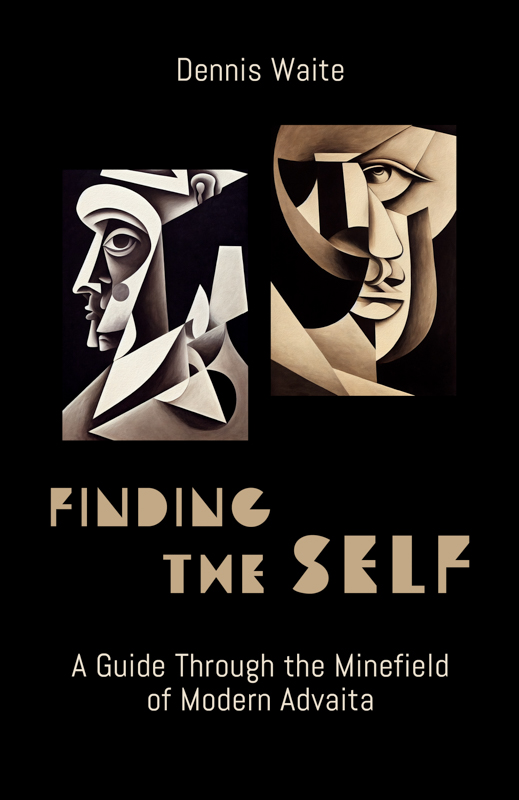
My next book may now be pre-ordered as a paperback (and shortly as an E-Book). Both are scheduled for availability on 26th Jan.
What follows is the preliminary material from the book, explaining its intended purpose and providing an introduction.
Introduction
This is partly a ‘companion’ book to ‘Self Seeking: Finding a Modern Teacher of Advaita’ (Ref. 127). That book was specifically concerned with enabling a seeker to differentiate between a good teacher (who would be able to use the proven methods of traditional Advaita to convey Self-knowledge) and those who merely claim to have an understanding but often seem to be only interested in making money.
It can also be considered to be a ‘follow up’ book to ‘Back to the Truth: 5000 years of Advaita’ (Ref. 94). That book aimed to show how modern teachers were following in the footsteps of traditional sages and teaching Advaita for a modern audience.
This book shows how most modern teachers fall short of that aim, using examples from their books and/or websites. It considers all of the key topics within Advaita and illustrates how they are often misrepresented, thereby misleading the seeker. As with ‘Back to the Truth’, it then present the ‘correct’ understanding, and adds quotations from scriptures or Śaṅkara in support. It is this approach that is most likely to advance the seeker’s understanding.
The remainder of this introduction duplicates just a little of the explanatory material from ‘Self Seeking’ for the benefit of anyone who has not read that. It should be noted that it is not necessary to read that book first, or at all. But I am not going to repeat all of the introduction from that book since those who have read it, or own it, would feel justifiably aggrieved at the repetition. And there is so much to cover in this book that I cannot afford the repetition either!
I was originally going to call the book ‘Mining for the Truth’, the idea being that seekers looking for the truth are like prospectors trying to find gold. Whilst we might find valuable nuggets by reading modern books, or attending satsangs, one is also very likely to encounter the fools’ gold of iron pyrites, or false teachers out to take advantage of our ignorance and make some easy money.
The real gold is only found in the ancient mines of the Vedas, and it has to be carefully extracted using the long-acquired understanding of a qualified teacher. As readers of ‘Self Seeking’ will be aware, genuinely qualified teachers are very rare, so we are obliged to read books and listen to recorded talks. What we are looking for is a source of knowledge – we do not actually have to do anything. Enlightenment is an event of intellectual realization in the mind, not any sort of experience.
The fact is that we are already the non-dual Self, perfect and complete. There is nothing else. All that is needed (!) is to discover this to be the truth. Advaita is a teaching method that uses lots of ‘prakriyā-s’ to convince us of this. (Note that, when I give a Sanskrit term in the plural, I usually show this by adding ‘-s’ to the singular word. Sanskrit plurals do not end in ‘s’!) A prakriyā is an interim explanation of some aspect of the teaching which advances our understanding towards that final realization. Any explanation would be ok if it achieved this. They all have to be taken back in the end anyway since reality, being non-dual, cannot be described or explained in any way. The word ‘prakriyā’ simply means a particular teaching topic or method, used by traditional teachers to explain some aspect of Advaita. Examples would be the ‘five sheaths’ ‘covering’ our true nature or the ‘three states’ of waking, dreaming, and deep sleep.
The point about Advaita is that it has many prakriyā-s, devised and polished over thousands of years, and which have been proven to work.
This book will look at many of these. It will give examples of how some teachers give quite misleading or confusing explanations that do not tally with the traditional explanations of Advaita, although they often claim to be doing precisely that. In each case, the confusing elements will be highlighted and the correct explanation given.
My qualifications for writing this book
I included two previously unpublished articles to explain this in ‘Self Seeking’. These briefly described my educational background and why my previous employment in Communication Software qualified me to become a writer in the first place.
Regarding my Advaita qualifications, I attended an advaita-related ‘school’ for many years in the 1980 ’s – 90 ’s, in a tutoring role for the last few. I have maintained two websites and been one of the managers of the Advaitin group for the past 20+ years. I have been studying and writing about Advaita full time since 2002 and this will be my 14th published book on the subject.
A (very brief) Introduction to Advaita
‘Self Seeking’ contains an extensive explanation of the teaching of Advaita and its place in Indian philosophies. I just touch on the key points here.
Advaita is a philosophy, rather than a religion, although it functions as the highest understanding of Hinduism. Its aim is to convince us that reality is non-dual, meaning that there are ‘not two things’. For the sake of giving this a name, this non-dual reality is called ‘Brahman’. In the west, we often call it ‘Consciousness’ (with a capital ‘C’ to differentiate it from our usual use of this term). Since there is only Brahman, this means that who-I-really-am is Brahman. Indeed, everything is Brahman. All of the seemingly separate entities in the world, including ourselves, are simply name and form of Brahman. When we want to refer to Brahman as myself, the word ‘Ātman’ is used (may or may not have a capital ā). And it follows that this Ātman is Brahman.
And that sums up the teaching of Advaita. Why bother reading books or visiting teachers, when it can be explained in a single paragraph? Indeed, it can be summarized even more briefly. A famous phrase attributed to Śaṅkara is: brahma satyam jaganmithyā jīvo brahmaiva nāparaḥ. This simply means: Brahman is the reality; the world is mithyā (not in itself real); the jīva (individual person) is none other than Brahman.
The reason that the teaching exists is that someone hearing the above for the first time, is most unlikely to believe a word of it! Accordingly, there has to be a long process of explanation. The way that this works is that each aspect is explained in an interim manner that will be acceptable to the new seeker. As her understanding grows, however, this provisional story is shown to be untrue and a new picture, which is more subtle, is given. Ultimately, each description has to be rescinded since none could ever be true in any objective sense – reality, being non-dual, cannot be spoken of. But the giving up of the grosser standpoint entails the sublation of the mistaken ideas which are preventing the intuitive realization of the truth. This method is fundamental to the teaching of Advaita and is called adhyāropa-apavāda.
Adhyāropa literally means ‘wrong attribution’, temporarily talking about something in a way that is not strictly true so that we can gain a preliminary understanding. Apavāda means ‘refutation or contradiction’, as in saying “well actually, it is not quite like that; really it is…”.
If this has triggered your interest, the book may be ordered from Amazon UK (£17.99) or Amazon US ($24.95), and soon from other outlets of good spiritual books (!).
Note that the E-Book is in EPUB format. You should be able to read this on the vast majority of E-Readers. You cannot read EPUBs directly on Kindle, but you can convert them to MOBI or Amazon’s own AZW format (which can both be read on Kindle), using a free conversion app such as Calibre. If you have any problem finding either, you can purchase them directly from the publisher.My next book may now be pre-ordered as a paperback (and shortly as an E-Book). Both are scheduled for availability on 26th Jan.