
Navigating the Primal Muddle of Self-Ignorance
In the quiet moments of spiritual reflection, most of us are gripped by a persistent sense of limitation—a feeling that we are incomplete, finite, and somehow separate from the vastness of reality. Traditional Advaita Vedānta suggests that this entire predicament is rooted in a single, fundamental error: Self-ignorance. The Sanskrit term for this is avidyā, a concept so pivotal that it serves as the cornerstone for Advaitic metaphysics, epistemology, and ethics. Yet, despite its importance, it remains one of the most misunderstood and over-complicated topics in non-dual study.
For the serious seeker, unraveling the nature of avidyā is not a mere academic exercise; it is the key to unlocking the gate to liberation (mokṣa). This is precisely why my second volume in the series, Confusions in Advaita Vedānta: Ignorance and Its Removal, is dedicated to clearing the ‘minefield’ of misconceptions surrounding this term.
The Etymology of Not-Knowing
The word avidyā is a simple compound: the prefix ‘a’ (negation) added to ‘vidyā’ (knowledge). Literally, it translates as ‘not knowing’. In the context of Advaita, however, it is not just a lack of general information, such as not knowing a foreign language; it refers specifically to ignorance of our true nature as the non-dual reality, Brahman.
According to Ādi Śaṅkara, avidyā manifests in the mind through three distinct features: non-perception of the truth (agrahaṇa), doubtful perception (saṃśaya), and wrong perception (viparīta). We are not only unaware that we are the limitless Consciousness, but we also actively believe we are something else—a limited, suffering body-mind.
Avidyā and Adhyāsa: The Act of Superimposition
If avidyā is the underlying condition, adhyāsa (superimposition) is its experiential result. Śaṅkara defines adhyāsa as the ‘mixing up of the real and the unreal,’ or the apprehension of one thing as something else.
The classic metaphor used to explain this is the rope and the snake. In the dim light of twilight, a traveler sees a coiled rope and, failing to recognize it clearly (lack of knowledge), superimposes the image of a snake upon it. The resulting fear and urge to flee are real experiences, yet the snake has no objective reality. In his Adhyāsa Bhāṣya—the vital introduction to his commentary on the Brahmasūtras—Śaṅkara explicitly equates the two: ‘This superimposition… is considered by the learned to be avidyā’.
One of the major goals of Confusions Vol. 2 is to demonstrate that understanding this superimposition is vital; if you fail to grasp adhyāsa, you cannot understand Advaita.
The Two ‘Powers’ of Illusion
Post-Śaṅkara authors developed the theory that avidyā possesses two distinct ‘powers’ (śakti) that maintain the world-illusion:
- Āvaraṇa (The Veiling Power): This acts like a cloud covering the sun. It conceals the true nature of Brahman, making the Self appear non-existent or unknown.
- Vikṣepa (The Projecting Power): This power projects the appearance of a dualistic universe onto the veiled reality of Brahman, much like a film on a cinema screen.
While these ‘powers’ are useful teaching tropes to explain why we don’t see the truth, Confusions Vol. 2 warns against taking them as literal, ontological entities. They are metaphors for the mind’s dysfunction, not cosmic forces to be worshipped or feared.
The Mūlāvidyā Controversy: A Modern Minefield
Perhaps the most significant ‘confusion’ addressed in the new book is the status of mūlāvidyā (root ignorance). Post-Śaṅkara writers, particularly of the Vivaraṇa school, treated ignorance as a positive, existent entity (bhāvarūpa) that acts as the material cause of the universe.
However, modern traditionalists like Swami Satchidanandendra Saraswati (SSSS) argue that Śaṅkara never taught the existence of a ‘root ignorance’ entity. They maintain that avidyā is strictly epistemological—it is simply the absence of knowledge (jñāna-abhāva). Calling ignorance a ‘positive entity’ is merely a teaching device (adhyāropa) that must eventually be rescinded (apavāda).
If ignorance were a real, positive entity, it would imply a fundamental duality (Brahman plus ignorance) and would be impossible to destroy, making liberation unattainable. And ignorance cannot ve real ignorance cannot be real because what is truly real can never be brought to an end. Confusions Vol. 2 examines all the various aspects of this debate.
The Locus: Who is Ignorant?
One of the thorniest academic knots in Advaita is: Where does ignorance reside?.
- The Jīva as Locus: From a practical standpoint, it is the individual self (jīva) who experiences suffering and seeks liberation.
- Brahman as Locus: In a non-dual reality, there is nothing else for ignorance to rest upon.
Śaṅkara often bypassed this academic knot by telling questioners that ignorance belongs to the one who perceives it. If you ask, ‘Whose is this ignorance?’, the answer is: ‘It belongs to you who are asking the question’. The apparent locus is the mind of the person who thinks they are ignorant; once you realize your identity as Brahman, the question of ‘whose’ ignorance it was vanishes entirely.
The World After Enlightenment: Does it Disappear?
A persistent and dangerous misconception in modern spiritual circles is the belief that the physical world literally disappears upon enlightenment. This often stems from an over-literal interpretation of metaphors like the rope-snake.
Confusions Vol. 2 dedicates over 21,000 words to refuting this notion. Drawing on quotations such as Śaṅkara’s Brahmasūtra Bhāṣya (2.2.28-29), the book establishes that external objects are not non-existent because they are perceived and have consistent utility. Enlightenment is a mental event—the akhaṇḍākāra vṛtti—that destroys the delusion that the world is an independent, separate reality. Just as a person can know that a mirage is not real water while still seeing the image, a realized person (jñānī) still perceives duality but knows it to be mithyā—a dependent appearance that is none other than Brahman.
The value of Traditional teaching
The modern landscape of non-dual spiritual teaching is often a ‘minefield’ of grandiose marketing, spiritualized egos, and mystical mumbo-jumbo. Many teachers circumvent the necessary mental preparation and systematic unfoldment of traditional Advaita, leading seekers into fruitless cul-de-sacs.
Confusions in Advaita Vedānta: Vol. 2 – Ignorance and Its Removal acts as a critical ‘course correction’. By referring everything back to Śaṅkara and the original scriptures, it helps you:
- Identify whether avidyā is an entity or a lack of knowledge.
- Understand the vital role of adhyāsa (superimposition) in our daily suffering.
- Correct the error of thinking the world must vanish for you to be free.
- Navigate the differences between traditional teaching and the often-misleading styles of Neo-Advaita and Western satsang.
Conclusion: The End of the Muddle
Ultimately, the entire discussion of avidyā is part of the pedagogical method of adhyāropa-apavāda. We are given the concept of ‘ignorance’ to satisfy the intellect’s search for a cause of suffering, only to discover that it was a ‘useful fiction’ used to lead us to the truth. As the Māṇḍūkya Kārikā declares: ‘There is neither dissolution nor origination… none in bondage and none who strives for success… This is the absolute truth’.
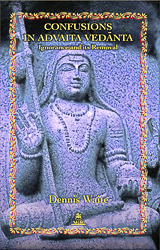
Here is the Contents List for the book:
Contents
About the Book 6
Who is this book for? 6
Traditional versus Modern 6
Learning from books 7
Difficulties with this book 8
Specific Topic of this Volume 8
What qualifications/authority? 9
- Terminology 11
a) Introduction 11
b) Words for ‘Ignorance’ 15
i) Avidyā and ajñāna 16
ii) Adhyāsa 26
iii) Māyā 39 - The Power of Ignorance 52
a) Āvaraṇa and Vikṣepa 52
b) Non-apprehension and non-existence 54
c) Pratiyogin 54 - The Existence of Ignorance 57
a) Introduction 57
b) Difference between ‘real’ and ‘existent’ 57
c) Not ‘absence of knowledge’ 58
d) A Positive Entity 59
e) Ended by knowledge 61
f) Ignorance is not objective 62
g) Epistemology versus ontology 64
h) Mind — cause or result? 65
j) ‘Destruction’ of ignorance 67
i) Is avidyā nivṛtti real? 67
ii) ‘Rise of knowledge’ 68
k) Perception and Error 70
i) A brief diversion into Nyāya philosophy 70
ii) Advaita continued! 71
l) Khyāti 72 - More Terminology 74
a) Mithyā 74
b) Anirvacanīya 75
c) Difference between mithyā and anirvacanīya 77
d) Self-ignorance 77
e) Other terms 78 - The ‘Key Players’ 80
a) Pre-Śaṅkara 80
b) Sureśvara 81
c) Rāmānuja and ‘The Seven Great Untenables’ 81
i) Locus of ignorance — āśraya anupapatti 82
ii) Obscuration — tirodhāna anupapatti 90
iii) Ontological status — svarūpa anupapatti 91
iv) No pramāṇa — pramāṇa anupapatti 92
v) Right knowledge cannot remove —nivartaka anupapatti 92
vi) Inexplicability — anirvacanīya anupapatti 93
vii) Cessation of avidyā — nivṛtti anupapatti 94
d) Vimuktātman — anirvacanīya khyāti 94
e) Vidyāraṇya 96
f) Sarvajñātman 97
g) Satchidanandendra 99
i) Introduction 99
ii) His objections 102
iii) Existence of ignorance 103
iv) Cause of avidyā 106
v) Beginninglessness 107
vi) Deep-sleep state 108
vii) Re-emergence of avidyā in waking and dream 114
viii) Locus and object of ignorance 115
ix) Result of ignorance 116
x) Removal by knowledge 116
xi) Problems with his understanding 117
xii) Final Remarks 118 - Related Topics 120
a) Self-knowledge 120
b) Unmanifest creation 120
c) Plurality 121
d) Language 121 - Some Conclusions 124
a) Who is ignorant? 124
b) Malevolent force 125
c) Removal of ignorance 125
e) Arrival of knowledge 126
f) What and where is ignorance? 127
g) Shell-silver and anubhava 127
h) Summary of key aspects 128
j) A final example 130 - What happens on enlightenment? 132
a) What happens to the ‘person’ 132
i) The rope-snake metaphor 132
ii) Enlightened Man disembodied 133
iii) Enlightened Man has no ego 136
iv) Enlightened Man has no mind 137
v) Expiration of prārabdha 139
vi) Enlightenment means the end of saṃsāra 140
b) Enlightened Man still sees the world 141
i) Upadeśa Sāhasrī 141
ii) Aṣṭāvakra Gītā 18.72 142
iii) Gauḍapāda Kārikā 2.31 143
iv) Naiṣkarmya Siddhi 4.51 143
v) Brahmasūtra 3.4.50 144
vi) Brahmasūtra 1.1.4 144
vii) Gauḍapāda Kārikā 3.32 145
viii) Bhagavad Gītā 5.18 146
ix) Realizing the truth 146 - What Happens to the World 148
a) The confusion 148
b) The problems 149
c) The world is Brahman 150
d) Negation of the error 152
e) World has never existed 153
f) It is Self-ignorance that disappears 155
g) World appearance cannot be denied 157
h) Anṛta 161
j) Relevance of Dream metaphor 161
k) Relevance of the Deep-sleep State 163
l) Misconstruing and mis-translation 165
i) Brahmasūtra Bhāṣya 3.2.21 165
ii) Brahmasūtra Bhāṣya 4.1.3 168
iii) Brahmasūtra Bhāṣya 2.1.14 170
iv) Kaṭha Upaniṣad 1.3.14 171
m) Eka-jīva-vāda 172
n) Post-Śaṅkara teachers 172
i) Sureśvara 172
ii) Vidyāraṇya 173
iii) Ramakrishna and Vivekananda 173
iv) Ramana Maharshi 175
v) Nisargadatta 177 - Summary of the Essential Points 178
Conclusion 180
Glossary 181
Bibliography 207
Index 222
The hardback and paperback versions are now finally available, although currently only direct from the publisher – Indica Books (India). If you have a PayPal account, buying from them is extremely easy and almost certainly cheaper than waiting for Amazon. Here are the instructions from the publisher:
Customer has to write to indicabooksindia@gmail.com or info@indicabooks.com with his request, give his postal address plus contact phone, and whether he wants the book to be sent by post or by courier, and HB or PB. We will reply with the cost (we can also give him the different costs: HB/PB; post/courier). He can then pay through PayPal, which is the easiest, or else do a bank transfer.
The book is also available on Kindle, in either print-replica or reflowable formats.
These definitions have been assembled by NotebookLM AI based entirely upon my own writing from published books and posts to Advaitin and this website. You can see a complete list of my books here. Note that the reader will find repetition in these definitions. This is intentional, as they are primarily directed at relatively new seekers and intended to function both as an ‘overview’ and as ‘revision’. Links to the other definitions are added where appropriate.