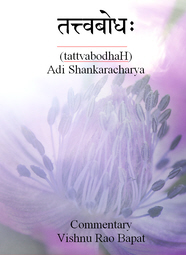
Tattvabodha – Part 19

Part 19 of the commentary by Dr. VIshnu Bapat on Shankara’s Tattvabodha.This is a key work which introduces all of the key concepts of Advaita in a systematic manner.

The commentary is based upon those by several other authors, together with the audio lectures of Swami Paramarthananda. It includes word-by-word breakdown of the Sanskrit shloka-s so should be of interest to everyone, from complete beginners to advanced students.

Part 19 looks at the traditional description of the formation of the mental aspects from the sattvika qualities of the five elements and the formation of the organs of action from the rajasika aspects.

There is a hyperlinked Contents List, which is updated as each new part is published.

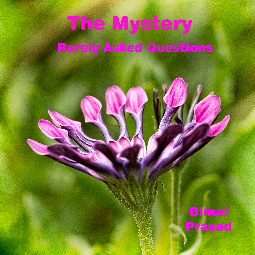
The Mystery – Part 6

Continuing this new, short series presenting the booklet by Bimal Prasad, in which he answers some ‘Rarely Asked Questions’ on Life. Primarily from the perspective of Advaita, questions addressed include the nature of happiness, consciousness, mind and ego. There is also practical guidance on meditation in the final chapter. Answers are relevant and succinct, so that many of the issues of interest to the seeker are covered.

This sixth part looks at the relationship between Consciousness, witness and ego, at the nature of the Self and reality, and asks what we mean by Self-knowledge. See the Contents List or go straight to Part 6 of the series.

The complete (electronic form) booklet may also be purchased from Amazon.

The Mystery – Part 5

Continuing this new, short series presenting the booklet by Bimal Prasad, in which he answers some ‘Rarely Asked Questions’ on Life. Primarily from the perspective of Advaita, questions addressed include the nature of happiness, consciousness, mind and ego. There is also practical guidance on meditation in the final chapter. Answers are relevant and succinct, so that many of the issues of interest to the seeker are covered.

This fifth part looks at how we can be ‘in the present’ and at how the mind functions. See the Contents List or go straight to Part 5 of the series.

The complete (electronic form) booklet may also be purchased from Amazon.

The Mystery – Part 4

Continuing this new, short series presenting the booklet by Bimal Prasad, in which he answers some ‘Rarely Asked Questions’ on Life. Primarily from the perspective of Advaita, questions addressed include the nature of happiness, consciousness, mind and ego. There is also practical guidance on meditation in the final chapter. Answers are relevant and succinct, so that many of the issues of interest to the seeker are covered.

This fourth part addresses  creation and the nature of the ego. See the Contents List or go straight to Part 4 of the series.

The complete (electronic form) booklet may also be purchased from Amazon.

Free Will versus Fatalism


Below is another essay from Atman Nityananda whose earlier essay on sAdhana triggered so much interest. This is preceded by an essay on the same topic from Swami Sivananda.


Free Will versus Fatalism
by Swami Sivananda

The controversy between free will and fatalism is still going on in the West and no one has come to any definite conclusion. It is a great pity that the doctrine of Karma is mistaken for fatalism. Fatalism is the doctrine that all events are subject to fate and happen by unavoidable necessity.

Fate is otherwise known as luck or fortune. That indefinable mysterious something which brings trials, successes and failures to man, which shapes and moulds him by teaching lessons of various sort, which takes care of him like a mother, which brings various sort of experiences, which brings cloudy days and days of bright sunshine, which raises a beggar to the level of a landlord and hurls down a mighty potentate to the level of a street-beggar, which gives different kinds of fruits and experiences to two people of equal talents and capacities, which made Napoleon at one time a terror in the eyes of the people and at another time a prisoner, and which makes a certain portion of the life of a man quite stormy and another portion quite smooth, is called fate. Fate educates and instructs man. However whimsical the fate may appear to operate, it works in harmony with the law of causation. Continue reading

Does spiritual practice empower the ego?

Does sAdhana (spiritual practice) empower the ego?
An essay by Atman Nityananda

If you abandon sAdhana in order to avoid this sAdhana-ego you are left with nothing except egoism. Egoism plus sAdhana is better than egoism minus sAdhana.
~Swami Sivananda

Liberation is the dissolution or the death of the ego which is a field of energy crystallized in our bodies. Liberation has nothing to do with an enlightened ego. There cannot ever be an enlightened or liberated ego.

Liberation is neither for the ego nor for the consciousness which is already free. Liberation is for the mind. When the mind after intense spiritual practice (sAdhana) becomes free from all egoistic tendencies, rajas and tamas then liberation takes place for none and the mind celebrates its unity with the spirit or Consciousness.

But some neo-advaita or non-teachers as they call themselves like Tony Parsons claim that the spiritual practices empower the ego instead of dissolve it. They claim that is impossible the ego to be eliminated by sAdhana by the very fact that the sAdhana is done by the ego. They say that sAdhana and the dissolution of ego is a contradiction because the ego itself is engaged in sAdhana and this keeps the ego alive. Continue reading

The ego, the ‘soul’ and metaphysics – 6th and final part

EXPLANATION
.
It was made clear at the beginning of this essay that what we mean by the “ego” (the “personality”), it being no more than a delusion, a false image or projection, cannot be a subject, except in a dream -and is itself a “dream”. We described the fight of the “ego” in its efforts at reaffirmation as an “unholy war”. That it is obviously the soul, the person, who is the subject of the delusion, the “dream” ; his/her’s the “holy war”, the suffering and the required effort towards reawakening (is not life itself a dream? –it is so for “fallen man”). The soul’s, the person’s destiny – and this is conditional according to the monotheistic religions – is to finally be “reabsorbed”, united or reintegrated , and thus liberated. Liberated not from itself (its Self!) by itself , not even from life, but from a false image of itself and of life (“the world”) due to ignorance (avidya).

It is thus through ignorance, passion and attachment, that individual man (non-gender term) has “become” an “ego”, a “dreamer”, until, or unless, he wakes up. Existence itself is a ‘becoming’, not ‘being’, according to Plato and all traditional thinking. This subject is otherwise inexhaustible, and here we may remember the saying of Râbi’a quoted at the beginning, as well as the utterances of so many other sages and mystics. Continue reading

The Mystery – Part 1

bimal_coverA new, short series presenting the booklet by Bimal Prasad, in which he answers some ‘Rarely Asked Questions’ on Life. Primarily from the perspective of Advaita, questions addressed include the nature of happiness, consciousness, mind and ego. There is also practical guidance on meditation in the final chapter. Answers are relevant and succinct, so that many of the issues of interest to the seeker are covered.

See the Contents List or go straight to Part 1 of the series.

The complete (electronic form) booklet may also be purchased from Amazon.

‘Ego’, self, and metaphysics – Part V

From these considerations it may be seen that the boundaries between the normal and the abnormal, psychology and spirituality, medicine and metaphysics are not so well defined after all; they are not so (separate and apart) in principle, despite the attempts of modern Western science at so dividing and separating them. Our age is one in which empiricism, along with individualism and humanism (these last two almost equivalent, interchangeable terms), its ideological or philosophical underpinnings, still holds sway, although perhaps in its last, declining, phase. Continue reading

‘ego’, self, and metaphysics – Part lV

In the Buddhist perspective, the ego or self as ordinarily considered in Western traditions (i.e., as soul or person), is a non-self, actually a non-entity (anatta). Hence the suffering, which stems from an experience -ultimately illusory- of separation and vulnerability.

Here we have to consider two things. First, according to Mahayana Buddhism, Adi-Buddha, equivalent to Dharmakaya – the highest metaphysical, or divine, level – represents that unique Being or Divine ‘State’, pervading all manifestation as Buddha-nature; and second, the notion of the Self (Atman, derived from the Hindu Vedanta) is not only compatible with that view, but also with that of the Spirit in Christianity and in Islam.

As to the soul (metaphysics and theology), though intrinsically perfect or whole in itself (one could add: in ‘primordial man’ –the purusha or Hiranyagarbha of Hinduism)- it experiences imperfection, self-limitation, anxiety and doubt in its state of (aparent) separation -the ‘fallen state’. Being, not just potentially, a ‘focal point of the Universe’, yet it becomes, through ignorance and self-will, the subject of illusions, attachments, and passions which lead to that predicament. Its condition is thus ambivalent; it can orient itself upwards (or towards the centre) – to ‘holiness’ and integration – or downwards, pulled by its ‘lower nature’ (nafs in its lower stages, according to Sufism). The end result will be either self-denial, or self-assertion; self-giving, or ego-centeredness. Inevitably, this latter tendency, based on ignorance, can only lead to an unwanted result: dispersal, disintegration, and suffering. Alas!, on the whole, if not in principle, psychiatry is not interested in this distinction or dichotomy; but let not anything else be said about this at this point.

From the viewpoint of advaita vedanta, all of what is described in this paragraph – and what follows – pertains to the empirical, relative (ontological and epistemological) level: mithya (or vyavahara), in other words. Continue reading