Jivanmukta and Jivanmukti – 4/12:

[Part – 3/12

NDM: When you say:  “The most basic point to remember is that in order to talk in terms of vAsanA-s and so on, one has to first believe in the ‘reality’ of the existence of a cause, an effect and a relationship between them. Looked at from the position of a Jivanmukta, there are no different entities, one as a cause and another as an effect and a formula expressing a relationship between them.  The entire thing is One.  And that is the only Truth.  Not so many different things and their inter-relationships which are all imaginary.”

So are you saying that the Jivanmutkta no longer acknowledges that there is an empirical relationship of cause and effect on this relative level. (samvriti-satya or vyâvahârika-satya) 

That they only recognize or acknowledge the absolute perspective? (pâramârthika-satya). That they in fact deny that a relative level even exists like some of the neo advaitins do.

Ramesam Vemuri:  The terminology of Absolute Truth, transactional reality and dream-like reality and stories around them are inventions for appeasing a seeking mind. They have as much value, meaning and significance as the conversations and technologies of a dream experience have in the wakeful world.   You may dip into a river and next thing suddenly be flying over a mountain peak in a dream.  You could do so in the dream because you possessed that technology in your dream.  But what relevance has it in the wakeful world?  Similarly, the terminologies and classifications and theories used in the wakeful world carry no meaning or relevance to a Jivanmukta. Continue reading
Jivanmukta and Jivanmukti – 3/12:

[Part: 2/12]

NDM: When you say:  “Who and what for does one set these standards?  Are the standards not highly contextual, local, artificial and subjective?  Does qualifying anything – vAsanA-s or actions – based on such purely judgmental aspects have any holiness?  A society’s imposition of rules and regulations, howsoever high may be the value and whatsoever may be the morality and nobility, does not have Absoluteness.  They may have a societal sanction but lack intrinsic Sanctity.  Who to say right or wrong or good or bad?  Things just exist.  Nothing is positive or negative until a ‘thought’ interferes.”

But what about dharma? The natural laws of the universe or God as some would call it. Some vAsanA-s violate dharma, others do not. Such as a vAsanA for smoking cigarettes like Nisargadatta had, is an unhealthy vAsanA but it’s only going to injure his lungs at most. Someone like the American guru Adi Da had extreme vAsanA-s such as having sexual relationships with his students, physically and psychologically exploiting and abusing them. How does dharma play into this equation?

Ramesam Vemuri:  ‘Dharma’ to me in the context of Advaita is synonymous to brahman, undefinable, ungraspable.  The Sanskrit word for the “Natural Laws of the Universe or God” is ‘niyati.’  Thus these two words are not the same for me. Continue reading

Vedanta the Solution – Part 54

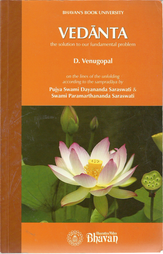
VEDĀNTA the solution to our fundamental problem by D. Venugopal

Part 54 looks at Ramana Maharshi’s ‘Who am I?’ practice and explains that the ‘I thought’ cannot be removed by self-investigation. It also explains that we do not have to get rid of vAsanA-s in order to gain mokSha.

There is a complete Contents List, to which links are added as each new part appears.

I Am Awareness

An article by Eaden Shantay

shantay2

Experience is awareness cast through karma.

Every sensation, emotion and thought is the direct result of past karma (action). In each incarnation we bring forth parabdha karma – that portion of sanchita karma, our total karmic bank account, meant to be experienced, learned from and neutralized in this life.

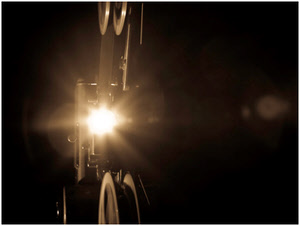
Think of parabdha karma as images on a film strip, vasanas (impressions) in consciousness left from past action. The light of true self, awareness, then shines through these impressions, creating a three dimensional, five sensory experience called me and my life.

Like any good movie, it’s easy to become hypnotized by the drama and lose touch with what is real. In realizing we are not the projected story but the awareness which animates it, we release the life or death grip we have on moment to moment experience. This is the process of dis-identification or non-attachment the Buddha spoke of.

Imagine the sky with clouds moving through it. The sky is a metaphor for awareness and clouds, the objects of sensation, emotion and thought. In meditation we practice welcoming the clouds, blessing them and then bringing our attention back to the breath. In time, we even let go of the breath and dwell in the space between the clouds – awareness, a reflection of our true nature appearing in the mind. Continue reading

The Ghost of Bharcchu

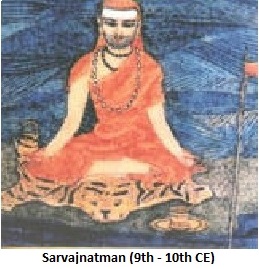
SarvajnatmanSarvajnatman, a well-reputed advaita Acharya of the 9th-10th century, was the author of samkshepa shArIraka.  As the title indicates, this book is a brief presentation of Sankara’s sUtra bhAshya in four chapters corresponding to the four adhyAya-s of the brahma sUtra-s.

Sarvajnatman sums up the essential nature of brahman in ten words. They are:

nityasuddha, buddha,  mukta, satya,  sUkshmasatvibhuadvitIya and Ananda

(eternal, pure, knowing, free, true, subtle, existent, auspicious, without a second and infinite (or happy)).

advaita teaches that you and brahman are one and the same. You being already brahman, the above ten words, therefore, describe you also. That means you, yourself, are Happiness.  So Happiness should be known to you like you know the back of your hand. You do not have to search for or attain Happiness.

But an enigmatic question arises: Okay, I know that I am already eternally existing, knowing and  ever happy brahman.  How come then I don’t know the Happiness which should be present right here? What ghost of an obstruction would block me from feeling it, from seeing it?

The shAstra replies: Oh, Yea, something like the Ghost of Bharcchu can cripple you from seeing the very things that are right in front of you!

“The Ghost of Bharcchu?  What’s that?,” you ask in wonderment.

Continue reading