Q.454 How should one live one’s life?

Q: One of the problems I encounter with Advaita is that, even though it makes sense and resonates with me, it does not help from the point of view of providing guidelines on how to live my life. If we consider Buddhism, for example, we find a clear path on how to live one’s live that goes in accordance with the deeper philosophical explanations of what reality is, etc.

This is the part in which I find myself discouraged and not knowing how to move forward. What could you tell me about this? What would you recommend that I read?

A: All of the guidance given by Advaita regarding ‘how to live’ is directed at preparing the mind so that it is optimally able to gain Self-knowledge. Once this has happened, you know that in reality there is no world, there are no persons. ‘Life’ is just the apparent movement of forms of Brahman.

Continue reading

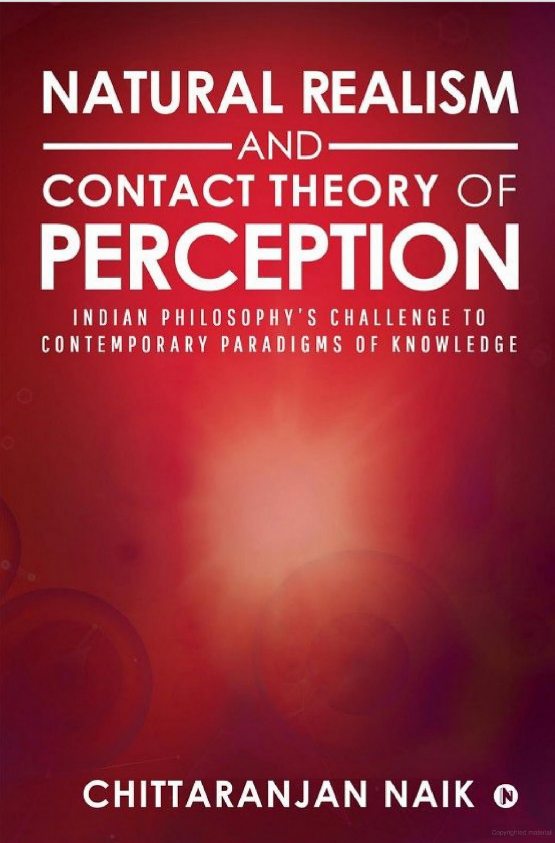
Natural Realism

Natural Realism and Contact Theory of Perception : Indian Philosophy’s Challenge to Contemporary Paradigms of Knowledge, Chittaranjan Naik, Notion Press, 2019. ISBN 978-1-64678-012-9. 

Buy from Amazon US
Buy from Amazon UK

A challenging but worthwhile read

[Note that the conventional view of how we perceive objects is what is called the Representational theory of perception. This is the belief that light rays from a source hit the object and are reflected to the eye of the observer. The light is focused by the eye onto the retina, where it triggers responses in receptors. Electrical signals are generated, which pass along the optic nerve and thence to the visual cortex of the brain. Something else then happens to make us somehow reconstruct an image of the original object. It is this representation that is actually perceived and not the object itself. 

Continue reading

Q.453 Consciousness is happiness?

Q: I have just read your book ‘How to meet yourself’. I am not sure if I understand what you mean when you say that “Consciousness is happiness” and that “I am happiness”. Since everything is an appearance within consciousness, wouldn’t happiness be just that? Why would we equate consciousness to happiness?

A: Before answering the question, it would be useful to note the difference between Consciousness and consciousness. Consciousness with as capital ‘C’ is used throughout in all of these answers to refer to Brahman, the non-dual reality. The mind is conscious because Consciousness is reflected by the mind. The body and mind are both inert in themselves. It is important not to confuse these terms.

The actual paragraph is:

“Fourthly, it would not be meaningful to talk about Consciousness being happy or unhappy. Being complete and without limitations of any sort, it is more appropriate to say that Consciousness is happiness. This, then, is an aspect of my true nature. Since I am Consciousness, there is nothing that I need, nothing to be achieved, nowhere to which I have to get. I am already perfect and complete – I am happiness”.

Continue reading

Q.452 Why is non-duality teaching ‘cold’?

Q: I am wondering why none of the teachings on Advaita/non-duality address the seeker with compassion or answer the question directly in a manner that would embrace the seeker. I have read several questions regarding thoughts and the creation of observed reality. Understanding that the person asking is still seeking, why would the near hostility of the answer that there is “no person to think, no concrete reality to experience, etc.”. possibly be acceptable from the standpoint of pure awareness.

Wouldn’t it be aware that this is not just ‘not an answer’, but a steering away from the question, and in terms of attaining a nondual experience not helpful? I would think awareness should know to first answer the question and then provide the next level view.

This is by far not the only site/teaching/vision of non-duality where this semi-hostility and often circular logic is present. I frequently see angry articles that just say “LOOK, it’s all right there, just LOOK”, as if that is helpful for someone who is seeking to understand. It’s not. It’s off-putting.

By far the worst answer I frequently come across is: “but who is asking?” That answer, while I have yet to see it here, is reprehensible. It is not an answer intended to help; it is intended to put people off and convey a sense of superiority. It shows less than no compassion and is ostracizing.

Why does it seem that the modern teaching of non-duality is hostile, cold and harsh with an almost elitist and upper crust air that defies an idea of an ever present awareness? What am I not seeing? Is there no teacher that can lead without being dismissive?

Continue reading

Q.451 Nothing to be done?

Q: After reading and listening to non-duality teachers I got to know that there is nothing that can be done; there is nothing to attain and nothing to achieve. Whatever ‘is’, simply is.

So what should we do actually? After knowing this truth how should we live our life? Earlier I wanted to do sAdhana to attain self-realization and enlightenment. Now I have understood that it is the ego which is asking that.

Now in my life I have a feeling that, whatever activity I undertake, it’s just about keeping my mind and body engaged. Be it any activity – reading a book, doing meditation, working at the office – I feel that there is a separation between ‘I’ and the ‘mind’. When an activity or any kind of work starts, then the Mind and body are involved in it but I am separate from all of them. When the activity finishes, I again have my body and mind available to be engaged in another activity.

A: You seem not to be differentiating between absolute and empirical reality (paramArtha and vyavahAra). From the absolute viewpoint, there is only Brahman so that doing, enjoying, knowing etc. have no meaning – there is no one, no thing. But from the empirical perspective – from your personal viewpoint – there is a world and people. And there are j~nAnI-s and aj~nAnI-s (people who know the truth and those who do not). If you do not know the truth, you will suffer in life, so what can (and should!) be done is to find out the truth: that who-you-really-are is Brahman. Of course it is the ego that wants to do this but this desire is the one desire that is not only permissible, it should be encouraged!

Once your mind truly and irrevocably knows the truth (this is the meaning of being ‘enlightened’), you can then do whatever happens to be your svadharma or ‘calling’. This may just be carrying on doing your everyday job, living a family life, or whatever. But you may need to continue nididhyAsana in the form of study, reading, teaching, discussing Advaita so that the Self-knowledge is consolidated and you benefit from peace and happiness etc. for the remainder of the jIva’s life.

Q.450 Witness – mind or Brahman?

Q: Talks that I have been listening to use the terms ‘witness’, ‘eternal witness’ and other synonyms. Is pure consciousness or Brahman this ‘Ultimate Witness’? If so, obviously, it can’t witness unless there’s a manifesting medium to do so, correct? But ‘to witness’ implies duality. Also, it is often said that Brahman is transcendent or beyond the body-mind, and something other than the mithyA universe. So that means, again, that it can witness everything.

How do you reconcile the fact that knowledge is in the mind with Brahman being the witness beyond and apart from it? And how does this fit in with non-duality – there can’t be two things?

A: The effective explanation is ‘adhyAropa-apavAda’. The reality is that there is only non-dual Brahman or Consciousness. You begin with the conviction that the world is real, you are your body etc. Advaita gradually disabuses you of such notions by use of prakriyA-s (teaching ‘ploys’) such as analysis of the states of consciousness, cause and effect, real and unreal, seer and seen. Each of these takes you a little further in understanding. But, once the particular example has served its purpose, it is discarded. Analogy and metaphor can only take one so far; they are means to an end. Metaphors to illustrate this are leaving the boat behind once you have crossed the river, and letting go of the pole in pole vaulting before you go over the bar.

Continue reading

Q.449 Definition of Consciousness

Q: Do you have the perfect definition of Consciousness as per Advaita Vedanta?

A: Traditional Advaita prefers to use ‘Brahman’ as referring to the absolute reality, although the aitareya upaniShad says ‘praj~nAnaM brahma’, which is translated as ‘Consciousness is Brahman’. Probably the most famous ‘definition’ (as far as that is possible) is the one in the Taittiriya Upanishad (2.1.1): satyam j~nAnam anantam brahma – Brahman is real/truth/existence – knowledge/consciousness – limitless.

And in 3.1.2, the same Upanishad says that one should strive to know that from which all these beings are born, that in which they live and exist, and that to which they return – that is Brahman.

Brahman is the sRRiShTi sthiti laya kAraNa – the cause of the creation, maintenance and destruction of everything.

And so on! There are lots of ‘pointers’ but no definition as such, as explained in the answers above.

Q: Maybe I’m asking about consciousness with a lower case ‘c’ – I just want to know how you would define that word.

A: Nothing special here. The Sanskrit word is ‘chit’. Swami Dayananda’s definition is ‘limitless self-effulgent awareness; the self-revealing’. The book ‘A-U-M’ tells you all about the ‘states of consciousness’ and that their ‘substratum’ is turIya. See the article I wrote about ‘states’ of consciousness (https://www.advaita-vision.org/states-of-consciousness-2-3-4-and-1-2/).

The world does NOT disappear

(Response to those who claim it does)

Some time ago (31st Oct 2020), during our prolonged discussions (beginning early Sept 2020) upon whether the world literally disappears when a jIva gains enlightenment (Ramesam and Venkat say that it does and I deny that), Ramesam asked me to provide references to support comments that I had made. Since this topic is very relevant to Volume 2 of my book on ‘Confusions in Advaita’, I have been researching and writing about it for the past 6 months. Since the various aspects now take up some 30,000 words plus, I will not be posting any more material – you will have to wait for publication of the book, unfortunately unlikely to be before 2023.

Apologies to readers who will find that this post is not particularly readable or directly helpful. The book presents all of the arguments in a logical and readable manner, only using the indicated quotations as supporting material. Here, the references only are presented solely to complete the earlier discussions and provide ‘answers’ to Ramesam and Venkat as the pUrvapakShin-s.

Continue reading

Q.448 Are animals real?

Q: I am struggling to understand where reality ends and mithyA begins.

I understand that everything in my experience is Consciousness. But I cannot reconcile this with seeing ‘things’ in the ‘world’. I appreciate that, if I am Brahman, meaning that my little jIva consciousness is actually Brahman, then it is my consciousness that is generating this entire perception of nature and mammals. In other words, the only thing going on with the ‘jIva seeing world and objects’ is Consciousness.

But what is going on for the animals and objects? Are they really there or not? Are they appearing just through my human mind via Brahman/Consciousness? Are there no objects in reality? When I see a leopard, all that is real is Consciousness seeing Consciousness? Then how are the leopards appearing with so much complexity and purpose?

I realize that time and space are appearing in Consciousness; I realize that leopards are appearing in Consciousness. But what are they? Do you have any way to answer this that doesn’t rely on the Advaita Vedanta language since that language isn’t getting through to me? I.e. dependent reality, Ishvara, mAyA, mithyA: none of these words seem to be pointing me in the right direction.

Continue reading

Q.447 Realizing Brahman

Q: I know that Brahman is not an object I can find; I think of it more like the realization that I am the tenth man (you know this story I assume). But when I have this sort of realization (I have a lot of them), I can’t tell whether I am realizing Brahman or something else.

One set of realizations involves a sort of inner presence that reveals itself like existence-consciousness-limitless, and I feel it as present in my heart region. It’s very deep and real and it does not come and go like an experience. It gets covered up by my thoughts and emotions, but it’s always there.

Another set of realizations involve a sense that the world of objects is not actually there because the objects are made of consciousness rather than matter.

So my question is: Is Self-realization something you discover in your heart like a presence of happiness or of a consciousness that doesn’t ever come and go but only seems to be obscured by thoughts? Or is self-realization the knowledge that all the objects in the world and mind are made of only consciousness, in the way that dream objects are made of dream-consciousness?

I believe that Advaita Vedanta is saying that somehow nothing exists other than consciousness and thus the objects that appear (including the mind and subtle realm) are not made of matter but rather are ‘made of’ consciousness. Is this correct?

Continue reading