
A-U-M Awakening to Reality – Review of book

‘Lucid and exhaustive of most important book in Advaita Vedanta’

The Mandukya Upanishad, the shortest (it has just 12 verses) and , according to a general opinion, the most important of the 12 main Upanishads, has the added interest in being associated with the authoritative karikas of Gaudapada, grand-mentor of Shankaracharia, the initiator of Advaita Vedanta. Of the former it has been said that his is ‘a rational analysis of the totality of our experience in all three states: waking, dreaming, and deep sleep. Incomplete and insufficient will be any philosophy that is based on the waking state alone’ (Swami Brahmananda).

‘When everything has been said, the fact remains that Vedanta is the only way of thinking that claims to study life in all its aspects in a scientific manner. It treats of truth, wisdom, and happiness, subjects of eternal interest to mankind. The credit of having brought to the notice of thinkers the value of its all-comprehensive method revealed in the Upanishads, and of having successfully built an impregnable system on that solid basis, will ever belong to Gaudapada.’ (Swami Satchidanandendra Saraswati).

This new book, authored by the well-known (and, one could say, prolific writer in the field of Advaita Vedanta – this is his 7th book), Dennis Waite, has several features that make of it an important addition to the literature in this specialized area, one that is becoming much better known than it was some 10-20 years ago.

Beginning with a few general remarks, something that strikes the reader is the clarity of the writing and the logic of the exposition of its contents which, at first sight, appears to be an introductory text for the un-initiated. Far from it! – and it is not a question of its length (420 pages) or even of the exhaustive coverage of everything that is relevant to the Upanishad itself and Gaudapada’s running commentary in the karikas. Clear and didactic it is, but the tools (armamentarium), organization of the work, and employment of many important Sanskrit words together with their English translation, plus a long Glossary (41 pp.), make of this book an indispensable reference for the modern reader of both this important Upanishad and Gaudapada’s contribution.

An important feature of the book consists in the numerous references (81 in all!) – most of them with short-to-medium length descriptions of the tenets or arguments of the, mostly modern, authors consulted when DW was in the process of preparing this work (Annotated Bibliography – 33 pp.)

Apart from the illuminating Introduction (36 pp.) and ‘What the Mandukya Upanishad is About’ at the beginning, the following 7 sections are: The World Appearance, Causality, Creation, Nature of Reality, Self-Knowledge, Practical Aspects, and Conclusion. They are all important, certainly, but I found ‘Nature of Reality’ to be like a centre-piece.

There are 7 Appendices at the end, comprising altogether 95 pp. To give one an idea of the completeness of the work, one of the Appendices (No. 5) deals with pronunciation and transliteration, using a recently proposed method: ITRANS. Lastly, a full Index, containing also a list of all the karikas mentioned in the book. AM
Yogavaasishta – A Review

Image

Excellent new modern translation of Yoga Vasishta, September 9, 2015
By
Amazon Customer (AM)

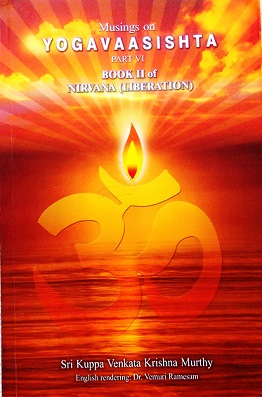
DSCN7289This review is from: Musings on Yogavaasishta Part VI – Book II of Nirvana (out of the Set of 6 Volumes) by K. V, Krishna Murthy, Avadhoota Datta Peetham, Ooty Road, Mysore 570025, India , English rendering by Ramesam Vemuri, 2013 (Paperback)

The Yogavasishta is a work attributed to the ancient Indian sage Valmiki, in which the sage Vasishta teaches his pupil Prince Rama and others how one may come to the immutable reality that is veiled by the fleeting world of sensory impressions. It has a pride of place in the tradition of Advaita Vedanta comparable to the Bhagavad Gita (the Indian gospel) and the Mandukya Upanishad. The reading of this monumental work on the rigorous advaitist (non-dual) doctrine and its profound philosophical thought is quite pleasurable as it is punctuated by entertaining and imaginative stories or tales that sound like real-life examples. One can dip into the narrative repeatedly and at leisure in order to regain that pleasure and edification – nay, real wisdom that it is.

The present new translation into English uses a modern idiom which, when the text permits, is consistent with present cultural (Western as well as Eastern) ideas and experiences, but without detracting from the overall intent and even style of the work. The actual flavour comes from the exchanges between the master and the disciple, and also from the stories themselves. I highly recommend this excellent translation of the classic that the Yogavasishta, by its own merits, is.

(Sample):

Rama: Agreeing that the world is nothing but a phantasmagoria, can’t we help a person to avoid the troubles in the world using some clues from the world itself?

Vasishta: No, that is not possible. Will any amount of hammering by us here break the mountains in the dream of another? Any clue, any method, is a part of your imagination. Misery is part of his imagination. The two imaginations cannot meet in the same place. Hence each man has to get rid of his sorrow on his own through Self-Knowledge.’

How could we merge absurdist and Buddhist philosophies?

www.quora.com/How-could-we-merge-absurdist-and-Buddhist-philosophies

M. Provisionally we could put side by side ‘absurd’ (or illogical) and ‘unprovable’, even if they are not synonymous; and the main tenets of all religions are such. They are not ‘rational’. On the other hand, neither science, ‘common sense’, or rationality are the ‘end all’. There are many things that escape explanation with the current state of our knowledge and understanding.

Paradox is a term related, one way or another, to the above. Just consider the following:

i) “How wonderful that we have met with a paradox. Now we have some hope of making progress”. Niels Bohr (famous physicist)

ii) Is there anything more absurd to ordinary understanding of the world and us than the following (taken from my blog): “That truth, put into words, is paradoxical: you are all (as Consciousness) and ‘you’ (as perceived individual) are nothing, or a phantom; you are the final witness, but ‘you’ are not a witness; the world is illusory (as appearance), but in essence is reality itself. That revelatory, transcendental experience is non-transferable, not provable to another.”

GL. If by absurdism you mean acknowledging that there is no absolute truth, then zen buddhism when asked what is enlightenment, answers “6 pounds of flax”, which is, I believe, trying to point out that absolute truth is impossible.

M. You probably mean ‘impossible to demonstrate, or to know, with the ordinary mind’, but ask a zen buddhist if it (absolute reality or truth) is impossible to grasp, to grok.

GL. I think the point of the flax koan is that you can’t know satori with certainty.

M. Is it not rather that the experience cannot be explained – or transmitted – with words, being ineffable? Such is a transcendental experience, where there is no individual per se present.

GL. Isn’t “ineffable” the same as saying we can’t know with certainty?

M. No, it means ‘inexpressible’, the experience being overwhelming (rather than being too sacred – another meaning).

GL. If you can’t describe it, then it isn’t knowable.

If it is purely a matter of experience, then there is no way for me to know you are experiencing something the same way I am. Color is ineffable. You experience red and green the way you do, and I experience it the way I do. And unless we have an objective test for color blindness, there is no way to know if you see what I see. Some people see color when they hear sound. And as long as that experience is ineffable, there is no way to know if we see color the same way. Only when we establish some objective explanation and some objective testing can we know with certainty if we are experiencing similar things.

M. You refer to what are called qualia, but I am not sure how far you want to go (can nothing be known? In what sense?) Most empiricists/scientists tend to disregard this question or deny that it presents any problem for their physicalist stance. In non-duality, which is what interests me, there are not, cannot be, any objective tests referable to either external or internal experiences of what generally is understood as reality (the world and oneself) except, perhaps, in one’s facial expression and/or demeanor. That agrees with what you say about qualia but, aside from non-duality (or as a preliminary to it), it doesn’t mean that there cannot be agreement, concurrence, in the realm of thought, sensations, and feelings. Two people reading the same book or page – if they are on the same wave length (let’s say interest in non-duality, or in a particular modality of art, like Baroque or modern) – will have similar thoughts and feelings. Language is for communication – even about the understanding of non-duality (like zen) – but certain experiences cannot be communicated, such as particular intuitions or epiphanies, regardless of what we understand as qualia, though related to it.

Consciousness/Awareness, the brain, and memories

(Q&A published recently in QUORA)

Q. ‘Why wasn’t my consciousness generated by another brain? Why am I linked with this brain?’

I heard that everybody experiences consciousness, but then why am I my consciousness and not another person’s consciousness? It’s hard to explain.

Paul Bush. Yes, it’s hard to explain. Basically it’s because the most important part of consciousness, which is awareness*, is the same for everybody. There is only one awareness, and in fact nothing else. All the other aspects of consciousness, the contents, are projections of awareness as it identifies with small parts of reality such as bodies and minds. Such misidentification creates a perspective. From each perspective the part of reality not identified with is seen as the external world. The observer with a particular perspective and the world observed as a consequence of that perspective are both inferences created at the moment of identification.

So, there is only one awareness that is continually pulled into the illusion of being this or that observer. The ongoing personal identity that we think of as ourselves maintains coherence through the construction of the concepts of time and space; memory and an apparent (though not total) physical separation from the rest of reality. Awareness has no personal identity, it is exactly the same for you and everyone else, because it is singular awareness that creates each experience depending on the perspective of the entity that it is identifying with.

*(AM Awareness and Consciousness are generally taken as equivalent in Advaita Vedanta – no distinction being made) Continue reading

The ‘ego’, the soul, and metaphysics – 3

2. And here we come to a necessary distinction: ego and ‘ego’, or self and ‘self’; the necessary, real or true ego, and the contingent ‘ego’, the ‘false ego’. Based on the previous considerations, it might seem that the latter is what is meant by the empirical, worldly ego, or ‘outer man’ of philosophical discourse (as in Frithjof Schuon), but that would be an error, since that ‘ego’ does nothing, being merely an impostor, or a mask, thus ultimately as unreal as the son of a sterile woman. What is real – though ambivalent, as will be shown just below in this same paragraph – is the soul (jiva in non-dualistic advaita philosophy), that is, the subject, one of his sides, as it were, facing the higher, spiritual domain and the other facing the outer world. This last, outer or ‘empirical man’, is the doer and the sufferer – this is the way he sees him/herself (cf. ‘Explanation’, p. 9, et passim).

Similar remarks can be made for now about individual and ‘individual’, the second term referring to a limited, narrow view, actually an ideology, that is, viewing the individual, and the individual viewing himself, as ‘self-sufficient’, ‘self-motivated’, independent and autonomous –in other words, the product or result of individualism (about which there would be much to say in psychological and sociological terms). The first (individual or jiva) is a metaphysical entity, rooted in being… but why ‘ambivalent’? The answer is that while the second, ‘individual’, stands for a psychological construct (as the ‘ego’, its equivalent term, is such, obviously), what can be said of it – namely, that this deluded ‘individual’, rootless, ‘for himself’ alone, happy may be at times, but mostly forlorn, and subject to all sorts of dis-ease if not despair(1)- is by and large the actual description of the ‘normal ego or individual’! And so a clarification is in place: Continue reading

The ‘ego’, the ‘soul’, and metaphysics ll

 It can be said that, in psychological and existential or ontological terms, the ‘only’ problem, or the main one, is that of the ego or self, seemingly a legitimate, authentic and real entity, and at the same time an apparent aberration. Why is this so? The ego is a conundrum, if not the conundrum in the realms of philosophy, metaphysics and religion. Here we are confronted with two problems, one of them metaphysical and the other linguistic – the use of terminology.
The ego (self), to begin with, is the centre of experience, the human subject; in it, both the poles of thinking and feeling, of knowing and being, unite. It can be referred to as the individual mind or consciousness and, as such, it is ‘undivided’ (in-dividuus), as the human subject itself (equivalent term) is undivided. But there is more to this, as it will be shown.


Logically and metaphysically we can refer to the individual man, woman, as a subject or self: ‘I’; psychologically as an ego and, metaphysically and theologically, as a soul or person.

In any case, the ego, the individual, is a unit, single and undivided, even though, when we consider the soul as such (and one should not shrink on hearing this word) we may ascribe qualities or dispositions –or faculties- to it. That single entity is the total human being (person or individual soul) who has those qualities, such as memory, rationality, imagination, desire, and who, consequently, is different from every other person, each being unique in some respect. A totality is a unit, a unity, whether seen as whole-and-parts, centre-and-periphery, or essence-and-qualities or aspects.

Taking the word ego as equivalent in meaning to ‘person’, ‘individual’, ‘soul’, as just indicated, we must make two important considerations: 1) the enigma of diversified subjectivity1 and 2) the distinction between ego and ‘ego’ (in what does it consist). Continue reading

THE ‘EGO’, THE ‘SOUL’, AND METAPHYSICS (CONSEQUENCES FOR PSYCHOTHERAPY)


Abstract.

This essay is an attempt at looking at the psychodynamics of the ego or self from the metaphysical perspective of Buddhism and Advaita Vedanta. Initially a distinction is made between ‘ego’, related to ‘individual(ism)’ or ‘personality’ (who I think I am), and ego –soul, person or individual– (who I am…?) immediately followed by a deepening of the significance and reality behind the terms ‘soul’ or ‘person’ as far as it can be taken, and whose consequences are far-reaching. This distinction is central not only to religion but also to philosophy and psychology. The enigma of multiple subjectivities is discussed as a preliminary. A possible relationship between Eastern wisdom and Western empiricism, and between philosophy and medicine, are postulated. Two important Buddhist triads are given a central position in this exposition: ‘the three poisons’, and ‘the three marks of existence’, as well as some important Advaitist concepts. Suffering and its release would be the aim. Reasons are advanced as to why the empirical method, by itself alone, is insufficient with regard to integral (holistic) healing or ‘liberation’.

 ***

 This self lends itself to that Self, and that Self to this self; they coalesce. With the one aspect (“rupa” form ) he is united with yonder world, and with the other aspect he is united with this world.”

                                                      Aitareya Aranyaka  II.3.7                                      

                                                                                                                               The present age is a strange mixture of optimism and Angst. The purpose of this essay is to express the view that metaphysics, Eastern philosophy, and, to some extent, traditional religion – all three generally ignored with respect to health in whatever of its dimensions – have something fundamental to offer, their standards being more solid by far than those offered by contemporary Western philosophy and psychology. The metaphysical principles or presuppositions of the various religions agree with each other and are a testimony to a universal wisdom for which the expression ‘sacred science’ has been used in the past. In the West the predominant religion is Christianity, but I take as my main focus some Buddhist doctrines and, to a lesser extent, the Advaita Vedanta of Hinduism, which are easy to understand when properly explained. A study of traditional, universal teachings under a foreign and unfamiliar guise may prompt an understanding of the same or equivalent teachings in their more familiar (but often neglected) Christian form, as is the case in the West. This is my reason for using Buddhism and Advaita Vedanta as points of reference in this article.
Continue reading

Modern knowledge and the Vedas

Do the Vedas really contain any advanced knowledge as so many people claim they do?    QUORA

15.3.15 – I’d say the Vedas contain the most fundamental and ‘advanced’ knowledge there is, though mostly portrayed  in the form of paradox (analogy, metaphor, story, etc.), so that one has to crack the code in order to find the wealth hidden in them. That knowledge is not like empirical science, which is cumulative and provisional, and which could be said to be somehow contained in it, even if in embryonic or potential form. That knowledge or perspective is metaphysical rather than mystical. According to the Vedas there is one and only one reality: consciousness (brahman, the Absolute, etc.), which pervades the whole universe; it is immanent in it as well as transcendent… “the smallest of the small, the largest of the large”. It cannot be measured out or understood by the mind, for which it is ineffable, but it is that by which the mind comprehends… it cannot be expressed in words but by which the tongue speaks… it is eye of the eye, ear of the ear, mind of the mind, as expressed in the Upanishads.

Modern physics is having a hard time trying to explain away what consciousness is in terms of physical phenomena (neuronal activity in the brain), but consciousness is not just an irreducible phenomenon or datum; it is reality itself, everything being comprehended in it (theories, doubts, projections, emotions, things, thoughts, intelligence, observer and observed, you and I). The part (for instance, an ‘external’ observer) cannot understand the whole into which he/she is enclosed. For the Vedas, to repeat, reality is one, and contemporary physics is trying to find out in which way it is so (‘theory of everything’, ‘unified field’…). Not all physicists are reductionist, some of them having seemingly mutated into philosophers with a workable understanding of the core of Vedic teachings.


Science and Philosophy – Part III  

“The intellectual life of the whole of western society is increasingly being split into two polar groups…literary intellectuals at one pole – at the other scientists, and as the most representative, the physical scientists. Between the two a gulf of incomprehension.”

“A good many times I have been present at gatherings of people who, by the standards of the traditional culture, are thought highly educated and who have with considerable gusto been expressing their incredulity at the illiteracy of scientists. Once or twice I have been provoked and have asked the company how many of them could describe the Second Law of Thermodynamics. The response was cold: it was also negative. Yet I was asking something which is about the scientific equivalent of: Have you read a work of Shakespeare’s? “- C.P. Snow (in the 1960s)

Continue reading

Life is a dream – The world is real

DIALOGUE in Quora

A. Of course, if everything is like a dream (mithyA), then the sages and their scriptures are a part of that dream. But that doesn’t necessarily mean that the teachings and the scriptures are not useful for awakening from the dream.

B. That is true, in my understanding. ‘Life is a Dream’ (Calderón de la Barca’s play), ‘All the world’s a stage’ (Shakespeare). As to Vedanta, here is what a sage (among so many others) has said: “Vedanta plays the role of the dream lion in this world. Vedantic knowledge itself is part of the illusory world. But then it dissolves the entire illusion of this world, revealing reality as it is.” Sw. Parthsarathy.

A. If no one dies, then no one is enlightened either, and yet we still talk as if people really do die and really do become enlightened.

B. True also. That modifier, ‘as if’, is crucial.

In the next para. you write: “…an individual who appears to exist while not really existing (AS AN INDIVIDUAL) has appeared to become enlightened while not really being enlightened (AS THE PURPORTED INDIVIDUAL).” I have taken the liberty of adding the capital letters, for advaitic sense. Further, while ‘everybody is enlightened’, as Neo advaitins claim, ‘no one is enlightened’, as the sage Gaudapada declared. Are these two seemingly contradictory statements true – and in what sense? *

A. I think the problem with brain damage is the possibility that a j~nAnI [sage] would lose most or all of the knowledge (including Self-knowledge) that he gained through his studies.

B. This is as seen from the vyavaharika (empirical) perspective, which cannot be denied (only understood). Jñani/s (sages) also experience thoughts and emotions. With them, these either quickly disappear, or are transmuted or resolved into consciousness; in fact, they are only consciousness, as mind is also a projection of consciousness.

Something more for pondering: “People forget the reality of the illusory world”. Huang Po.

(*) Gaudapada (Shankara, and the whole tradition of advaita Vedanta) deny multiplicity as being real. In essence ‘all is One’. The Neo-advaitin’s dictum (’everybody is enlightened’) is thus true and false at the same time.