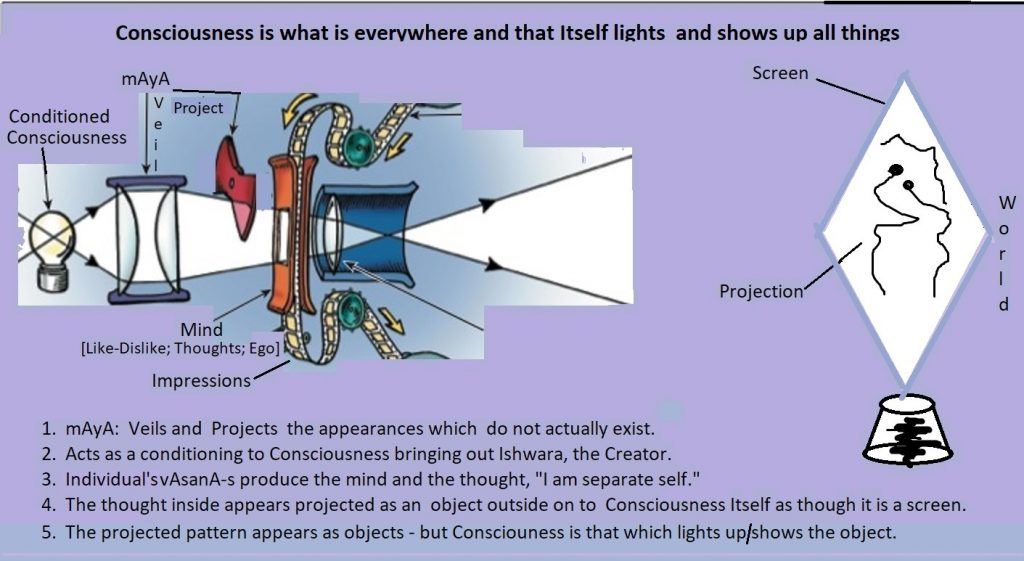
What we have are clearly two entities. They are the kShetra, the field comprising all that which is the knowable, and the kShetrjna, who is the Knower. If ignorance and misery were to be the inherent properties of the Self, it amounts to say that Self perceives Itself because the Self is able to know them (the misery and nescience). That obviously is an absurd position, “since one and the same thing cannot be both the agent and the object of an action.” Whatever is perceived, as for example form and color, cannot be a property of the perceiver.
Likewise, it is the Self that perceives joys and sorrows. They cannot perceive themselves. They are objects to the Self; they are not the Self. For the Self to perceive these, they must be different from the Self. Only then can they be experienced. If the object is totally identified with the Self (me), it cannot be perceived anymore. It itself becomes the Self.
Hence it is incorrect to say that “nescience and misery and the like are the attributes and specific properties of kShhetrajna.” Continue reading