Topic of the Month – akhaNDAkAra vRRitti

OLYMPUS DIGITAL CAMERAThe topic for May is akhaNDAkAra vRRitti.

This is the mental ‘occurrence’ which supposedly causes enlightenment. It is the vRRitti (thought modification) in the form of (AkAra) the formless or undivided (akhaNDa). (Personally, I no longer favor this view and will endeavor to find some quotations which show that it is not quite like this for most people!)

Please submit your quotes, short extracts or personal blogs on this topic!

Atma-j.āna, Self-knowledge (2)

Quote

(ii) Svarūpa-j.āna, knowledge of one’s true nature. What is the nature of this

Atman? Unfortunately we are aware of only the existence of the Atman but, owing to the covering of kāraṇa-aj.āna, we are not aware of its true nature, svarūpa. According to Shankara, the true nature of the Atman can be known only from Vedantic scriptures. The Upanishads state that the true nature of Atman is Brahman. This kind of knowledge is at first only a conceptual knowledge produced by mental vṛttis, modifications. But this vṛtti-j.āna is the starting point. According to Shankara, once this knowledge is gained, all that remains to be done is to stop identifying oneself with one’s body, mind, and so on.

This non-identification, practised with the help of the ‘neti, neti ’ process,begins as dṛg-dṛśya-viveka—discrimination between the seer and the seen—andculminates in a higher type of inner absorption, known as nididhyāsana.

Sureshwaracharya equates nididhyāsana with savikalpa samādhi. Beyond this lies nirvikalpa samādhi, in which akhaṇdākāra-vṛtti, a unitary mental mode, removes themūlāvidyā, causal ignorance. When the mūlāvidyā is completely removed, the Atman is realized as Brahman. When this happens, astitva-j.āna is replaced by svarūpa-j.āna.

The popular notion that in Advaitic experience the Atman ‘merges’ into Brahman is not quite true.

The Atman remains as self-existence. Owing to the coverings of aj.āna and its products, the Atman is at first experienced as ‘I exist’. But as the coverings are removed, the Atman’s self-existence expands until it becomes infinite. The same Atman that was at the beginning remains at the end also, only its coverings are gone; we then call it Brahman.


From: Four Basic Principles of Advaita Vedanta

by Swami Bhajanananda, Ramakrishna Mission

Source: Prabuddha Bharata — Jan/Feb 2010

Q. 355 – Faith in a Path

Q: How do we get the conviction to go on a spiritual quest?  Unlike science, there are no indicators to give feedback if this is even the right path. We need to have blind faith in the general idea itself before we venture into it. Can we only do this through negation of the other paths, where apparent validations are possible by material feedback.

A devil’s advocate argument could be to dismiss everything associated with the vedas/upanishads as nonsense, since nothing can be proved. Another way to look at this is to acknowledge that the ancient sages have come up with practices such as yoga and meditation, which sort of proves their intellect and extrapolates on their ability to see things farther than a average person can and thereby have faith in their judgements.

 I am not able to articulate my question very well but I hope I got my point across.

Answers are provided by: RamesamDhanya, Ted and Dennis.

A (Ramesam): Man, by his/her very nature, feels incomplete. He seeks fulfillment of what he lacks through effort using his natural or acquired talents.  In fact, it is this “lack” that drives his passion for action along the path of the means chosen by him suiting to his comfort-level.

At the most basic level the drives that motivate a man for action are the biological and physiological needs.  As described by the Psychologist Maslow, the subtlety of these needs changes from a lower to higher level in the following manner: Continue reading

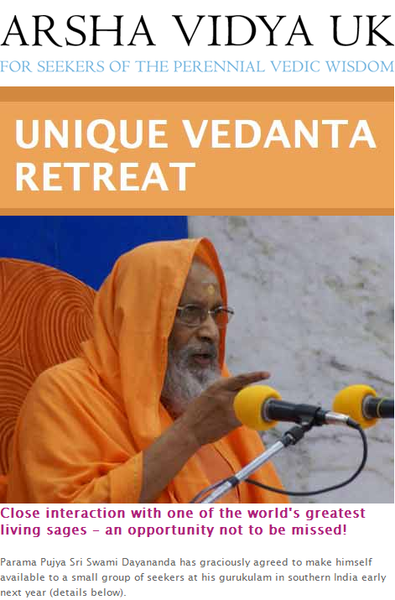
Swami Dayananda retreat

dayananda_retreatThis specially arranged 16–day retreat (15–30 January) offers the rare privilege of sitting at the feet of a master teacher. There will be several classes a day, each day ending with a question and answer satsang. The retreat will be followed, from the 31st, by a further 4–5 days of optional visits to sites of historic importance, including Sringeri Math.

The ashram is situated in beautiful, peaceful forest 45 minutes drive from Coimbatore.

See more details.

Q. 352 – sexual desire and happiness

Q: I have read the book ‘How to Meet Yourself’. I understand I think about desire; that it is a searching for a return to our natural state of happiness. I understand that we are already that, but when around women or just bored I start moving toward pornography to get relief from the desire. How exactly can I just access this happiness? Do I not take the desire seriously and not look at women, or do I need a more practical way to cope and not go down this spiritual route so to speak?

Answers are provided by: Ramesam, Sitara, Ted, Martin and Dennis. Continue reading

upadesha sAhasrI – Part 13

upadesha13

Part 13 of the serialization of the  presentation (compiled by R. B. Athreya from the lectures given by Swami Paramarthananda) of upadesha sAhasrI. This is the prakaraNa grantha which is agreed by most experts to have been written by Shankara himself and is an elaborate unfoldment of the essence of Advaita.

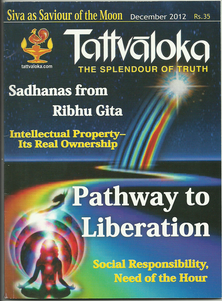
Subscribers to Advaita Vision are also offered special rates on the journal and on books published by Tattvaloka. See the full introduction

Ecstatic Spiritual Practices


293065_10151161696282265_71803492_n-2
Who doesn’t like to get high? Let’s face it getting high is what we human beings live for. Getting high can also be called getting happy. Getting very, very, very happy. People pursue a high in all sorts of ways, from negative ways like drinking alhohol and taking drugs, to more positive ways like spiritual practices such as ecstatic chanting and dance.

When we do spiritual practices like ecstatic chanting and dance we feel we are entering another ‘zone,’ a place that is not available to us in ordinary life. We may feel we are progressing on the spiritual path. We may even assume that the goal of spiritual life is to always feel as high, or even higher, than when we do when we engage in ecstatic practices. Continue reading