Swami Dayananda retreat

dayananda_retreatThis specially arranged 16–day retreat (15–30 January) offers the rare privilege of sitting at the feet of a master teacher. There will be several classes a day, each day ending with a question and answer satsang. The retreat will be followed, from the 31st, by a further 4–5 days of optional visits to sites of historic importance, including Sringeri Math.
The ashram is situated in beautiful, peaceful forest 45 minutes drive from Coimbatore.

See more details.

upadesha sAhasrI – Part 14

upadesha14

Part 14 of the serialization of the  presentation (compiled by R. B. Athreya from the lectures given by Swami Paramarthananda) of upadesha sAhasrI. This is the prakaraNa grantha which is agreed by most experts to have been written by Shankara himself and is an elaborate unfoldment of the essence of Advaita.

Subscribers to Advaita Vision are also offered special rates on the journal and on books published by Tattvaloka. See the full introduction

Q. 354 – Consciousness and reality

Q: I have an odd question, a question that I am not even sure how to formulate, it concerns consciousness. Why does Advaita philosophy insist on calling the ultimate reality consciousness? The word consciousness implies intelligence and thought – how do we know that anything outside of brains is in any way conscious?  Does this mean that physical reality amounts to the “thoughts” of this consciousness? Can the transcendent consciousness send messages to an embodied consciousness? 

 I know that an advaitin will say that there is only a non-dual reality but I mean this (however unreal or relative a reality my individual reality may be from an ‘ultimate’ perspective’) in much the same way that, until you received this e-mail from me, you were not aware of any ‘message’ or meaning from me.

  If I see a figure in clouds or a face in some wood-grain, should I see this as information with meaning? Does the consciousness ‘behind’ or ‘underneath’ everything communicate meaning with physical events (pictures, or ‘my thoughts’ , or even ambiguous hand-writing!) the way we normally communicate meaning with words and concepts? In other words–if the entire universe is consciousness, can anything be truly mindless or meaningless? Continue reading

Two-Icings on the Cake of SAND-2013:

For AV PostSAND-2013 has undoubtedly matured.

There is a greater participation of  Scientists well-known and respected in their fields of study spanning from Cognitive science to Computational Neuroscience, Lucid dreams to Non-linear mathematical models, Physics to Consciousness.

Susana Martinez-Conde from Barrow Neurological Institute was a pleasant surprise. A number of years ago I wrote  to her and her colleague Stephen, after seeing their work on the Perception-Reality Disconnect, about how Non-duality considers the world as an illusion and if they would like to explore this line of thought. They had no interest and disposed off my mails as if it’s all quack science. They may not remember the correspondence, but the change in their perspective is very welcome!

The highly popular Non-dual Teachers like Francis Lucille, Rupert Spira and others were also there. Continue reading

The Ghost of Bharcchu

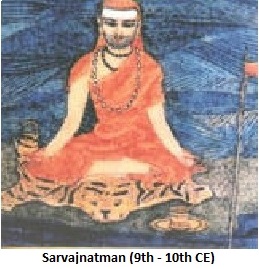
SarvajnatmanSarvajnatman, a well-reputed advaita Acharya of the 9th-10th century, was the author of samkshepa shArIraka.  As the title indicates, this book is a brief presentation of Sankara’s sUtra bhAshya in four chapters corresponding to the four adhyAya-s of the brahma sUtra-s.

Sarvajnatman sums up the essential nature of brahman in ten words. They are:

nityasuddha, buddha,  mukta, satya,  sUkshmasatvibhuadvitIya and Ananda

(eternal, pure, knowing, free, true, subtle, existent, auspicious, without a second and infinite (or happy)).

advaita teaches that you and brahman are one and the same. You being already brahman, the above ten words, therefore, describe you also. That means you, yourself, are Happiness.  So Happiness should be known to you like you know the back of your hand. You do not have to search for or attain Happiness.

But an enigmatic question arises: Okay, I know that I am already eternally existing, knowing and  ever happy brahman.  How come then I don’t know the Happiness which should be present right here? What ghost of an obstruction would block me from feeling it, from seeing it?

The shAstra replies: Oh, Yea, something like the Ghost of Bharcchu can cripple you from seeing the very things that are right in front of you!

“The Ghost of Bharcchu?  What’s that?,” you ask in wonderment.

Continue reading

Vision Of Truth (saddarshanam) – Part 14


निद्रा न विद्या ग्रहणम् न विद्या

गृह्णाति किन्चिन्न यथार्थ बोधे

निद्रा प्रदार्थ ग्रहणेतरा स्यात्

चिदेव विद्या विलसन्त्यशून्या—१४

nidrA na vidyA grahaNam na vidyA

gRihNAti ki~nchinna yathArtha bodhe

nidrA pradArtha grahNetarA syAt

chideva vidyA vilasantyashUnyA—14

निद्रा न विद्या = Self knowledge is not sleep;   ग्रहणम् न विद्या= grasping (perceiving) of worldly objects is not self knowledge; गृह्णाति किन्चिन्न यथार्थ बोधे= In self knowledge, as it is, one does not grasp anything; निद्रा प्रदार्थ  ग्रहण् इतरा  स्यात्= It is different from grasping and non-grasping of objects; चिदेव विद्या विलसन्ति अशून्या = consciousness alone is self knowledge which is self effulgent and not a void.

What is knowledge of the self? Is it like the normal knowledge we gain in our worldly transactions or is it a sleep like state where nothing is known?

In this verse, bhagavAn RamaNa is refuting what self knowledge is not. He mentions it is not like the objective knowledge and sleep. On a positive note, he mentions it is where there is no grasping (of objects), the consciousness itself which is self effulgent is the self knowledge.

We have various sciences, art forms, various branches in Mathematics etc. We gain knowledge in these fields and consider ourselves knowledgeable. Is self knowledge akin to this type of grasping? Is it like a gross appreciation of the world? If not, then is it like sleep where one grasps nothing? Continue reading

Mithya, Mythology, and Metaphysics – an exchange, ll

13.5.2013

“All that now exists will die” (The goddess Erda, in Wagner’s opera Das Rheingold, 4th scene)

M: P, I have to commend you for the exacting work and research you have done on The Terrestrial Garden in such a short time. I am in substantial agreement, as you will see, with much of what you are saying, but take some exception with respect of part of the methodology (parallelisms mostly, rather than contrasts) you use, which has consequences to me either excessive or unwarranted. Also, agree that it is  “pointless to look for the single Truth in this story”. I start with some observations in the way of contrasts (rather than parallelisms or analogies): ‘unlike’, rather than ‘like’, realizing that I am not actually discovering anything new to you.
1. Mythology vs. Mithya

2. Monotheist exoterism (Moses, Old Testament) vs. Esoterism (Jesus,
New Testament)

3. Right and wrong (ethics & morality; or ‘moralism’) vs. sat-asat
(metaphysics or spiritual science)

4. (Christian) God vs. (Hindu) Ishvara

5.  a) Knowledge, empirical, religious, philosophical (‘categorial’) vs.
KNOWLEDGE (reality, realization)

5b) doctrine (theory) vs. method (practice)

1. We could consider, I think, The Garden of Eden, or Terrestrial
Garden, as a myth, like that of Prometheus, or the deeds of heroes –
as much in the East as in the West (puranas, sastras, sagas). They are
illustrative, imaginative stories applicable to man and society (or
collectivities). Not so mithya, which belongs to the spiritual or
metaphysical science of the Indian tradition exclusively, as you know
(that is, esoteric or sapiential: jñana). They (myth and mithya) are
quite different; though there is an overlap in the way we can make use
of them in order to bring out a deeper understanding of something
which may only be implicit in them. I think this is what phenomenological
analysis consists of (briefly, ‘the contents of consciousness’ – to be
elicited). Also, myth and mithya are in the same relationship as pratibhasika and vyavaharika – the first of each pair being merely illusory, subjective, imaginary. Continue reading