
To be free from the other, from all others, is true freedom.
To be one with the other, with all others, is true love.
Both together is true happiness.
Photo credits: berggeist007@pixelio.de

To be free from the other, from all others, is true freedom.
To be one with the other, with all others, is true love.
Both together is true happiness.
Photo credits: berggeist007@pixelio.de

This book has arisen from Direct Pointing sessions that I’ve had with clients around the world. These deceptively simple inquiries and dialogues work. Men and women who have studied Nonduality for decades, both in and out of structured traditions, without experiencing even the first authentic glimpse of themselves have come to recognize their true nature during these talks. Some of them have been glimpses, and others remain ongoing. Still others, who were confounded by oscillation when we began to talk, have moved from there into stable Nondual awareness. And of course there are a few people who’ve reported no change at all; such is the way of it. Continue reading
The quintessential teaching of Advaita is well encapsulated in the famous half-verse long apopthegm comprising eight words:
Brahma satyam
Jagat mithya
jIvah brahmaiva na aparah
(Brahman alone is Real; the world is unreal; and the individual (jIva) is in actual fact non-different from Brahman).
Thus the jIva-brahmaikya vAda (the Doctrine of the Identity of the individual and Brahman) effectively sums up the message of Advaita.
All of us are jIvas. Obviously then, without doubt, we are Brahman.
However, we outdo Brahman, if I may say so, with two additional qualities. These are (i) a delimited size, shape etc. (finitude in dimensions) and (ii) an ID (individual name, lineage etc.). Continue reading
Review of ‘A New Approach to Understanding Advaita asTaught by ´Sa ˙ nkara Bhagavadp¯ada’ – Ramakrishnan Balasubrahmanian — 2
We saw in the 1st part of this Review the primary or prior, not to say exclusive, importance that the author, RB, gives to the superimposition of a subject, individual mind or jiva, on the Self: “the superimposition of an observer is avidy¯a and is prior to the reverse superimposition”, not mentioning that Shankara does not talk of a ‘reverse process’, as if it was something happening through time, but of mutual superimposition of Self and non-Self in a primary sense. He continues: “It is not completely incorrect to say that avidy¯a is the mutual superimposition of the real and unreal. ´ San˙ kar¯ac¯arya and Sure´svar¯ac¯arya do mention this … the superimposition of an observer on the inner-self naturally leads to the reverse process of superimposing the inner-self on the inner organ”. RB’s objective in maintaining this priority of the subject in this ‘act’ seems to be to show that SSS is guilty of circularity (petitio principi, in logic). Even so, and rather surprisingly, he claims that avidya is not something subjective (neither is it ontic nor epistemic – see below). Continue reading
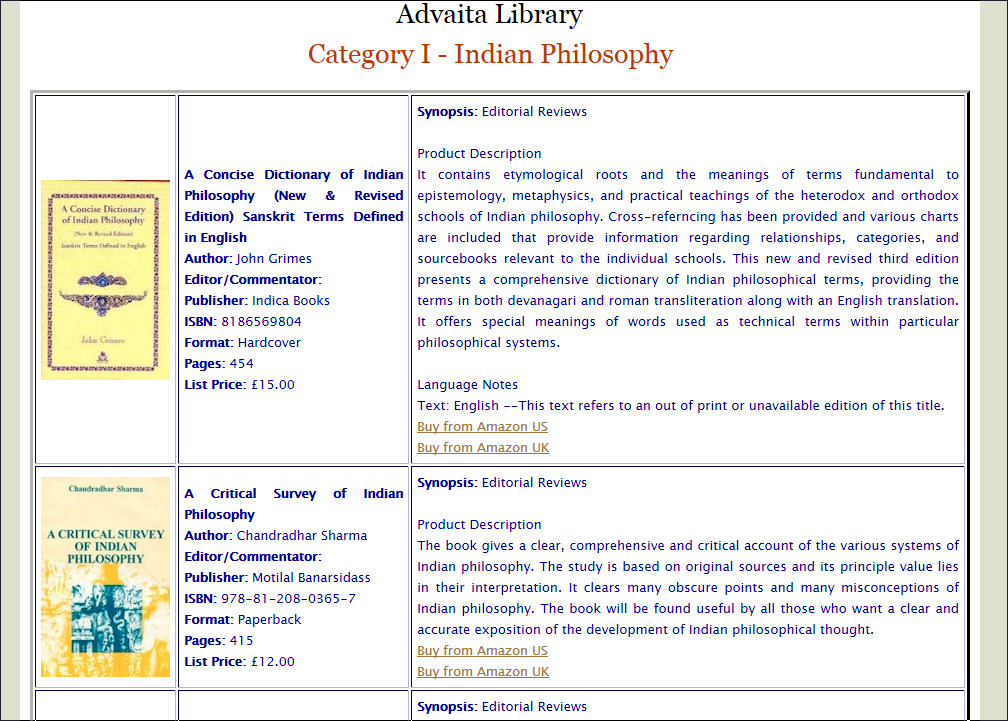 The Advaita Library has been completely updated, with the number of separate categories (one page per category) now expanded to 35. There are nearly 1400 books, DVDs and audio tapes catalogued, including Amazon synopses where available, links to purchase from Amazon and elsewhere and links to reviews and extracts on the site, if we have them. If you want any advaita-related book, this is the place to look. (And if you link through to buy from Amazon, the site gains a small royalty towards future purchases.)
Q: There are moments when I think I am the one that is creating my world with my specific positive thoughts – is that true?
Or is it the concsiouness bringing me those positive thoughts or negative thoughts? I know that I don’t have to ask for anything because in that way there is an infinite possibility of something fresh and new and totally different.
How do I pray? In silence only doing meditation?
A (Sitara): Yes, it is true. Your experiences (positive as well as negative ones) are constructs of your mind. The question is, what do you do with this information?
It seems that all of your questions are about, how to get a different life. For that you would like to know the mechanism of what in New Age (or Yoga, magic etc.) is called materialization of things, events, persons etc. Continue reading
 So how do we know how Brahman is? The teacher says that each object of experience has 5 aspects: asti, bhāti, priyam, rūpam, nāma. Asti = ‘is’. You know the meaning of the word ‘cat’, but not pay attention to the meaning of the word ‘is’, which means ‘isness’, which means ‘existence’. When you say ‘cat is’ you mean that the existence of the cat is. Any object of experience you can name is.
Existence is the intrinsic nature of Brahman, the Reality. In what form is Brahman? Continue reading
(Ramesam asked me to review the following article, with which I complied after much hesitation. The article is over 40 p. long and quite dense and complicated in parts – in other words, ‘academic’: for specialists only; one could add: cutting the slices so thin, that the substance is practically lost, or forgotten).
Review of ‘A New Approach to Understanding Advaita as Taught by ´Sa ˙ nkara Bhagavadp¯ada’ – by Ramakrishnan Balasubrahmanian
The first impression, on a quick glance at the beginning of the article, is that the criticisms of the author contained in the article, and addressed to the writings of Swami Satchidanandendra Saraswati (SSS), a recognized sage and scholar, are extensive to the latter’s whole opus, as coming from an uncompromising position concerning the teachings and method of Shankaracharia. Some of the words and expressions used in the article are quasi-litigious (e.g., ‘intellectual arrogance’, ‘vociferously opposes’, ‘pointless’, ‘glaring inconsistency’, ‘making errors’, ‘misconstruing’, ‘twisting’, ‘has invented a new term’, etc.), reminiscent of the theological disputes and diatribes in the European Middle Ages. Evidently, SSS had his followers as well as his detractors, and the same can be said of the author of this article, who belongs to an opposite camp. Occasionally, he shows signs of (partial) approval of his adversary’s (if one can use this term) enunciates; for example: “No doubt SSS’s textual analysis skills are excellent, but the problem I see with SSS’s writings is his obsession with terminology, rather than philosophy. Indeed none of his works are about the philosophy of advaita [!], but are oriented almost exclusively towards contradicting previous commentators of ´Sa˙nkar¯ac¯arya”. And soon after that: “The difference between Padmapada and SSS is that the former is a philosopher, while the latter is a textual analyst”. Concerning these pervading criticisms of the work of SSS by the author, Ramakrishna Balasubramanian (RB), the reader may judge whether they are excessive, unwarranted, or justified.
The main criticism by the author, in respect of the interpretation of avidya by SSS, is that this is not due to a double superimposition of the self and the non-self, as the latter maintains, but only to a superimposition of a subject, non-self, on the self: “[T]he fundamental error is a superimposition of an observer on the real… and by a reverse process the inner self, which is the witness of everything, is superimposed on the inner-organ”. He calls this reverse act (or process, as he calls it) ‘natural’, since “a superimposition of observer on the self naturally leads to the imagination of objects ‘outside’ and ‘inside’ the observer, just as described by Gaud.ap¯ad¯ac¯arya”. He adds: “The usage of the continuative ‘adhyasya’ in the above passage also clearly indicates that the superimposition of an observer is avidy¯a and is prior to the reverse superimposition”.
Logically prior?, prior in time? Or simultaneous, by mutual implication? Continue reading

Part 9 of the serialization of the presentation (compiled by R. B. Athreya from the lectures given by Swami Paramarthananda) of upadesha sAhasrI. This is the prakaraNa grantha which is agreed by most experts to have been written by Shankara himself and is an elaborate unfoldment of the essence of Advaita.
Subscribers to Advaita Vision are also offered special rates on the journal and on books published by Tattvaloka. See the full introduction and part 1 of the new series.

Edouard Vuillard, The striped blouse 1895
Spiritual seekers who aim to go beyond duality often fancy that, at the end of the journey, they are going to experience reality altogether differently. That’s right and wrong at the same time.
Even before, there are many situations that allow us to experience non-duality, which is in and through everything. Reality being non-dual, it would be quite surprising if non-duality was untraceable up to the time of enlightenment. So even unenlightened mortals experience non-duality plenty of times throughout their day. Indeed we interpret the experience wrongly. What happens with enlightenment or awakening, is that this wrong interpretation, based on ignorance, is dropped. This means that all those possible non-dual experiences are recognised for what they essentially are: non-duality itself. Continue reading