
Q: I read some serious critique of Advaita by a philosophy professor in a web page. If you have time, I`d like to know your thoughts about it.
Here it is:
. The View is Self-Contradictory: The first problem with the core of Sankara’s philosophy is that it seems to be self-contradictory. As advocates of the other Hindu schools of thought have pointed out, if the only reality is Brahman, and Brahman is pure, distinctionless consciousness, then there cannot exist any real distinctions in reality. But the claim that this world is an illusion already presupposes that there is an actual distinction between illusion and reality, just as the claim that something is a dream already presupposes the distinction between waking consciousness and dream consciousness. Moreover, Sankara’s idea of salvation–that is, enlightenment through recognition that all is Brahman–already presupposes a distinction between living in a state of unenlightenment (ignorance) and living in a state of enlightenment. So this view contradicts itself by, on the one hand, saying that reality (Brahman) is distinctionless, while on the other hand distinguishing between maya and the truth of Brahman, and by distinguishing between being enlightened and unenlightened. Continue reading
Panchadasi part 1
 A series of posts, presenting a new translation and commentary by James Swartz on the Panchadasi. This was presented by James as a week-long course during July 2012 and was very well received. It will be posted in around 35 parts at the rate of one part every 2 – 3 weeks. I will be editing and commenting on the material as we go and James may provide additional commentary if time allows. So there may be scope for readers to provide feedback. Please email me via the ‘Contact Form’ if you do not understand anything and wish to seek clarification.
Read Part 1 of the Panchadasi.
Consciousness
 For most spiritual seekers ‘consciousness’ has a positive connotation; they want to extend, raise, deepen their consciousness, or simply become more conscious. But as with so many other terms – soul, spirituality, freedom, love, truth, bliss, energy – everybody understands something else by them.
In Advaita Vedanta every term is defined unambiguously. In our normal usage of words, depending on the context, one defines consciousness in diverse ways. Generally, however, a material viewpoint forms the basis of the Western view. We think that consciousness depends on the brain, for example that one can switch it off or can raise and extend it (temporarily) by certain drugs. Also we think that we can direct our consciousness, align it to something or withdraw it from something.
We consider ourselves as conscious if we remember whether we have switched off the iron and as unconscious if we forgot it. Also, we should always remain conscious of internal processes – we consider ourselves more conscious if we note that an emotion has arisen inside us at the time that is arises, than if we note this only afterwards or not at all. Continue reading
Now, Now, Now
T here is a picture that is making the rounds on Facebook of an old fashioned clock, and each number on the clock face is replaced by the word ‘Now.’
Although this is a fun picture to share, I wonder if in some ways it doesn’t give the wrong impression.
Is there a now, and then another now, and then another now, as if each now is different and separate from the other? Is there a now, now, now, which flows along in time and which changes, or in reality is there only the Now? Continue reading
Book Extract – Meeting the Mystery
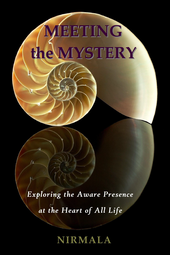 Meeting the Mystery – Nirmala
Extract – ‘Grace Is All There Is‘.
Note that the whole of Chapter 7 may also be downloaded from Nirmala’s website.
QUESTIONS NOT RAISED OR ANSWERED – Part 1
[Here are three questions that I did not come across a seeker raising them. Nor did I find any teacher discussing directly those specific issues and answering them in a logical way. Maybe my literature search is incomplete, I admit. Before I go on to provide my replies to these questions, I will very much appreciate to know the reactions / thoughts of the interested / knowledgeable readers – ramesam.]
The Questions:
A. Bhagavad-Gita related: Continue reading
Clearing some myths about mithyā
 Adi Shaṅkara’s vision of advaita is most succinctly expressed in the following pithy statement: Brahma satyam, jagan-mithyā; jīvo-brahmaiva nāpara. (Brahman is Absolute Reality, satyam; the universe is dependent reality, mithyā; the individual, jīva, is none other than Brahman itself).
In this statement there is one word that has caused great confusion by being wrongly understood – much of the critical rejection of advaita (as well as the fundamentalist stand on non-duality adopted by some Western advaitins) can be avoided if this word is understood correctly. The word is mithyā.
Traditional advaita vedānta postulates two orders of reality: absolute and relative. The name given to the relative order of reality is mithyā, commonly mis-translated as ‘illusion’. Whereas the neo-advaita teachers accept only one level as valid (i.e. satyam), vedānta accommodates both levels. In the Taittiriya Upaniṣad it talks about two birds on the same tree: one enjoys the fruit of the tree, the other just witnesses. The Īśa Upaniṣad says that one should see everything as the Lord, but if that’s not possible due to attachment to the body then one should live a life performing one’s duty. The very structure of the Vedas themselves reflects this acceptance of a two-fold reality and prescribe (in the karma kāṇḍa section) the best way to live the worldly life and in the vedānta section it reveals the vision of truth. Satyam is the absolute level of reality, mithyā is the ‘as though’ real. Continue reading
Gunas and History (Q. 318)
Q: 1. If the triple gunas are the matrix of the “reality”, aren’t they immutable and therefore truly real? (I have asked this question a while ago in our personal correspondence but I can’t access my old email and it still bothers me…).
2. What is the ontological status of the course of human history? Is it objective, or just a sort of shared mass illusion that somewhat gets transferred from generation to generation? I am aware of the imprecision of my language but hopefully you will understand my meaning.
A to Q1 (Peter): Guṇas are the subtlest form of manifest matter and, being matter, are thus subject to change. So they are not immutable.
Guṇas in their unmanifest and undifferentiated form are the triple śakti of māyā: jñạna, krīyā and dravya shakti, the undifferentiated and unmanifest powers of knowledge, action and materialisation. When these move into manifestation they get the names sattva, rajas and tamas. Continue reading
Sankara Bhashyas vs. Prakarana Granthas – A View
My studies of Advaita, the ancient wisdom of Oneness without a second, began with the small precise Monographs that teach its core philosophical essence without making us feel Advaita to be a remote inaccessible concept. The Monographs (called Prakarana Granthas) are usually written in simple Sanskrit words without complex or compound sentences pointing the seeker directly to the Ultimate Reality. Some of them contain excellent metaphors “for easy comprehension” of the abstruse and abstract teachings, some others provide tools for one’s own analysis of one’s experience and yet others provide a step by step guidance on the path of Knowledge holding the hand of the seeker gently and with compassion.
One What?
Neem Karoli Baba, my first guru and inspiration on the spiritual path, famously said, “Sub ek,” which means ‘All one.’ I, as perhaps many of us, who heard and contemplated the phrase throughout the years, had my own concept of what that phrase meant.
Many drops, one ocean; many petals, one flower; many sunrays, one sun; many parts, one whole.
It was not until I encountered the teachings of Vedanta that I came to understand what Maharaji in fact most likely meant by ‘sub ek.’
From the perspective of the teachings of Vedanta, sub ek, does not mean many drops one ocean, what it means is the truth of the drops and the truth of the ocean is one alone. One water. The reality of the drops and the reality of the ocean is water.
It means that in reality there are not many separate things that actually exist. There is only one thing that really and truly exists, upon which everything else depends for its apparent existence, and Tat Tvam Asi, You are That.
So what is this That, this one thing, that everything is and you are?
What is the one common denominator in the world of name and form?
Isness, existence. In Sanskrit satyam.
Think about it. Do you ever in your entire experience not exist?
Lord Krishna tells Arjuna in the Bhagavad Gita: “There was never a time I did not exist, neither you, nor these kings. Nor will any of us cease to exist in the future.”
(Chapter 2, verse 12)
Things—objects—which exist and are subject to coming and going in terms of time and space—come and go in existence itself. That existence, which is only one and never ceases, that existence you are.
The recognition of one’s very being as that existence is called ‘jnanam’ or ‘self-knowledge.’ You are That right now, but take your Thatness to be a product of the body/mind, and it isn’t.
Is there ever a time you do not exist? What is your experience? You always are.
“Always I am (sat)
Always I shine (chit)
Never at any time am I not beloved to myself (ananda)
Therefore it is established that I am that One alone,
The meaning of the word satchitananda”
Advaita Makaranda (The Nectar of Nonduality) Verse 2