
Part 1 of 2
The Ignorance that Isn’t – 8/8
15. jIva and jagat are Notional (Contd):
When Arjuna laments at the prospect of killing his loved ones in the war, Krishna tells him, “It was not that I was not existing before nor will I stop existing in the future.” That means there is no beginning or end, nor do the birth and death exist. Life is merely a transitional form that arises in between the unreal appearance of birth and death. Since birth and death are unreal, we (as the Self) are already liberated.
न त्वेवाहं जातु नासं न त्वं नेमे जनाधिपा |
न चैव न भविष्याम: सर्वे वयमत: परम् || — 2:12, Bhagavad-Gita.
[Never was there a time when I did not exist, nor you, nor all these kings; nor in the future shall any of us cease to be.]
In the very next verse, Krishna, however, says: Continue reading
Q.484 Sense of Self
Q: About six years ago I was looking for the separate self through directly paying attention to the sense of self in my immediate experience. I did this over about a week or ten days during regular life. I followed this sense of self when it shifted say from the body to the thinking mind, to the sense of will etc. Suddenly everything dropped away and what was seen was just openness/absence of self /no me /nothing +everything.
I’m not sure how long this lasted. Then the mind came back. I felt liberated from all worry and desire for a couple of months. Then slowly old habits reestablished themselves. Since then I am at a loss what to do.
So I have no problem accepting Advaita teachings but I could do with some further guidance.
A: Presumably you are prepared to accept the basic premise of Advaita – that reality is non-dual. If it is true, then it must be the case that you already are the ‘Self’. So it is not really a case of ‘looking for it’ but rather realizing that you are already ‘It’. So you can ask yourself the question ‘who would be looking for what?’. The ‘sense of self’ is not the Self; it is a feeling or an idea in the mind.
If you practice meditation seriously (twice a day, 30mins at a time, for several years), you will eventually experience periods of samAdhi, which correspond to the experience you describe. But this is just an experience – as you can tell because it has a beginning and an end. Realizing the truth of Advaita, becoming ‘enlightened’, is Self-knowledge, not an experience.
Having said that, it is possible to gain Self-knowledge and yet still not have the ‘sense of bliss’, fulfillment or whatever, that you believe ought to result. This is because of ‘obstacles’ in the mind (pratibandha-s) remaining from having insufficiently ‘prepared’ the mind beforehand (sAdhana chatuShTaya sampatti).
The book I am currently writing is all about the confusions that are brought about in seekers as a result of wrong understanding by many modern teachers. pratibandha-s will be one of the topics covered and, because there has been much discussion on related issues at the website recently, I will be begin posting the material for this topic within the next week. It is quite long so will be in 3 or 4 parts. I suggest you look out for it and join in any subsequent discussion if you like. [Since this Q&A, I have posted the pratibandha series, now in around 11 parts, and it begins here.]
The Ignorance that Isn’t – 7/8
13. The Logical Fallacy of Infinite Regress:
While explicating further on the question of “Whose is avidyA (Ignorance)?” Shankara points out that the contention “I am ignorant” is a logical fallacy which would lead one to an infinite regress.
Shankara says:
न च ज्ञातुः अविद्यायाश्च सम्बन्धस्य यः ग्रहीता, ज्ञानं च अन्यत् तद्विषयं सम्भवति ; अनवस्थाप्राप्तेः । न च ज्ञातुः अविद्यायाश्च सम्बन्धस्य यः ग्रहीता, ज्ञानं च अन्यत् तद्विषयं सम्भवति ; अनवस्थाप्राप्तेः । यदि ज्ञात्रापि ज्ञेयसम्बन्धो ज्ञायते, अन्यः ज्ञाता कल्प्यः स्यात् , तस्यापि अन्यः, तस्यापि अन्यः इति अनवस्था अपरिहार्या । यदि पुनः अविद्या ज्ञेया, अन्यद्वा ज्ञेयं ज्ञेयमेव । तथा ज्ञातापि ज्ञातैव, न ज्ञेयं भवति । यदा च एवम् , अविद्यादुःखित्वाद्यैः न ज्ञातुः क्षेत्रज्ञस्य किञ्चित् दुष्यति ॥
“How can you perceive the relation between the Self and avidyA? It is not indeed possible for you to perceive your Self as related to avidyA, at the same moment (that your Self cognizes avidyA); for, the cognizer (Self) acts at the moment as the percipient of avidyA. (The Self cannot be both the perceiver and the perceived at the same time). Continue reading
Q. 445 Experience and brahman
Q: What exactly (in Reality – i.e. Brahman is the only reality) is experience?
I know that there is a relative level where there are jIva-s and objects and minds and Ishvara, but if we talk about the absolute reality – Brahman – then I believe that there is no experience possible.
Brahman is the only reality and Brahman does not have experiences of any kind – yes?
So if I realize myself as Brahman, then I have to see all my experience as mithyA, yes?
SO: if you are agreeing to the above, and if I am following correct logic: why do so many teachers of non-duality and even of Advaita Vedanta say that experience is the only means through which we can explore reality?
As jIva-s in the relative realm, the only thing we have to navigate reality, is our experience. So again: what is an experience? Is there no reality to an experience?
Many teachers who are famous and well-respected point to the Presence of God as a palpable experience of peace, fullness, truth, love which comprises the reality of all our experiences. They say Presence is Brahman in manifest form and is eternal.
Is experience comprised of Brahman-as-Presence?
Q.483 Inert elements?
Q: The five elements of this universe (space, air, fire, water, earth) are considered inert by nature and in Vedantic teachings. However, Brahman is the substratum for everything and is Consciousness. So, how can the 5 elements be fundamentally be considered inert?
A: In reality, there is no matter. What appears to be matter, from the standpoint of phenomenal existence, is actually Brahman (Consciousness) but we see ‘forms’ and give them ‘names’ as if there were separate entities.
The elements are certainly inert. But so also are the bodies and minds of humans. (We differentiate these of course as being ‘gross’ bodies and ‘subtle’ minds but they are all still inert.) The difference between a mind and a rock, is that the mind ‘reflects’ Consciousness, whereas the rock does not. Thus the mind expresses consciousness (small ‘c’) but the rock doesn’t.
You always have to remember that explanations such as these are ‘interim’ only, in order to point the mind towards an intuitive understanding of the nature of reality. You can never have ‘true’ explanations because reality is non-dual.
The End of Quantum Reality
The End of Quantum Reality: A Conversation with Wolfgang Smith
Wolfgang Smith [b 1930] is a nuclear physicist and mathematician who has also written on philosophy, religion, and metaphysics from the perspective of traditionalism or perennialism. As a young man, he spent two years in India and studied under Sw. Nikhilananda and also met Sri Anandamayi Ma. He took from the French philosopher René Guénon the idea of whole-s and how a (physical) whole is not just the sum of its infinitesimal parts – there is an Aristotelian substantial form inherent (in-forming) and causally related to the whole. A recent film about him (Wolfgang Smith) has recently been made: ‘The End of Quantum Mechanics’ (obviously all lay and not scientifically savvy people will not have a clue about what goes on in the discussions by several physicists in the film). Continue reading
The Ignorance that Isn’t – 6/8
What we have are clearly two entities. They are the kShetra, the field comprising all that which is the knowable, and the kShetrjna, who is the Knower. If ignorance and misery were to be the inherent properties of the Self, it amounts to say that Self perceives Itself because the Self is able to know them (the misery and nescience). That obviously is an absurd position, “since one and the same thing cannot be both the agent and the object of an action.” Whatever is perceived, as for example form and color, cannot be a property of the perceiver.
Likewise, it is the Self that perceives joys and sorrows. They cannot perceive themselves. They are objects to the Self; they are not the Self. For the Self to perceive these, they must be different from the Self. Only then can they be experienced. If the object is totally identified with the Self (me), it cannot be perceived anymore. It itself becomes the Self.
Hence it is incorrect to say that “nescience and misery and the like are the attributes and specific properties of kShhetrajna.” Continue reading
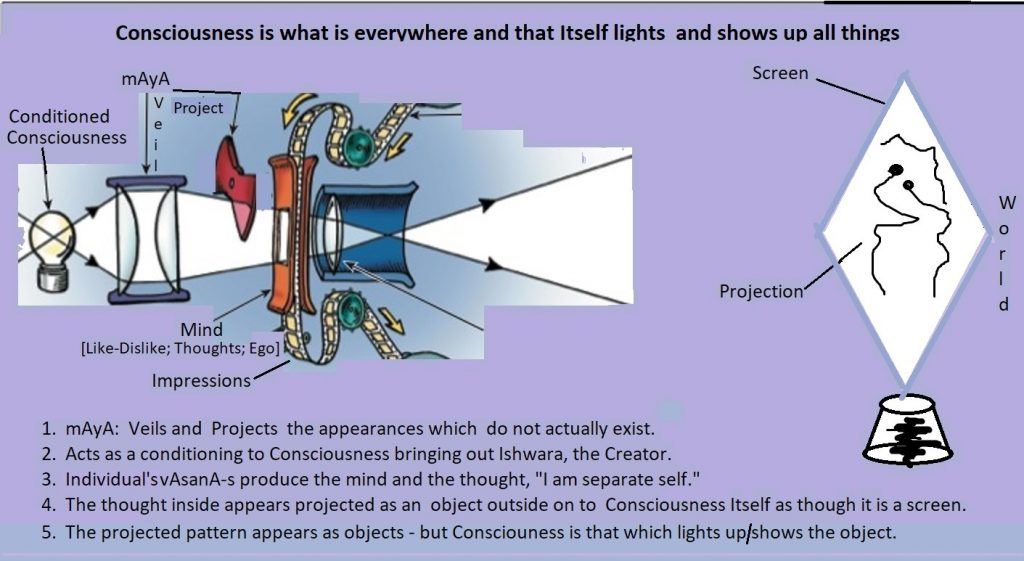
Projector Metaphor:
I tried to visualize the Advaita teaching using the Projector Metaphor. A slide is prepared based on that visualization.
Any corrections/suggestions for improvement will be gratefully appreciated.
The Ignorance that Isn’t – 5/8
8. Self is never in Bondage (Contd.):
Shankara is very categorical in his observation that “Very rare is the person who attains discriminating wisdom. The ignorant don’t follow the man of Wisdom, because of their attachments and evil passions which necessarily lead to action.” He regrets that such people resort to even black magic. He adds that “Therefore, samsAra is only based on avidyA and exists only for the ignorant man who sees the world as it appears to him. Neither avidyA nor its effect pertains to Kshetrajna, pure and simple.”
9. A Man of Erudition (paNDita) vs. A Scholar:
Shankara says that, not only many of the common people, even some of the scholars (Experts in shAstra-s) fail to understand the essential message of the scripture. Proud of their knowledge in the Vedic rituals, they think that they are the doers (with a strong sense of a “me”) and believe they will attain great merit (as “mine”) in this life-time so that they can reap the fruits of their meritorious actions in the next world. They perceive their body, life-force, senses, and mind, but are unable to grasp their innermost Self (pratyagAtmA) which is the actual witness to all that they perceive. If they are able to recognize their inner Self, they will easily cognize the Supreme Self (paramAtmA) that is present everywhere and in everything. They will come to realize that their inner Self is not different from the Supreme Self. As the Gita says,
विद्याविनयसम्पन्ने ब्राह्मणे गवि हस्तिनि |
शुनि चैव श्वपाके च पण्डिता: समदर्शिन: || — 5.18, Bhagavad-Gita. Continue reading