Doership and personal responsibility

Q. Is the standpoint of the Vedanta man not the doer? If so, where does his/her personal responsibility begin and end? (from Quora)

A. Individual man is a doer (and an enjoyer) so long as s/he identifies themselves as such, thus reaping the results of their actions. If the presumed – seemingly independent – individual knows that s/he is in essence the supreme Knower/Actor, that is, pure Consciousness, then actions, enjoyments, happen, but s/he does not claim any of that: any response comes directly and spontaneously from Consciousness.

Bear in mind, though, that it is not Consciousness itself which acts, rather it is behind all actions: ‘It is the hearing of hearing, touch of touch, mind of mind’, speech of speech’, etc. (Ke Up, 1-2) as their background or substrate.

‘Mind alone – when ignorant – is the cause of bondage and mind alone – when enlightened – is the cause of liberation’ (Amrita Bindu). M.

Jivanmukta and Jivanmukti – 7/12:

[Part – 6/12]                                         

NDM: What would you say are the odds of someone being “enlightened” also becoming a Jivanmukta?

Ramesam Vemuri:  Advaita holds that everyone is already a Jivanmukta.  Some scriptures unequivocally declare that the mind is most important.  If it knows clearly that it is unbound, it is free.  If it thinks it is bound, it is in bondage!

And incidentally, the Advaita teaching does not say one “becomes” a Jivanmukta. The teaching is that “You are That.”  It is not to ‘become’ but just to ‘be.’

Enlightenment or the first glimpses of ‘realization’ may entitle one to be called as a Jivanmukta.  But to be unceasingly in/as brahman, one has to overcome several of the distractions that the mind keeps posing.

NDM: The one question that really interests me is what someone can do about their vAsanA-s if they are enlightened, but still have problems with them?  Continue reading

Jivanmukta and Jivanmukti – 6/12:

 [Part – 5/12]

NDM: What about an energetic shift?  Does this also take place?

Ramesam Vemuri:  A particular individual may call his experience as an ‘energetic shift’ and only he can tell what those terms signify.  Most people may figuratively express “realization” as a change in perspective, a sort of re-orientating, rather than as anything extra-ordinary or dramatic.

NDM: So if the understanding isn’t crystal clear, are you saying this is the reason why one may not become a Jivanmukta?

Ramesam Vemuri:  That is true.  Absolute clarity without even a speck of confusion or doubt on the teaching (shall we call the “theory”?) of Advaita is a must and is the primary step. Lack of clarity or misunderstanding can lead one astray into pursuit of false mental states, fancy expectations and may even result in unhealthy minds or dead ends.

NDM: Will crystal clear knowledge wipe out all vAsanA-s? Continue reading

Q.469 Consciousness versus consciousness

Q: Consciousness (capital C) is brahman is ineffable. consciousness (lowercase c) is the state of being aware (of something). These are fundamentally different ‘things’ … they really have nothing to do with each other. They might as well be called x and Y instead of x and X.

What am I missing here? What justifies consciousness and Consciousness being portrayed (linguistically, in any case) as the same thing except for the capitalization? How is consciousness similar to Consciousness? 

Or is it as simple as: What we call consciousness is <whatever happens to arise mentally when> Consciousness reflects off the mind? In other words: There is no consciousness per se, there is only reflected Consciousness in ALL its forms? The feel of consciousness … qualia, presence, what it is like to be a particular mind-body at a particular moment.

How is this *feel* similar to Consciousness? If they are utterly dissimilar, why use the same root word with different spellings?

A: Interesting questions, although I think maybe you are making more of this than is really there.

Firstly, Consciousness and consciousness have to be the same in reality, since there is only Consciousness. How can you say they have nothing to do with each other? In the light analogy I used [If you look at the analogy of light, the light reflected off a mirror is still light, still photons of electromagnetic radiation, even though the mirror itself is not the originator of those photons.], the reflected photons are the same photons, not newly originated imitations. We call the reflected Consciousness ‘consciousness’ but it is still only ever Consciousness. The reason that we want to differentiate is to explain aspects such as why Consciousness manifests differently in different minds. You could say that a clear, disciplined mind ‘reflects’ Consciousness much more ‘brightly’ than a dull, identified mind, in a similar way to a clean mirror reflecting light much more brightly than a dirty one.

You say to begin with that “consciousness (lowercase c) is the state of being aware (of something)”. But it is Consciousness that enables us to be aware of anything. When Consciousness enlivens the mind, we just happen to call it ‘being conscious’. Your statement “There is no consciousness per se, there is only reflected Consciousness in ALL its forms?” is one way of putting it.

The ‘feel’ of being conscious is one aspect of the mind’s response to the reflection of Consciousness. There is no ‘feel’ under anesthesia, for example, because there is no reflection taking place since the mind is inactive.

Jivanmukta and Jivanmukti – 5/12:

[Part – 4/12]

NDM: What is the difference with simply being enlightenment in the advaitin sense, knowing one is Brahman, infinite, eternal non-dual awareness and so on and being a Jivanmukta?

Ramesam Vemuri:  The first and foremost thing is the knowing of information “I am brahman.”  This has to be understood by the mind intellectually.  It is the shravaNa (Listening) phase.  Next is to assimilate it and internalize it to the extent that no doubt remains in one’s mind about the Truth of that statement.  This is the manana (Reflection) phase.  After being firmly convinced and free of doubts, one needs to continuously stay with it as brahman (not become brahman but be brahman).  This is the nididhyAsana (Contemplation and Meditation) phase.  Jivanmukta is one who unwaveringly and unbrokenly abides as brahman.

NDM: Why would one person become enlightened and get the added benefits of bliss, no aversions, fears, desires and being a Jivanmukta, while another may not?   Is this grace, karma, or because of one’s practice or some other factors involved?

Ramesam Vemuri:  If one continues to mistake the rope as snake or the understanding is only superficial, his understanding is obviously incomplete. Continue reading

Jivanmukta and Jivanmukti – 4/12:

[Part – 3/12

NDM: When you say:  “The most basic point to remember is that in order to talk in terms of vAsanA-s and so on, one has to first believe in the ‘reality’ of the existence of a cause, an effect and a relationship between them. Looked at from the position of a Jivanmukta, there are no different entities, one as a cause and another as an effect and a formula expressing a relationship between them.  The entire thing is One.  And that is the only Truth.  Not so many different things and their inter-relationships which are all imaginary.”

So are you saying that the Jivanmutkta no longer acknowledges that there is an empirical relationship of cause and effect on this relative level. (samvriti-satya or vyâvahârika-satya) 

That they only recognize or acknowledge the absolute perspective? (pâramârthika-satya). That they in fact deny that a relative level even exists like some of the neo advaitins do.

Ramesam Vemuri:  The terminology of Absolute Truth, transactional reality and dream-like reality and stories around them are inventions for appeasing a seeking mind. They have as much value, meaning and significance as the conversations and technologies of a dream experience have in the wakeful world.   You may dip into a river and next thing suddenly be flying over a mountain peak in a dream.  You could do so in the dream because you possessed that technology in your dream.  But what relevance has it in the wakeful world?  Similarly, the terminologies and classifications and theories used in the wakeful world carry no meaning or relevance to a Jivanmukta. Continue reading

Can consciousness exist without time? 

From the viewpoint of Advaita Vedanta (and I believe also zen and Dzogchen), time is not just something elusive, but ultimately unreal – only an idea or concept. The same can be said about the concept of ‘now’, which cannot be elucidated or measured in any way. ‘Now’ can only be a symbol of eternity, immeasurable but always present. ‘Eternity’ itself is a symbol or slanted conception of reality or existence/being, which is timeless. For the absolute time does not exist. Consciousness alone is real and, thus, timeless. Stated differently, ‘what is never ceases to be; what is not never comes into being’ (Shankara). Parmenides, Gaudapada, and Shankara were strong in that position.


Vedanta the Solution – Part 62

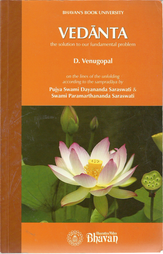
VEDĀNTA the solution to our fundamental problem by D. Venugopal

Part 62 concludes the series with a short summary of the function of Vedanta in revealing the truth about the nature of the Self, the world and Ishvara; and the role that saMpradAya plays in achieving this. A list of addresses is provided to access the Arsha Vidya teaching via talks and books. There is a complete Contents List, providing links to the relevant material.


Our special thanks to Sri Venugopal for writing this brilliant and accessible summary of the teaching and allowing its serialization at the site.


Jivanmukta and Jivanmukti – 3/12:

[Part: 2/12]

NDM: When you say:  “Who and what for does one set these standards?  Are the standards not highly contextual, local, artificial and subjective?  Does qualifying anything – vAsanA-s or actions – based on such purely judgmental aspects have any holiness?  A society’s imposition of rules and regulations, howsoever high may be the value and whatsoever may be the morality and nobility, does not have Absoluteness.  They may have a societal sanction but lack intrinsic Sanctity.  Who to say right or wrong or good or bad?  Things just exist.  Nothing is positive or negative until a ‘thought’ interferes.”

But what about dharma? The natural laws of the universe or God as some would call it. Some vAsanA-s violate dharma, others do not. Such as a vAsanA for smoking cigarettes like Nisargadatta had, is an unhealthy vAsanA but it’s only going to injure his lungs at most. Someone like the American guru Adi Da had extreme vAsanA-s such as having sexual relationships with his students, physically and psychologically exploiting and abusing them. How does dharma play into this equation?

Ramesam Vemuri:  ‘Dharma’ to me in the context of Advaita is synonymous to brahman, undefinable, ungraspable.  The Sanskrit word for the “Natural Laws of the Universe or God” is ‘niyati.’  Thus these two words are not the same for me. Continue reading

Meditation- Vedantic Way

Advaita seeking is in three gradual stages: ShravaNa( Hearing), Manan (Contemplation) and NididhyAsanA (Meditation).  In  Bṛhadāraṇyaka Upaniṣhad  sage Yagnavalkya says to his wife Maitreya:  Self should be realized by ShravaNa, Manan and NididhyAsanaA; upon realization of the Self, all this is known.

ShravaNa means listening to vedantic teaching by a guru. It would also include reading vedantic literature and in the age of technological advancement, accessing the teaching offered by other sources. Contemplation means analyzing the teaching and grasping intellectually. All doubts should stand cleared at this stage.  Next stage is meditation which enables internalization of the teaching and making it a living practice. No doubt, there is a wide gap between intellectual understanding and living practice, like two shores of a river. Having understood the enormity of task, the sages of yesteryear, out of compassion for the mankind, laid down the technique of vedantic meditation so as to swim across the river.  Drg Drsya Vivek describes vedantic meditation. It is progressive and in conformity with vedantic teaching.

There are two broad categories of meditation, namely, internal and external. Each category is further divided in three stages, namely, savikalpa meditation with thought, savikalpa meditation with word and nirvikalpa meditation.  It is noteworthy that the three stages follow in the same order.  Thus it is six- fold method. Vikalpa means division. In savikalpa meditation, subject-object division and duality exist. In nirvikalpa meditation there is no such division and is non-dual. Continue reading