Jivanmukta and Jivanmukti – 2/12:

[Part: I/12

NDM: When you say “he clearly understands the falsity of the cause-effect  relationship and other such mechanisms and patterns conceived by the mind,” are you also referring to saMskAra-s and vAsanA-s and can you please explain what these are?

Ramesam Vemuri:  That is right.  Jivanmukta understands the unreality of samskAra-s and vAsanA-s too.

Let us see what these words stand for.

samskAra-s and vAsanA-s are the learned behaviors.  If I wish ‘Good Morning’ to Mr. X, my samskAra (culture) expects an appropriate response from him.  If I run away in disgust at the sight of a rotting carcass giving off unbearable stink or if a baby cries with fear on seeing a dark scary spider, it is as per the blueprint (vAsanA-s) of the learned behavior stored in the genes. Continue reading

Jivanmukta and Jivanmukti – 1/12:

[John LeKay, Artist and Editor-Owner of the Non-duality Magazine (NDM) did a lengthy Interview (in two stages) almost a decade ago (July – August 2010) on the broad topic of Jivanmukta and Jivanmukti. The Conversation is not readily available now at the NDM Website (which is under renovation). John has, therefore, kindly permitted its republication and Dennis Waite, has very graciously consented to host the Interview as a Series of Posts at Advaita Vision Website because of the relevance of the topic even today. (A few words are tweaked here and there for better readability). 

NDM: Can you please tell me how you became interested in Jivanmukti?

Ramesam Vemuri: It is rather difficult to mark a specific date or relate my interest (in Advaita and Jivanmukti) to a particular event; it happened as a process of nature and nurture in the general atmosphere of Indian cultural milieu I grew up in.   Perhaps it was smeared on to my brain cells even when I was a young boy! I was born and brought up in a family steeped in philosophy (my father was a Theosophist and author of several philosophical works). I had been fortunate to be exposed to Mr. J. Krishnamurti’s talks early in life (even before I could fathom their full import). Both these situations could be the triggers for my interest in Jivanmukti.

NDM: What would you say Jivanmukti is exactly? Continue reading

Vedanta the Solution – Part 61

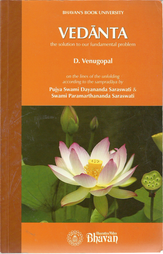
VEDĀNTA the solution to our fundamental problem by D. Venugopal

Part 61 describes what ‘happens’ on becoming a jIvanmukta and the ‘process’ of krama mukti. This part concludes the main presentation. The next post will be a summary of the material.

There is a complete Contents List, to which links are added as each new part appears.

On the Seer and the Seen

  Quoting from the talk of an Advaita teacher on the message of the aitareya Upanishad:

“It is Consciousness that impels us to feel hungry. It is Consciousness that impels the food to let itself be eaten. Consciousness propels us to perceive the world and It commands the world to be seen by us. Our seeing becomes meaningless if there is no world to be seen. The appearance of the world is meaningless if there is none as the seer. Both are impelled in their actions by the One Consciousness.   Continue reading

Advaita – Traditional to Neo

Here is an excellent video from Swami Tadatmananda. It presents a lucid overview of Advaita and then examines briefly how the neo-Vedanta of Vivekenanda and the neo-Advaita stemming from Ramana Maharshi and Sri Poonja have discarded key prakriyA-s and thereby short-changed modern seekers. The video is just under 1 1/4 hours but is well-worth watching – easy on the eye and ear, enjoyable and informative.

Q.468 Roles versus Witness

Q: I have been reading Vedanta for a few years and have a question. We are always playing some form of role such as Employee, Worker, Husband, Son etc. My understanding is that Advaita tells us to let the role do its own work but you remain who you are which is the ‘Absolute witness’.

How do we practice this in our daily life?   It seems difficult to have the same kind of energy when you are in that state.

A: What you are speaking of is karma yoga as preparation for j~nAna yoga. The aim in daily life is to respond appropriately to whatever is in front of you, perform the task with attention and do not be attached to the results. This is all a part of the process of acquiring discrimination, mental discipline and detachment. You need these in order to study Advaita (by listening to a qualified teacher explain the scriptures). It is not the purpose of any of this to acquire ‘good energy’ (whatever that means). Continue reading

Q.467 Clarifying pratibimba

Q: I’ve recently been reading about the reflection theory (pratibimba vAda). I’ve gone through a few articles that explain the theory, but still find the ‘bimba’ aspect confusing. I know it’s the pure original consciousness Brahman but what is its actual location? Is bimba (the original consciousness) located in the body or outside the body?

A: The bimba is Consciousness, with a capital ‘C’ – the non-dual reality. In reality there is only Consciousness; all seeming ‘things’ are just name and form of it. But, for the purposes of ‘explaining’ the empirical reality (vyavahAra), we say that each jIva has a ‘reflection’ of Consciousness in their mind. This is called chidAbhAsa or pratibimba. The ‘bimba’ is not located anywhere. If you like, everything is located in the bimba. Think of ‘space’ and ‘jar space’.

Read the essay and discussions at the site:
https://www.advaita-vision.org/chidabhasa/ and
https://www.advaita-vision.org/continuing-reflections-on-reflections/ and discussion at https://www.advaita-vision.org/discussion-on-chidabhasa/

Q: In your article ChidAbhAsa, you’ve added a passage from Shankara’s Brahma Sutra commentary, where he has said the following: Continue reading

Is a single neuron conscious? A brief discussion.

M. Advaita Vedanta’s perspective is better seen from the top down rather than from the bottom up. Consciousness or awareness can be considered (there is a consensus on this) as a ‘fundamental ‘property’ of (or pointer to) reality’, not reality itself, which is unfathomable and indescribable. It permeates every apparently external phenomenon, which is thus an expression or manifestation of Consciousness. Accordingly, a neuron, an electron, is a manifestation of Consciousness – ‘the One without a second’. Alternately, neurons, atoms, etc. are embedded in Consciousness or reality.

PB. I think the best words you can use to characterize reality are awareness/consciousness, existence/beingness and bliss/love. However, I wouldn’t identify reality with consciousness, the other two concepts, or all three together. They are just the purest manifestations of reality that we can identify. True reality is not a thing or concept, it is beyond definition.

But yes, I would agree that neurons, electrons etc. are phenomena of consciousness, as are these words and the bodies and minds that write them.

M. Metaphysical truth is sometimes called apperception, or direct supramental perception, and it is non-transferable. Nicholas of Cusa put it this way: “The highest wisdom is this, to know… how that which is unattainable may be reached or attained unattainably”. Metaphysics (philosophia prima, or first philosophy of medieval times) is not science, and its truths are often dressed as paradoxes, analogies, and metaphors; they are not meant to convince anyone who is not open to them.

……………………………..

A metaphysical truth appeals to intuition; it is an experience, or knowledge-experience… It is not speculation and is not amenable to subject-object relationship or distinction.

M. (to another participant) Did you look up the word ‘rishi/s’? It means ‘sage’ – Swami Vivekananda described Rishi-s  as Mantra-drashtas or “the seers of thought”. He told— “The truth came to the Rishis of India — the Mantra-drashtâs, the seers of thought — and will come to all Rishis in the future, not to talkers, not to book-swallowers, not to scholars, not to philologists, but to seers of thought.” (From Wikipedia).