
The Ignorance that Isn’t – 2/8

Part 1/8

4.  Ignorance is Indeterminate:

Ignorance is like a gossamer sheath that covers up and conceals our true Knowledge. An analogy may help. Think of a muslin cloth in which a few pieces of asafetida are kept wrapped in. The smell of asafetida lingers on the cloth even after the asafetida is consumed and the cloth is washed. Like the persisting smell on the cloth, impressions from the past experiences get stored in the causal body. Just like the smell of the asafetida that cannot be gotten rid of easily, the clinging impressions on the causal body too are difficult to be eliminated.  These lingering traces of the effects of past actions are called the vAsanA-s. They get expressed as the desires in the mind, and also as the individual’s likes and dislikes, proclivities, etc.

The Yoga system of Patanjali says that the causal body must be controlled so that the machinations of the vAsanA-s could be neutralized.  Shankara advises us that the causal body must be completely annihilated because suppression and control give scope for violent return of the vAsanA-s. He says that it must be completely melted away leaving no trace of the vAsanA-s so that desires do not sprout up in the mind. This process of dissolving the causal body is called pravilApana. Continue reading
The Ignorance that Isn’t – 1/8

1.  Introduction:

We are all familiar with our gross physical body. It is available to our direct perception and it gives us our ID. Vedanta tells us that we are blessed with two more bodies — the subtle body comprising life-force, the mind and the intellect, and a totally imperceptible third body, subtler than the subtle body. It is called the causal body, the source of the other two bodies. Advaita Vedanta avers, as we all know, that what we truly are is Pure Consciousness. Consciousness is our nature. It is the very Self that knows “I AM.” It is not that the Self possesses Consciousness. Self is Consciousness. We are actually none of these bodies.

But for some unknown and indeterminate reason, the Self, instead of being the Subject, the Knower or the Seer, got contaminated. We superimposed the Self with the known and the seen, the objects.  We shifted our ID from being the Self to being a body – mostly as the gross physical body, and sometimes as the subtle body. That is a great fall for the Self – from Self to not-Self because the bodies are insentient (anAtma). The strong association we experience with the three bodies stands as a proof of the apparent fall. The severity of the fall could have been far less had we considered the bodies to be “mine” instead of taking them to be “me,” identifying ourselves with them as “I am my body.” Continue reading

Tattvabodha – Part 11

OLYMPUS DIGITAL CAMERA

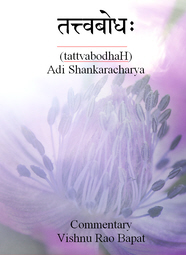
Part 11 of the commentary by Dr. VIshnu Bapat on Shankara’s Tattvabodha.This is a key work which introduces all of the key concepts of Advaita in a systematic manner.

The commentary is based upon those by several other authors, together with the audio lectures of Swami Paramarthananda. It includes word-by-word breakdown of the Sanskrit shloka-s so should be of interest to everyone, from complete beginners to advanced students.

Part 11 looks at the five organs of action and the nature of the causal body.

There is a hyperlinked Contents List, which is updated as each new part is published.