Living In The Moment Eternally – 1

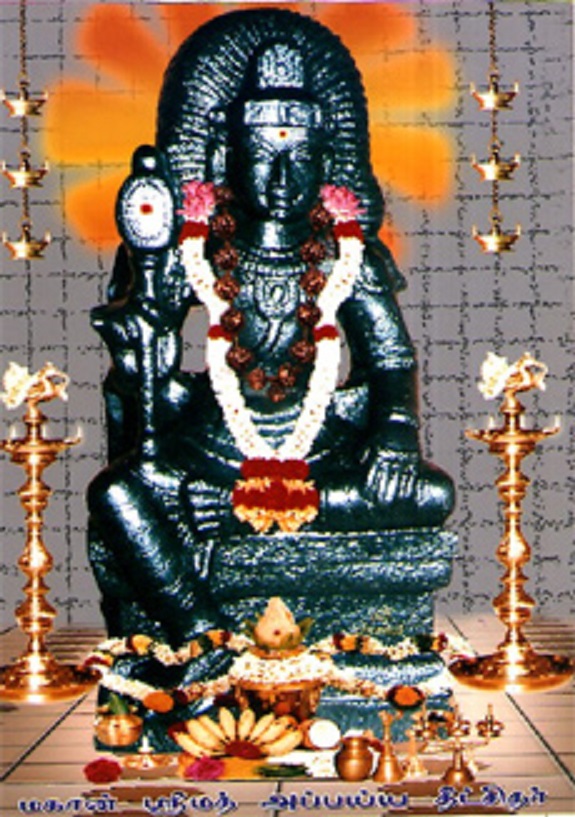
Appayya Dikshitar - (1520-93)

Appayya Dikshitar – (1520-93)

We, the traditional Advaitins, are a prejudicial lot – aren’t we?  Appayya Dikshitar’s words uttered in delirium when his brain was under the influence of the hallucinogenic Datura seeds are for us a beautiful AtmArpaNastuti in praise of Lord Shiva. But the mutterings of some other ordinary mortal with a differently affected brain is mere meaningless chatter unworthy of any notice. Let us not forget that both are actions done under conditions of an altered brain. And in both cases, an external agency is responsible for causing the change in the brain.

It was UG who famously said once that whether it was Beethoven’s 9th Symphony or pulling the chain in the WC sounded the same to him.  Some of the Zen Masters used to respond to the simple questions like “What is the time now?” with an answer that the mountain was running or some such response – totally frivolous and meaningless on the face of it. But their effort was to draw our attention to the way our mind functions in assigning ‘meaning and significance’ (which are actually not there) ever caught up in a habituated pattern which we  normally fail to detect.

Over six years ago, I prepared a comparative statement of the characteristics of an ordinary person and a ‘Self-realized’ man. I used the information  collated from many sources  that I could lay my hands on in preparing this tabulated compilation — almost like what a Purchase Officer does with the quotations (s)he obtains. There were several reasons behind this exercise of mine. Continue reading →

What is the point of enlightenment? – Q.339

Q: I have seen from articles and questions on your website that Brahman cannot ‘know’ or ‘do’ anything; that it (as if) acts and knows only through the body-mind of the jIva. What I would like to know is: why would anyone want to become enlightened if this means the end of rebirth, and ‘becoming’ one with Brahman? OK, this may mean the end of suffering but does it not also mean the end of enjoyment? If ‘I’ (even though this is only a reflection in the mind) cease to exist (when the body-mind finally ceases to exist) on the death of the enlightened person, then there is no more experiencing of any kind for me as that person, and none for the Brahman that I (as it were) become.

 You will perhaps say that, as Brahman, I will still experience through all the other body-minds but this does not sound like enlightenment to me! And don’t I do that already anyway since there is only Brahman? In which case what is the meaning (and point) of enlightenment? Continue reading →

An Assortment of Short Questions

Here are a few short questions, with answers from Dennis, from the as-yet-unpublished backlog:

Q: I am a student of James Swartz.  I was wanting to find a good reference book for learning the terminology of Vedanta in Sanskrit.  James recommended I contact you to ask which one of your books would the most helpful.  If you have time to point me in the right direction it would be much appreciated.  Thank you.

A: That’s an easy one! The best book by far (of which I am aware) is John Grimes’ book. See first entry on http://www.advaita.org.uk/library/i_indian.html (and if you click through to Amazon to buy, you will earn me a small commission!)

 *****

 Q: I am confused about what you mean (in the book ‘Enlightenment: The Path Through the Jungle’) by teachers who teach by Satsang.  I understood Satsang to mean an occasion to gather round a master to imbue his teachings and darshan and that this has been a time honored traditional practice of Saints and Gurus in India. Continue reading →