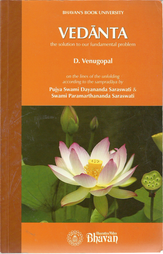
 VEDĀNTA the solution to our fundamental problem by D. Venugopal
Part 5 explains how getting what we think we want does not resolve our perceived limitations.
There is a complete Contents List, to which links are added as each new part appears.

VEDĀNTA the solution to our fundamental problem by D. Venugopal
Part 5 explains how getting what we think we want does not resolve our perceived limitations.
There is a complete Contents List, to which links are added as each new part appears.
The Topic from now until the end of February will be Atman-Atma vichAra, Self-Self-inquiry. All bloggers and visitors are invited to post quotations (indicating source), questions or short essays on this topic.
From: Peregrinus the Nihilist
I finished reading your five-part series on free will yesterday evening, after several sittings over dinner. It was an interesting and informative presentation indeed. The question of free will has occupied my mind for some years now. In fact, one of the things that drew me to Advaita Vedanta was its position on free will — it seems that more than a few of the arguments closely resemble my own.
Reading your case against free will in HOW TO MEET YOURSELF (pages 170-174), I was struck at how similar it was to the one made roughly 80 years ago by the 20th century English scholar Joseph McCabe. I think the passage is worth quoting in full, as you might find it interesting:
“When you say that you are free to choose—say, between the train and the surface car, or between the movies and the theater—you are using rather ambiguous language. All common speech for expressing mental experiences is loose and ambiguous. You have the two alternatives—movies or theater—in your mind. You hover between them. You do not feel any compulsion to choose one or the other. Then you deliberately say to yourself—not realizing that you have thereby proved the spirituality of the soul, which has made apologists perspire for centuries—‘I choose Norma Talmadge.’ Continue reading
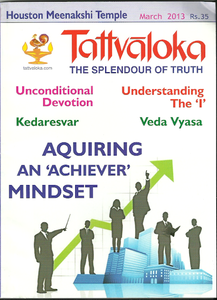
Part 16 of the serialization of the presentation (compiled by R. B. Athreya from the lectures given by Swami Paramarthananda) of upadesha sAhasrI. This is the prakaraNa grantha which is agreed by most experts to have been written by Shankara himself and is an elaborate unfoldment of the essence of Advaita.
Subscribers to Advaita Vision are also offered special rates on the journal and on books published by Tattvaloka. See the full introduction
Q. Dear Dennis,
I bought and read two of your ebooks and liked them so much then I looked at your blog and came across this:
http://advaita-academy.org/blogs/DennisWaite.ashx?Y=2010&M=November
You say objects really exists, Advaita is not idealism, it is realism. I don`t understand this, in your book you use dream metaphor, you use “cinema” metaphor you even said in your book:
“He goes on to explain that our normal states of consciousness – waking, dream and deep sleep – are at the level of appearance. Reality is the non-dual background to these states. Just as our dreams seem real to the dreamer, so this world-appearance seem real to the waker. But, on waking, it is realized that those dreams are nothing but an illusion generated by the mind.
Similarly only on awakening to god-consciousness will you appreciate and realize the staggering truth that there exists nothing other than Brahman everywhere. Until that supreme state is reached, the universe will appear real. Living in your present state of ignorance you will have to accept the world that you experience. But at the same time try to contemplate and realize the truth proclaimed by Self-realized souls that Brahman alone exists.”
So you changed your mind after writing the book and now you say World-appearance is real, Advaita is realism and there is no illusion at all?
I`m confused, can you explain? Continue reading
Q: I’m firmly convinced that nothing outside myself can give lasting fulfillment, I have acquired quite a facility for playing the piano and am still improving that skill, and when I do make an improvement it’s usually after a long period of practice until the next breakthrough ad infinitum, I’m in a fulfilling relationship with my girlfriend and I have a great job at a pharmacy, I’m in good health as well, but beneath it all is this sense it will eventually change and I ask myself is this it? All my needs are met but I still feel incomplete. I have good karma and predominantly sattvic tendencies, so how will I know I’m making progress on my path? Are there certain objective milestones that I will definitely notice and be like ok I’m closer to realizing who I am? You said the mind needs to be receptive and mostly controlled but I just wish there were more specific instructions.
Answers are provided by: Ted, Martin, Sitara, Ramesam, and Dennis.
A (Ted): The way you will know that you are making progress on the path is that your penchant for wanting things – be they tangible objects, money, relationships, power, prestige, achievements, particular physical or psychological states of being, spiritual experiences, or whatever – will diminish.
Vedanta says that all desires fall into four basic categories. The first three are security (artha), pleasure (kama), and virtue (dharma). From the description you offer, it sounds like your life is rife with objective phenomena that fit into all three categories. Your good health and great job offer security, your facility for playing the piano and the fulfilling relationship you enjoy with your girlfriend provide pleasure, and your good karma and predominately sattvic tendencies bespeak a virtuous character. Still, you remain unfulfilled. This, according to Vedanta, is as it should be – or rather as it is – at least for the person who still believes lasting peace and happiness can be had through the acquisition and enjoyment of objects. Continue reading
The immutable consciousness that the witness-self is, being reflected in the mind, and apparently limited by it, appears as the ego, the empirical self, which functions as the percipient.
Methods of Knowledge, Swami Satprakashananda, Advaita Ashrama, 1974. ISBN 81-7505-065-9.Buy from Amazon US, Buy from Amazon UK
The ego cannot be subjugated by one that takes it to be real. It is just like one’s own shadow. Imagine a man who does not know the truth of his shadow. He sees it following him persistently, and wants to get rid of it. He tries to run away from it, but it still follows him. He digs a deep pit and tries to bury it, filling up the pit; but the shadow comes to the top and again follows him. He can get rid of it only by looking away from it, at himself, the original of the shadow. Then the shadow will not worry him. The seekers of Deliverance are like the man in this parable. They fail to see that the ego is but a shadow of the Self. What they have to do is to turn away from it, towards the Self, of which it is the shadow.
Ramana Maharshi, quoted in Maha Yoga or The Upanishadic Lore in the Light of the Teachings of Bhagavan Sri Ramana, K. Lakshmana Sarma, Sri Ramanasramam, 1937. ISBN 978-81-88018-20-8. Buy from Amazon US, Buy from Amazon UK
Q: How do we get the conviction to go on a spiritual quest? Unlike science, there are no indicators to give feedback if this is even the right path. We need to have blind faith in the general idea itself before we venture into it. Can we only do this through negation of the other paths, where apparent validations are possible by material feedback.
A devil’s advocate argument could be to dismiss everything associated with the vedas/upanishads as nonsense, since nothing can be proved. Another way to look at this is to acknowledge that the ancient sages have come up with practices such as yoga and meditation, which sort of proves their intellect and extrapolates on their ability to see things farther than a average person can and thereby have faith in their judgements.
I am not able to articulate my question very well but I hope I got my point across.
Answers are provided by: Ramesam, Dhanya, Ted and Dennis.
A (Ramesam): Man, by his/her very nature, feels incomplete. He seeks fulfillment of what he lacks through effort using his natural or acquired talents. In fact, it is this “lack” that drives his passion for action along the path of the means chosen by him suiting to his comfort-level.
At the most basic level the drives that motivate a man for action are the biological and physiological needs. As described by the Psychologist Maslow, the subtlety of these needs changes from a lower to higher level in the following manner: Continue reading
Once the ego sees that it only seeks what it already knows, that its desires are conditioned and that its true desire is for permanent security and tranquility, it loses its dynamism to find itself in phenomenal things. Then what is behind the desire, the ego, the mind, is revealed. We are left in wonder and all dispersed activity dissolves in this wonderment.
I am, Jean Klein, compiled and edited by Emma Edwards, Non-Duality Press, 2006. ISBN 978-0-9551762-7-2. Buy from Amazon US, Buy from Amazon UK