Neo-Advaita versus Traditional Vedanta

A highly subjective view

By Tan

Introduction

I was on the “spiritual quest” for more than 12 years after success in the material world did not keep its advertised promise of lasting happiness. I started my quest with Greek Philosophy, Krishnamurti, Taoism, Zen, Neurological Science and Physical Science and had read more books and attended more “satsangs” than I can mention without being thoroughly embarrassed. The quest led me in the final stages to “Neo-Advaita” and then in the end to Vedanta. I had spent the considerable amount of 3 -4  years in meetings – with so-called “Neo-Advaita“ teachers such as Tony Parsons, Karl Renz and only very recently had developed an interest in traditional Vedanta teaching. There I had spent some short time with the books of Dennis Waite whose friendly input had led me to Swami Dayananda, Swami Chinmayananda and in the end to James Swartz. I have no profound knowledge of Vedanta teaching methods nor an encompassing view of Vedanta, but can only report the impact of Vedanta once revealed by a true teacher such as James Swartz. Continue reading

Dennis: Free Will (Part 3)

Go to Part 2

The metaphor of the motor boat crossing a fast-flowing river was used by Swami Chinmayananda. The current represents karma or destiny, as dictated by our prArabdha saMskAra; the power of the motor represents our own self-effort or free will. If the current is strong and our will is weak, we will be unable to overcome its force. If we are able to exert powerful self-effort (puruShArtha), we may overcome the force of habit and forge a new path.

Advaita tells us that who-we-really-are does not act in any case. For there to be action, there would have to be (at least) two things. But, empirically, we the witness see the body (which is only matter) performing actions. We identify with this and think that ‘I am acting’. The Bhagavad Gita (III.27) says: “The guNa-s of prakRRiti perform all karma. With the understanding clouded by egotism, man thinks ‘I am the doer’.” Continue reading

Advaita – neo, traditional… and music!

Here at Advaita Vision, we are aiming to bring you the very best of both traditional teaching and modern Western approaches. We acknowledge that the traditional route has a proven track record of over a thousand years, with many of the stories and metaphors working just as well now as they did then (think of ropes and snakes, wave and water). And yet it is also true that many modern seekers are not yet willing to make the effort to look into the scriptures or find a teacher capable of unfolding them. Satsang and neo teachers speak to them directly of the truth, rather than leading them by the hand along the well-worn paths which, though they will reach the destination, appear to take a lot longer!

The method of teaching is like the pole used to vault over the high bar. Whether we use an old wooden pole or a carbon fibre one, we have to discard it before we can cross over.

So the aims are the same and there is an opportunity for some integration! Traditionalists need to speak more directly to the modern seeker, perhaps distilling the wisdom of the scriptures and representing it in a more modern format, shorn of references to concepts which are alien to today’s society. And the neos need to acknowledge that the old approach cannot be all wrong – else how can it have survived for so long, and how can it have led so many to enlightenment?

A useful metaphor for this can be found in the Indian fusion group ‘Advaita’ – eclectic in music in the same way as this site is eclectic in teaching. They are aiming to marry Hindustani classical music from India’s traditional roots with modern Western rock – and they seem to be doing it very well indeed!

non-duality magazine

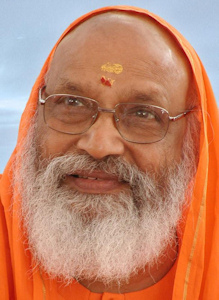
SWAMI DAYANANDA SARASWATI

Interview with non duality magazine

Swami Dayananda Saraswati

Swami Dayananda Saraswati is a contemporary teacher of Vedanta and a scholar in Sanskrit in the tradition of Śankara. Swamiji has been teaching Vedanta in India for more than five decades and around the world since 1976. His deep scholarship and assimilation of Vedanta combined with a subtle appreciation of contemporary problems make him that rare teacher who can reach both traditional and modern students.

A teacher of teachers, Swami Dayananda taught six resident in-depth Vedanta courses, each spanning 30 to 36 months. Four of them were conducted in India and two in the United States. Each course graduated about 60 qualified teachers, who are now teaching throughout India and abroad. Under his guidance, various centers for teaching of Vedanta have been founded around the world; among these, there are three primary centers in India at Rishikesh, Coimbatore, Nagpur and one in the U.S. at Saylorsburg, Pennsylvania. There are more than one hundred centers in India and abroad that carry on the same tradition of Vedantic teaching.

In addition to teaching, Swami Dayananda has initiated and supported various humanitarian efforts for the last forty-five years. The most far-reaching of these is the establishment of All India Movement for Seva in 2000. Awarded consultative status with ECOSOC (Economic and Social Council) by the United Nations in 2005, this organization is devoted to serving people in the remote areas of India, mainly in the field of Education and Health Care.

Swami Dayananda Saraswati has also promoted several international events and participated as a speaker in several global forums, among which are: the United Nations gathering of NGO’s, the UNESCO Seoul Global Convention, the United Nations 50th Anniversary Celebration, the Millennium World Peace Summit, the International Congress for the Preservation of Religious Diversity, the Conference on the Preservation of Sacred Sites, the World Council for Preservation of Religious Diversity, the Youth Peace Summit, the Global Peace Initiative of Women Religious and Spiritual Leaders, a Hindu-Christian dialogue with the World Council of Churches, and the Hindu-Jewish Leadership Summit

Read the interview at non-duality magazine.

Spiritual Progress (Q. 305)

Q: What are some indicators of progress on the spiritual journey? Is witnessing consciousness an indicator of progress? (Oct. 2010)

A: Most people actually don’t go along with the idea of ‘gradual’ progress. The enlightenment ‘event’ if you like (akhaNDAkAra vRRitti) is rather a catastrophic reorientation of the mind (in the mathematical sense of course, rather than the emotive!)

The progress indicators are rather in terms of mental preparation, as in sAdhana chatuShTaya sampatti. We notice that we are less prone to emotional disturbance, avoid emotional reactions, see issues more clearly and make right decisions without selfish motive and so on. And maybe we have increasingly frequent glimpses of the unity and increasing conviction of the truth of the teaching. If, by ‘witnessing consciousness’ you mean seeing what is going on around you with a dispassionate eye, yes – that, too.

How did ‘I’ come to deceive itself? (Q. 304)

Q: How did ‘I’, the all knowing, all loving, all powerful, the absolute & infinite blissful ONE, without a second, come to deceive itself, and place itself in this illusion of illusions? How or why did the Ultimate Reality have this come to pass? (Sept 2010)

A: The spirit of your question is unanswerable – it is effectively asking why there is Self-ignorance and this is said to be anirvachanIya – inexplicable. From the standpoint of absolute reality, of course, there is no deception because there is no creation; and there is no illusion because there are no persons to be deluded. There is only brahmansatyam j~nAnam anantam as the taittirIya upaniShad says, limitless consciousness. It is only from the perspective of this apparently limited entity, the mind of the person, that there seems to be a problem. Once the truth is realized, it is also seen that there is no problem because everything is brahmansarvaM khalvidam brahma.

Dennis: Free Will (Part 2)

sun on grassGo to Part 1

There are several Sanskrit words that carry the sense of free will but, if we look at these a little more closely, a pattern quickly emerges.

 A voluntary action, ‘acting of one’s own free will’ is kAmakAra. The kAra part is the ‘doing’ and kAma means ‘wish, desire, longing’. Even more specifically, sakAma – ‘acting of one’s own accord or free will’ –literally means ‘with desire’. svachChanda is another variant: sva means ‘one’s own’ and Chanda means ‘pleasure, delight, appetite’. svatantra indicates ‘independence’ or ‘self dependence’. saMkalpa means ‘will’ or ‘volition’ in general and yatna is an ‘activity of will or volition’. Possibly the closest in meaning is svechChA. which means ‘one’s own wish or will, free will’; svechChAra means ‘acting as one like, doing what is right in one’s own eyes’. But here again, breaking up the word svechChA gives us sva ichChA – ‘one’s own wish, desire or inclination’. Basically, what the scriptures seem to tell us is that having ‘free will’ means acting in accordance with our own wishes or desires.

 Whether or not our own desire influences an action or not is how Aristotle differentiates actions. If the cause of an action is external and we do not contribute anything to it, then it is ‘involuntary’. If the action is triggered by our personal desire or after appropriate deliberation about whether or not to act, then it is voluntary.

Continue reading

Dennis: Free Will (Part 1)

“Men believe themselves to be free, because they are conscious of their own actions and are ignorant of the causes by which they are determined.” (Spinoza. Ethics III)

The topic of free will is one which seems always to stimulate lots of discussion and some strongly held views. It occurred to me the other day that maybe this is because it is crucial to the sense of my ‘self’ as a separate entity. It is very important to ‘me’ that I should have the power of choice. If this is not the case, it somehow demeans who-I-feel-myself-to-be, relegating me to the level of an animal, forever bound by its inherited nature. It would mean that I am at the mercy of whatever chance events occur around me, reacting to them in an automatic, programmed manner, little better than a robot. Continue reading

Dennis: Welcome to Advaita Vision!

Advaita Vision is the new title of www.advaita.org.uk, which is currently being redesigned and overhauled. It is also, via the URL www.advaita-vision.org, the specific link to the Blog section of the site. You can reach it either by entering the link name in your browser, or by clicking on ‘Blog’ in the top menu bar at the main site. (N.B. This latter route will initially only work from the Home Page!)

I am joined in this endeavor by the following, who will be helping with aspects of the site and also providing regular blogs:

Peter Bonnici
Sitara
Dhanya

All have previously submitted material to the site and were, until November of last year blogging for Advaita Academy. Peter and I were also trustees for Advaita Academy but have now left so that we can devote all our efforts to this new venture.

More, general information will be provided here over the next few weeks but for now – enjoy the blogs!

For my own submissions, I will be beginning with a series drawn from the ‘akhaNDAkAra Newsletter’ which I produced 2 – 3 years ago. This was for a fairly restricted circulation so that most will not have read them. It also gives me the opportunity to provide some quality posts without having to do any work! (Or rather, it will enable me to devote my efforts to reworking the site. The first set is on the topic of Free Will, a perennial favorite!