‘adhyAropa’ to ‘adhiSThAna’ – 1/4

    राजविद्या राजगुह्यं पवित्रमिदमुत्तमम् 
प्रत्यक्षावगमं धर्म्यं सुसुखं कर्तुमव्ययम्   — 9.2, BG.

[This is the Sovereign Knowledge, the Sovereign Profundity, the best sanctifier; directly realizable, righteous, very easy to practice and imperishable.]

What is this world that is available for our experience?

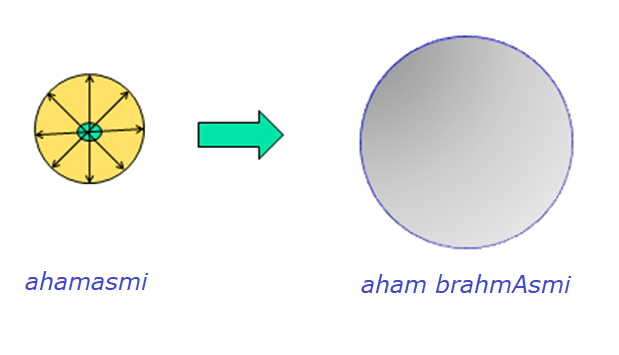
“The world is a ‘superimposition’ (adhyAropa). In other words, it merely appears to be present but does not really exist. It is like ‘casting forward’ a non-existing or unreal “form” (objects) onto the Eternal, Immutable and Real ‘Substratum’ (adhisThAna) or the Supreme Self,” avers the Advaita Vedanta. Because of our inherent inability to know what “exactly” is out there, our intellect ‘confabulates’ what could be present out there and ‘externalizes’ the internally imagined ‘form’ as a projection.

Shankara in his introduction to the Vedanta aphorisms (sUtra-s) explains to us that this ‘superimposition’ is natural (naisargika) to us – i.e., it exists from our birth itself. Left to itself uninvestigated, adhyAsa seems to have no locatable or known beginning-point (hence, anAdi); nor an end-point (hence, ananta).

No meaningful answer can be given to a question like “What is north of North Pole?” Similarly, a point of ‘beginning’ cannot be indicated for something which is outside of our familiar time-space dimensionality. “anAdi” also implies that it lies beyond our time-space framework. As a result, we find ourselves inexorably caught up in its snares and suffer the consequences as helpless victims trapped within the jaws of a mighty ‘diaphanous power.’

A superimposition or a projection is, however, an ‘action.’ There cannot be an ‘action’ without an ‘agent’ who does the act.

If I am just a ‘victim’ and not the doer of this projection, who is the ‘agent’ that does the ‘superimposition’? Continue reading

Ignorance Goes, but mAyA remains – Revisited

Ask any teacher of Non-duality the question “Why we see a multiplicity of objects instead of Oneness in the world?,” pat comes back the reply that “It is all due to mAyA, an inexplicable and indefinable power of the Creator God, Ishwara. mAyA is so much reified and deified in some texts that they present it almost as a given “fact.” They romanticize mAyA; sing paeans in lilting poetry as a Divine Goddess vested with special powers – that of concealment of the Truth and projection of an unreal world filled with variegated objects (e.g. 110-111, vivekacUDAmani).

But Gaudapada in his kArikA-s on mANDUkya and Shankara in his commentary on them regard mAyA to be no more than an explanatory artifact. Gaudapada mentions ‘mAyA‘ in the sense of a magic-show in the last chapter of his kArikA-s. For example: Continue reading

The World and the One ‘brahman’

mANDUkya Upanishad’ mantra 7 tells us that anything that is sensed, perceived, experienced or even thought about or conceptualized is not brahman. Consequently, Sages admit that “Advaita philosophy is incommunicable” (7, mANDUkya); “We do not know how to teach Advaita,” (1.3, kena). But at the same time, the Upanishadkars exhort us that “You should know It.”

Shankara too urges us in the Gita bhAShya (Ch 6, 9, 15.3, BGB;) and also at kaTha bhAShya that we should make every effort to attain the Knowledge of the Self in this life itself because “here alone it is possible to have a vision of the Self as clearly as (seeing) the face in a mirror, whereas this is not possible in other worlds apart from that of brahmA, which, however, is difficult to attain” (2.6.4, kaTha UB).

Hence, the teaching of Advaita philosophy is done adopting an apophatic approach, via negativa. It is the famous “na ( = not) (stated) iti ( = thus); not (stated) thus; na ( = not) (stated) iti ( = thus),” or netineti (2.3.6, BU); thus denying anything said about the Self is NOT It! Continue reading

Shankara Answers Beginner’s Questions

Shankara bhagavat pAda, a committed and earnest Commentator (bhAShyakAra) that he was, rarely, if at all, deviates from the immediate text on which he was making his explanatory observations. Fortunately for us, he relaxes, with compassion, his own self-imposed constraints of being a strict commentator and provides a detailed exposition on the subject matter occasionally. One of such instances is his 27-page long commentary at 2.1.20, brihadAraNyaka Upanishad (BUB). It comes before taking up the dense and meaty philosophical discussions on “the Highest Wisdom of Vedanta” beginning at the Fourth section, called Maitreyi brahmaNa. He provides answers to many typical questions that some one new to Advaita philosophy is likely to ask. I trust Shanakara’s replies help satiate the curiosity of the novice. We shall recapitulate below some of the questions and Shankara’s answers thereon. Continue reading

Equivalences in Advaita:

There are many equivalences that shruti and Shankara bhAShya there on teach us in order to make it easy for us to understand and appreciate the nuances of the Advaita doctrine. Crowning them all is, of course, the well-known equation Atman = brahman. The other equations being not so popular, we tend to forget them and draw some invalid inferences to claim that a sthitaprajna is gauNa compared to a jnAni; one can have dualist perception, though one is brahman and so on. Therefore, I present a few of the important equivalences we find in Advaita shruti and bhAShya and request the readers to add on to the list here.

i) Atman = brahman

[shruti and bhAShya support (SBS): Continue reading

“sadyomukti” (Instant Liberation) – 1/3:

What Shri Shanakara bhagavat pAda exhorts us in his commentary at the kaTha Upanishad, IMHO, is that we should try to “realize” the Self right in this life and not defer it to a later time because it involves a much more arduous effort to attain liberation with a stopover in some other loka (which involves continuing in the subtle body (or an AtivAhika sharIra)) after the gross body is dead. For example, Shankara writes:

तस्माच्छरीरविस्रंसनात्प्रागात्मावबोधाय यत्न आस्थेयः यस्मादिहैवात्मनो दर्शनमादर्शस्थस्येव मुखस्य स्पष्टमुपपद्यते, न लोकान्तरेषु ब्रह्मलोकादन्यत्र । स च दुष्प्रापः ॥ — 2.6.4, kaTha bhAShya Continue reading

Free Will and Choice in the Dualistic World

S&T is a creature of S and T!
In the absence of S and T, S&T gets asphyxiated; S&T doesn’t survive.

Perhaps, you have already guessed S&T stands for Science and Technology; S and T are Space and Time.

Science and Scientists work where Space, Time and Substance (material) exist out there facilitating an observation. Their entire edifice is based on causal relatonships – a prior cause, p1, giving raise to an effect, p2, over a time interval. The mAdhyamika Buddhist philosophy also is based on this principle. A given effect in the present is said to result from summation of all the antecedent causes. The cause-effect relationship invokes “Mind space,” when there is no tangible physical space present,

But what happens if Space and Time are merely “unreal or imaginary”? Can causal relationships exist without a mind? Continue reading

Who is a ‘tattvadarshI’?

The final goal of all the seekers on the Advaitic path is the realization of the nameless formless and featureless “tat” (That), “like It really is,” free from the distortions and aberrations introduced by the perceptual apparatus (the normal ‘vision’) we are accustomed to in our day-to-day life. Many a seeker, though very endowed, intelligent and well-read in scriptures, often finds it difficult to discern between one’s own true intuitive grasp of the Ultimate Advaitic Truth and mere intellectual decipherment of the verbal content of the teaching. Bhagavad-Gita highlights this fact eminently when it says:

मनुष्याणां सहस्रेषु कश्चिद्यतति सिद्धये ।
यततामपि सिद्धानां कश्चिन्मां वेत्ति तत्त्वतः ॥
— 7.3, BG.

Meaning: Among thousands of men, one perchance strives for Perfection; even among those who strive and are perfect, only one perchance knows “me” (i.e. Pure Consciousness) in “true essence” ( तत्त्वतः ).

Shankara explains the meaning of the word ( तत्त्वतः ) as “like It Is” ( यथावत् ) i.e. in Reality, in Its essence. Continue reading

Supreme Consummation of Self-knowledge (in Summary)

[This Article, “The Supreme Consummation of Self-knowledge (in Summary)” is about the aspect of “How To” attain the unbroken abidance in/as the Self by a mature and ready seeker. It is (mainly) based on Shankara’s explanation at 18.50, BGB.]

Q: Of what nature is the Self-knowledge?

A: Of the same nature as the Self.
(In other words, Self and Self-knowledge are one and the same).

Q: Of what nature is the Self ?

A: Of the (same) nature as described by Lord Krishna (in the Bhagavad-Gita) and (also) as mentioned in the Upanishads.

Q: But the Upanishads say that the Supreme Self is formless and featureless. For example, 

अरूपम् (formless)  — 1.3.15, kaTha Upanishad. 

Further, it is also said that the Self is not an ‘object’ that is available for perception:

न सन्दृशे तिष्ठति रूपमस्य न चक्षुषा पश्यति कश्चनैनम् (His form does not exist within the range of vision; nobody sees Him with the eye)  – 4.20, Shwetaswatara; 2.3.9, kaTha.

In addition, the Self is,

अशब्दमस्पर्शम् (soundless, not touchable)  –  1.3.15, kaTha.

The Self and the cognition (*) there of being formless and intangible, how can there be constant consummation on the Self? Continue reading

World, The Only Hospital

Swedish Health | P2S Inc.The entire world is like a huge Hospital!

We get admitted into it when we are afflicted by the “Disease” called “ajnAna” (i.e. ignorance of Knowing what we are in truth – disembodied brahman). This disease manifests with many symptoms – unique to each patient. There is no other place in the whole Universe where one can work to rid oneself from his/her disease. 

There are many specialists, doctors, nurses, ward boys and so on to help the patients to administer a medicinal antidote suitable for each so that they may get rid of their disease. But each patient has to take his/her medicine. Just looking at others or listening to the talks of their caregivers and wishes of their well-wishers will not work, however beautiful may be the doctors or however enthralling their words and blessings may be. Howsoever superhuman a patient may imagine the caregivers to be, they are still a part of the Hospital only.

After all, none has really lost his/her health! Everyone is eternally Healthy (swasthata). But that health got “infected.” None need to acquire “Health.” Each patient just has to lose ‘the infection.’ His/her normal health will automatically be back and s/he gets discharged (liberated) from the Hospital. One cannot cleverly manipulate a discharge, for, one surely comes back to the Hospital with a more severe relapse of the disease!

Be Healthy Ever. 

[guru pUrNima day – 07/03/2023]