QUESTIONS NOT RAISED OR ANSWERED – Part 1

[Here are three questions that I did not come across a seeker raising them. Nor did I find any teacher discussing directly those specific issues and answering them in a logical way. Maybe my literature search is incomplete, I admit. Before I go on to provide my replies to these questions, I will very much appreciate to know the reactions / thoughts of the interested / knowledgeable readers – ramesam.]

The Questions:

A.  Bhagavad-Gita related: Continue reading

Sankara Bhashyas vs. Prakarana Granthas – A View

My studies of Advaita, the ancient wisdom of Oneness without a second, began with the small precise Monographs that teach its core philosophical essence without making us feel Advaita to be a remote inaccessible concept.  The Monographs (called Prakarana Granthas) are usually written in simple Sanskrit words without complex or compound sentences pointing the seeker directly to the Ultimate Reality. Some of them contain excellent metaphors “for easy comprehension” of the abstruse and abstract teachings, some others provide tools for one’s own analysis of one’s experience and yet others provide a step by step guidance on the path of Knowledge holding the hand of the seeker gently and with compassion.

Continue reading

ANESTHESIA, DEEP SLEEP, DEATH AND CONSCIOUSNESS – Part 3/3

[Part 1/3         Part 2/3]

To eff the ineffable:

We travelled the depths of Non-duality in Part 2/3.

As Jeff would put it, “I am realized, you are not” is a silly game. There’s no one – none – that’s not Brahman. You are already realized! So relax.

And let’s know what the brainy brain-scientists say consciousness is.

What consciousness is and how the brain produces it (if it does), is still one of the great challenges to science. Until a few decades ago, science was averse to dabble into this subject for lack of adequate investigative tools (both conceptual and instrumental). “Today consciousness research has become a passion for many scientists.”

But what is consciousness? It’s like asking what life is or what energy is. You know it when you see it. We say that “a brain that is fully awake and constructing experiences is fully conscious.” The thalamus, a sort of hub located deep in the brain for information flows from the senses to the upper reaches of the brain is crucial for consciousness. A person turns into a vegetative state if the thalamus is damaged or the information flows are inhibited. This does not mean that thalamus produces consciousness; it may just show that one is conscious – much like a thermometer which doesn’t actually make the heat, but tells you how hot it is.

Dr.Giulio Tononi of the University of Wisconsin–Madison and his colleagues are studying
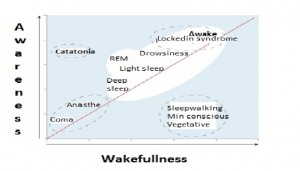
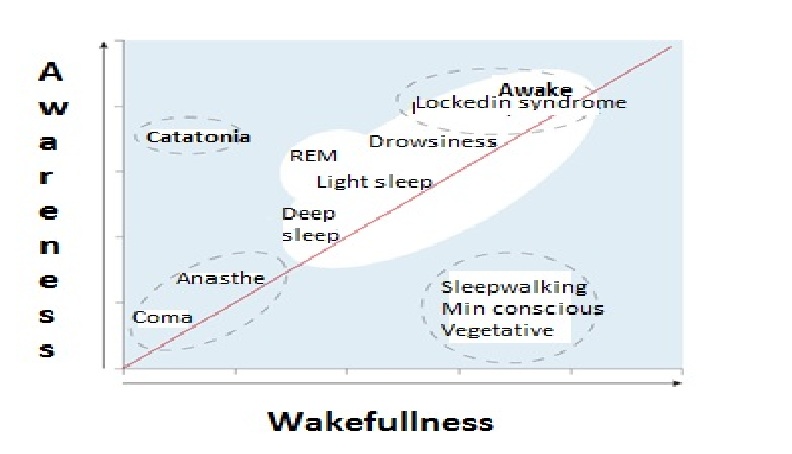
States of consciousness (After L. Saunders, 2012)

brains that are deeply asleep, under anesthesia or in comas to understand consciousness. As shown in the figure at the right, “awareness typically tracks with wakefulness — especially in normal states of consciousness. People in coma or under general anesthesia score low on both measures, appearing asleep with no signs of awareness. Sometimes, wakefulness and awareness become uncoupled, Continue reading

ANESTHESIA, DEEP SLEEP, DEATH AND CONSCIOUSNESS – Part 2/3

[Part 1/3      Part 3/3]

Before going into a consideration of Deep Sleep, once again a small detour.

Dennis raised in an e-mail the question of Sleepwalking. Where would it fit in the Model?

Some people amble around in sleep and even hurt themselves.  A few persons could commit heinous crimes in the state of somnambulism.  A well-known case is that of Kenneth Park in 1987 when he strangulated his father-in-law and killed his mother-in-law. However, he was let out by the court on the ground that he was sleepwalking when he harmed and killed people.  A similar case of acquittal also occurred in 1846. Apparently the body of the sleepwalkers is active but the mind seems to be asleep.

Neuroscientifically speaking, in the case of sleepwalking, the motor cortex of the brain is functional whereas the frontal lobe vested with executive functions is at rest. This means that a part of the mind (that propels the body to act) is active while the part responsible for reasoning and self-control is asleep. Continue reading

What is Moksha and what does Science say?

[A few friends asked me about Moksha to be explained in simple words without any mystifying scriptural references, quotations and citations. This is what I wrote to them.

The points are made accordingly with no hyperbole, no mystique but merely as barebones facts without any frills – bibliographic references, supporting evidence etc. for the sake of brevity. I thought of sharing it here so that it can be corrected / sharpened in expression and  improved in an overall way. ]

1. Moksha:

There is nothing mysterious about it. It goads the spirit of inquiry in us.

Our ancients’ inquiry was on:

i) Who am I? and ii) What is this world around?

Continue reading

ANESTHESIA, DEEP SLEEP, DEATH AND CONSCIOUSNESS – Part 1/3

Recently there was an interesting question about the disappearance of ‘me’ when a patient is administered anesthesia in preparation for a major surgery.  It is quite intriguing where the missing ‘self’ has gone and when under anesthesia (Q. 313).

Peter, Sitara and Dennis answered the question very ably explaining the Vedantic philosophy behind the various states of consciousness (as we usually understand the term).  The false concept of the sense of a separate ‘self’ we think we possess and the reality of an eternal Self; the misunderstanding that arises if we take the word Consciousness to mean the same in psychology (& medicine) and Advaita;  the possible existence of multiple ‘minds’ which derive their illumination from an unchanging, everlasting, self-effulgent One Brahman were dealt with by them. Hardly can anything be added to their clear exposition made from the stance of Non-duality beyond saying a word of our appreciation and gratefulness to them.

I would like to use this opportunity, if I may, to bring to the notice of a wider audience an approach I developed in 2004 relating the state of our alertness to our body-mind system in order to understand who we really are. We shall also in the process examine what are Deep Sleep and Death and what is the condition of the brain under different states, including awake, dream, deep sleep, death, coma, anesthesia etc.

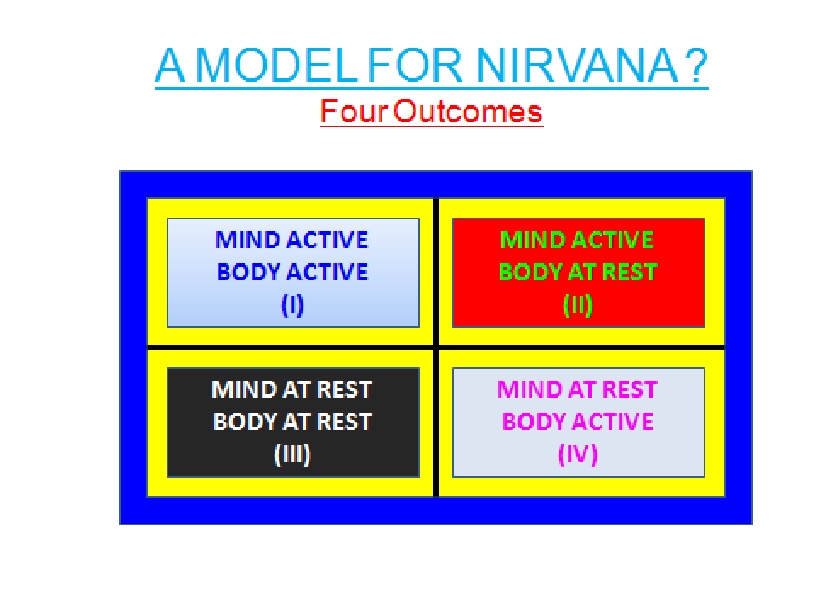
Let me call this as “A Model for Nirvana.”

Four Outcomes

Four Outcomes


Continue reading

Pleasure of Sex vs. Bliss of Self in Brain Scans

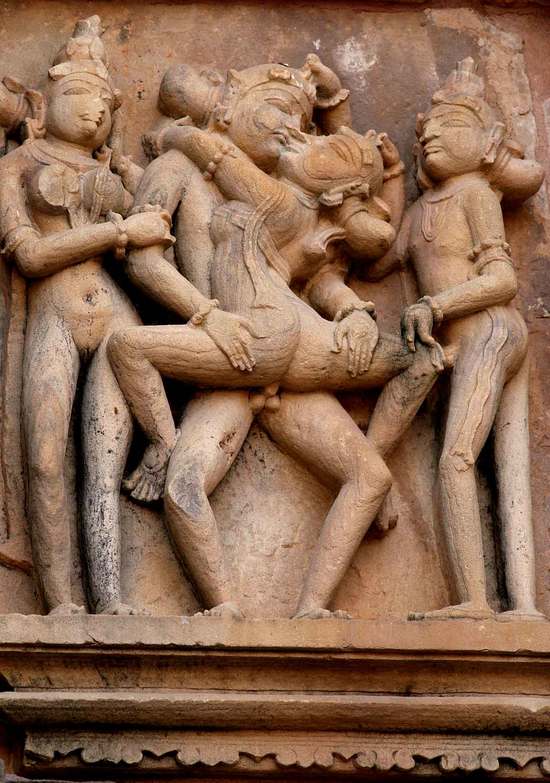
Khajuraho Temple Sculpture – 10th – 12th Century

Khajuraho and Kamasutra fire the fancy of any foreign tourist to India.  Add Spirituality and the heady mix becomes a killer app for seekers of quick-fix salvation for paying a visit to India!  Biologically sex evolved as a reproductive mechanism to possibly capture the advantageous heritable genetic traits from a partner.  Only humans and a few animals like bonobos and dolphins indulge in recreational sex.  Sex is closely tied to sensory perceptions and lies within the realms of the mind. Salvation transcends both senses and mind. “Rajneesh, the ‘horse’s mouth’ concerning the topic of enlightenment for Westerners for many years,” regrets James Swartz, “wedded two largely incompatible concepts, sense enjoyment and enlightenment.” One may lose ‘self identity’ and get enwrapped in an inexplicable joy in either of them as Brihadaranyaka Upanishad says. But the bliss of enlightenment and the pleasure of sensual gratification are totally different. Our brains can show it all very clearly!

Human brain is a mass of interlinked neurons piled up in three layers. At the bottom is the most primitive brain common to all animals. Continue reading

Where lies the “Person” of our personality?

A queer accident happened about four years ago in 2008.

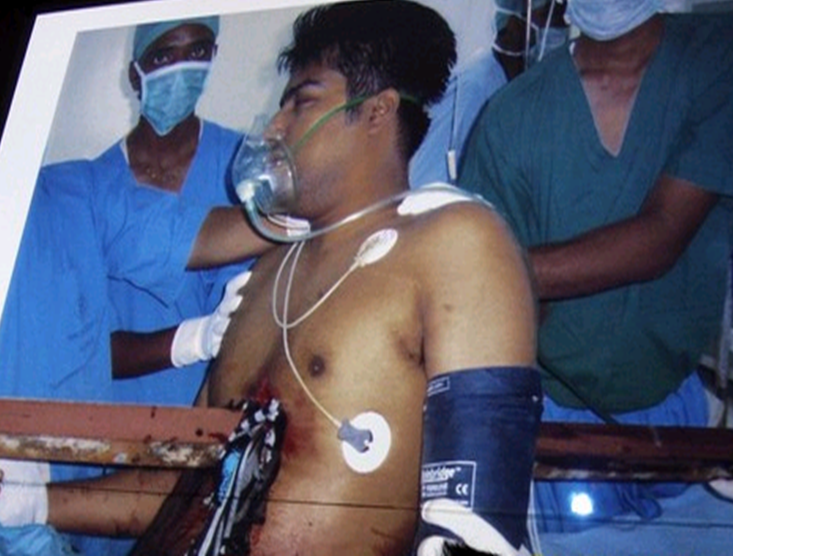
A long iron rod pierced through the chest of a 25 year old young man in a driving mishap.  Fortunately, the person had access to one of the top hospitals in New Delhi, India. Thanks to the developments in the surgical techniques, he survived the accident, was out of the hospital in a couple of weeks with a sound body and mind. He was Mr. S. Dutta, a software engineer. Neither his expertise nor his personality was affected by the accident. He retained his memories, his knowledge and skills and his temperament also did not change. In effect he continued to be the same person as before the gruesome accident.

S. Dutta, 18 July 2008

Wind backward 160 years. Continue reading

Mind Reifies Or Deifies

Mind occupies a significant place in the teaching of Vedanta philosophy.

All the talk of liberation pertains to the mind only.  Maîtri Upanishad (VI-34-11) holds mind to be central for the liberation or bondage of human beings.  amRitabindu Upanishad (mantra 2) makes it further clear stating that “the mind engrossed in objects of senses leads to bondage but the same mind free from attachment to objects leads to liberation.”

But what is this mind?

Continue reading

The Hole in The Whole

There is no Whole without a ‘h-o-l-e’ in it.
There is no hole without the whole around it.

The whole never contracted to become the hole.
The hole cannot expand to become the whole.

Pain is our struggle to keep up the identity
And the separateness of a “me”
That struggle for the survival by a “me”
Has been going on for millennia.
That story is the Theory of Evolution.

Suffering is our effort to become
Back again One Whole
Seeking for integration
Propels us for Self-inquiry.
That story is the Theory of Liberation.

The whole and the hole together simply “are.”
That is Oneness. So just Be.

That “Beingness” itself is Meditation.