A Unique Form of OCD

One of the great ironies of life in a world that is almost wholly preoccupied with the profit margin of any business transacted within its context – which in more personal terms equates with the degree of personal happiness that is the intended product of any action that one performs – is the fact that most people squander the greatest natural resource at their disposal for procuring the bounty of contentment they seek.


Duped by maya and suffering an innate condition of ignorance, the vast majority of people remain so preoccupied with the alluring objects calling for their attention in the surrounding world that they fail to realize that they themselves – i.e. the quality and texture of their own mind – are the source of the peace and happiness they experience through their acquisition of items, accomplishment of ends, and/or achievement of ambitions.  They fail to see that it is not the objects themselves they desire, but rather the sense of fulfillment they feel so sure these objects will afford them.  Instead of reveling in the joy that is their inherent nature as the limitless self, they dissipate their inner tranquility by training their attention upon objects – both subtle and gross – that they believe are the founts of satisfaction.


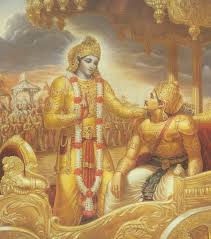
However, as Lord Krishna, speaking as the self, says in the Bhagavad Gita, “Fixing your mind on me, you shall pass over all difficulties, through my grace; but if, through egoism, you will not listen, then you shall perish” (18.58).  Rather than an ultimatum issued by a jealous god, this assertion is simply an appeal to practicality.  As long as the mind is distracted by objective phenomena it will be incapable of discerning the true nature of reality and remain unable to discriminate between the real and the apparent, the self and the not self, that which is inherently limitless, free, content, and blissful and that which is inherently limited, bound, agitated, and to a greater or lesser degree anguished.


Therefore, if such discrimination – i.e. atma-anatma-viveka – is the heart of self-inquiry, we might say that attention – and more precisely the ability to turn one’s attention “inward” and train it on the self – is its backbone.  It is no arbitrary coincidence that samadhana, the ability to sustain concentration on a given topic for a long period of time, is one of the fundamental qualifications for a seeker of self-knowledge.  Focused attention is indeed the foundation of all three aspects of the process of self-inquiry – i.e. hearing (shravana), reflection (manana), and meditation (nididhyasana) – that leads to the assimilation of self-knowledge and ultimate inner freedom (moksha).  It requires a mind with a unique form of OCD – a mind whose attention is characterized by the qualities of openness, critical thinking, and determination.

Continue reading

Attention – ad tendere

The word “Attention” is derived from two Latin words, ad tendere, meaning “to stretch towards.”

Rupert Spira explains very clearly how attention turning towards itself is the ending of the mind.

1.  Attention Falling Back to its Source (From Rupert at Parmoor in Dec 2013) – 8:35 min:  http://www.youtube.com/watch?v=JJzIz31rt4I

2.  Attention and Awareness (From Rupert at Santa Sabina in Oct 2013) – 8:38 min:  http://non-duality.rupertspira.com/watch/attention-and-awareness

3.  The Sinking of Attention into Itself (From Rupert at Santa Sabina in Feb 2014) – 13:07 min:  http://non-duality.rupertspira.com/watch/the-sinking-of-attention-into-itself

4.  Attention is Awareness Plus an Object (From Rupert at Mercy Center, CA in Apr 2013) – 14:53 min:  http://non-duality.rupertspira.com/watch/attention-is-awareness-plus-an-object

The message in these Videos is beautifully crystal clear and truly meditational, I submit.

Attention and Inattention

1.   “At any given time, a massive flow of sensory stimulation reaches our senses, but our conscious mind seems to gain access to only a very small amount of it.  … …… Conscious access is, at once, extraordinarily open and inordinately selective. Its potential repertoire is vast. At any given moment, with a switch of my attention, I can become conscious of a color, a scent, a sound, a lost memory, a feeling, a strategy, an error – or even the multiple meanings of the word consciousness.” — p: 20.

2.   “Out of countless potential thoughts, what reaches our conscious mind is la crème de la crème, the outcome of the very complex sieve that we call attention. — p:21.

3.    “[I]nattention can make virtually any object vanish from our consciousness. As such, it provides an essential tool for contrasting conscious and unconscious perception.” — p: 37

From: Consciousness and the Brain – Deciphering How the Brain Codes Our Thoughts by Stanislas Dehaene, Viking, 2014, pp: 333 ISBN 978-0-670-02543-5

You may watch this 1:54 min YouTube video (thanks to the London Transport Dept.) to know how attentive you are: http://www.youtube.com/watch?v=ubNF9QNEQLA

Attention – In the present

Quote

Attention surely is timeless. If I am listening, I am all there. Being totally in the present, I am not thinking ‘about’. That may come afterwards. But in the moment of giving attention, listening, I am there, in the present; I am Presence itself. I am not in time; the past plays no part whatsoever in giving attention, in being aware, nor does speculation on the future. If I have even the least expectation (as desire or fear), I am not fully attentive but indulge myself within the realm of thought. I am indeed totally fulfilled in the moment. What prevails is a state of total freedom, and death has lost its sting.

Dialogues on Reality: An Exploration into the Nature of Our Ultimate Identity, Robert Powell, Blue Dove Press. ISBN: 1884997163.
Buy from Amazon US, Buy from Amazon UK

Nothing you can do

The point is, if you want to know what you can do, what I will say is that you can do a virtually endless number of things, none of which will necessarily provide that which you are seeking, but it may. If it happens, you causally link the two; you ignore the 10,000 other cases in which it didn’t. You say: ‘But I did that and then I got this – therefore I am living testimony! I did this and then got that, therefore there’s a connection!’ The connection’s notional of course.

Wayne Liquorman in conversation with Paula Marvelly. ‘The Teachers of One. Living Advaita. Conversations on the Nature of Non-duality‘, Paula Marvelly, Watkins Publishing
ISBN: 1842930281. Extract Link. Buy from Amazon US; Buy from Amazon UK

adhikAritvam as explained by Sw. Paramarthananda

Quote

images-1If a qualified student gains the knowledge comprehensively from the shAstra through shravaNam and mananam, that j~nAnam itself is capable of directly giving liberation.  It  is  because  the  knowledge  is,  “I  am  already  free”.  Not  only  have  I had  the  knowledge  regarding  my  freedom.  I  am  able  to  look  at  the  aha.nkAra  as an  insignificant  one.  Therefore  I  become  a  sAkShi  pradhAna  puruShaH (for Sanskrit terms that are not common knowledge to advaitin readers see the glossary below).  aha.nkAra is  only  an  incidental  veShaH  that  I  have.  As  somebody  nicely  said,  I  am  a spiritual  being  incidentally  having  a  human  experience  and  I  am  not  a  human being  seeking  a  spiritual  experience.  Therefore,  for  a  qualified  student,  shravaNa and  manana  convert  him  into  sAkShi  pradhAna  puruShaH  and  his  aha.nkAra becomes a veSha. Continue reading

Thoughts on Seeking and Seekers III (adhikaris)

599101_web_R_by_Günther Dotzler_pixelio.deShravana for Western Students

Shravana is the first phase on the path of knowledge in the tradition. Preparation is all about becoming eligible to do shravaNa – listening to the scriptures.

This is another feature of the traditional teaching that rarely can be transferred to Western students.

Excerpts from the ‘Upanyãsa’ rendered by Brahmashi Mani Dravid Shastriji:

Vedanta shravanãdhikãri’, the requisites of a person that make him eligible for listening to Vedanta (…)

The term ‘Adhikãri’ refers to that person who is capable of attaining the fruit as a result of performance of some action (karma). Possession of some basic prerequisites are laid down by scriptures in order to attain the fruit of ‘Vedanta shravana’ (listening to Vedanta). Continue reading

adhikArah – fitness

Verses 795 – 818, Chapter 39,  in sarva vedAnta siddhAnta sAra sangrahah (The Essence of Entire Vedanta Theory in Brief) of Shankaracharya deal with adhikArah of the spiritual aspirant.  Though the word “adhikArah”  has several meanings like authority, right, privilege, position, prerogative &c &c, it is taken in this context to denote fitness or eligibility of the seeker. IMHO, “acuity” of the intellect is more important. Selected verses quoted here:

अध्यारोपापवादक्रममनुसरता देशिकेनात्र वेत्रा वाक्यार्धे बोध्यमाने सति सपदि सतः  शुद्धबुद्धेरमुष्य ।

नित्यानन्दाद्वितीयं निरुपममलं यत्परं तत्वमेकम् तद् ब्रह्मैवाहमस्मीत्युदयति  परमाखण्डताकारवृत्तिः ॥   — 797

(Meaning:  No sooner the meaning of the mahAvAkya (‘That thou art’) is made known to the aspirant by the teacher, who follows the method of superimposition and of negation, than there arises in the man of pure intellect that supreme mental modification which  knows no change, and he realizes: “I am that Brahman who is of the nature of eternal Happiness, Non-dual, incomprehensible, untainted, the One Supreme Reality.”)
अखण्डाकारवृत्तिः सा चिदाभाससमन्विता ।
आत्माभिन्नं परं ब्रह्म विषयीकृत्य केवलम् ॥                   —  798
(Meaning:  The  indivisible pure Consciousness makes Itself manifest in all that It reflects upon. It permeates everything. Because brahman is not other than Atman, it follows that it is only by means of brahman that the veil of avidya is lifted.)
श्रुत्योदितस्ततो ब्रह्म ज्ञेयं बुद्धयैव सूक्ष्मया ।
प्रज्ञामान्द्यं भवेद्येषां तेषां  न श्रुतिमात्रत: ॥                  —  808
(Meaning: brahman should, therefore, be known by the acute intellect. But those persons, whose understanding is limited, cannot directly attain that mental attitude merely by listening to what the shruti says. Such persons should recollect in mind what the shruti says and meditate upon it.)
स्यादखण्डाकारवृत्तिर्विना तु मननादिना
श्रवणान्मननाद्ध्यानातात्पर्येण निरन्तरम् ॥                      — 809
(Meaning: It is only by constantly listening to and reflecting on as well as by meditating upon what the shruti says, that the intellect becomes endowed with the power of ascertaining that which is subtle. It is only then that the Reality is known.)
बुद्धे: सूक्ष्मत्वमायाति ततो वस्तूपलभ्यते ।
मन्दप्रज्ञावतां तस्मात्करणीयं पुनः पुनः ॥                         — 810

(Meaning: That supreme reality is attained only by means of the sharp intellect. Those who are lacking in intellectual sharpness should therefore repeatedly do (hear and meditate over what the shruti says in order to attain the True Knowledge.))