Mind Reifies Or Deifies

Mind occupies a significant place in the teaching of Vedanta philosophy.

All the talk of liberation pertains to the mind only.  Maîtri Upanishad (VI-34-11) holds mind to be central for the liberation or bondage of human beings.  amRitabindu Upanishad (mantra 2) makes it further clear stating that “the mind engrossed in objects of senses leads to bondage but the same mind free from attachment to objects leads to liberation.”

But what is this mind?

Continue reading

shrutisAra samuddharaNam

The shrutisAra samuddharaNam

of

shri toTakAchArya

An Overview by C.S.Baskaran

A rare and much less known secondary scripture shrutisAra samuddharaNam is a composition  by  Shri Totakacharya, one of the four disciples of Shri Adi Sankara Bhagavatpada. Though most of the secondary Scriptures are on the same subject of oneness of jIva and brahman, ideas basic to Advaita Vedanta, this work is unique in certain ways. Firstly, it is composed in a meter that is named after the AchArya as toTaka meter. These verses are melodious when sung with their breath-taking rhythm, they remind us of Sri Sankara’s famous bhaja govinda stotram. He elucidated the nature of Brahman as one and non-dual, real, knowledge and bliss through a number of scriptural texts. Secondly he does not refer to the mAyA concept that is important to Advaita Vedanta nor discuss the tenability of the reflection theory (bimba pratibimba vAda) nor the limitation theory (avachCheda vAda ). The reasons are the possibility of his explaining the oneness of inner self (jIva ) and supreme self ( brahman ) of Advaita Vedanta without resorting to those concepts. He later became the Pontiff of the Sankara Matt established by his Guru at Badari, North India. With the blessings of my Guru, I shall try to give a short overview of this text. Continue reading

The vulnerability of ‘doership’

We live in turbulent times. And, when there’s turbulence, insecurity increases, and with the increase of insecurity neediness and desperation follow. The needy and desperate are ripe for exploitation. A school teaching ‘practical philosophy’ in London observes that in economically buoyant times the numbers walking though their doors drops, but when the economy gets tougher the numbers joining their classes shoot up.

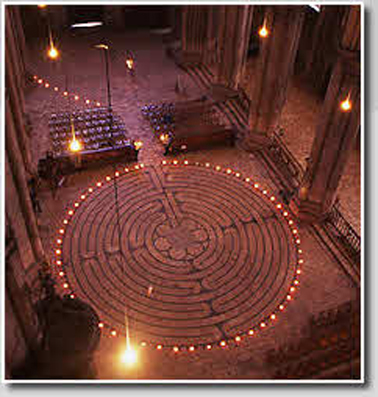
Recently I bumped into people from this school promoting silence and contemplation by inviting people to walk through a labyrinth (based on the one in Chartres Cathedral) chalked in the courtyard of a church in the heart of London’s West End. Adults were very serious about being calm in following the instruction, but looked clumsy when ‘disturbed’, especially when those on the inward journey encountered those returning on the narrow chalked pathway – who should give way? Should one smile or maintain composure? If one speaks would one be disturbing the other or breaking the spell? Kids, on the other hand, just ran through the labyrinth with squeals of delight as they encountered sharp bends and jumped around like gazelles to avoid obstacles. Continue reading

The Hole in The Whole

There is no Whole without a ‘h-o-l-e’ in it.
There is no hole without the whole around it.

The whole never contracted to become the hole.
The hole cannot expand to become the whole.

Pain is our struggle to keep up the identity
And the separateness of a “me”
That struggle for the survival by a “me”
Has been going on for millennia.
That story is the Theory of Evolution.

Suffering is our effort to become
Back again One Whole
Seeking for integration
Propels us for Self-inquiry.
That story is the Theory of Liberation.

The whole and the hole together simply “are.”
That is Oneness. So just Be.

That “Beingness” itself is Meditation.

Science and the nature of absolute reality (Part 1)

(Note that this was published to the restricted distribution for my ‘akhaNDAkAra’ journal in Jan 2010)

As an adolescent…I craved factual certainty and I thirsted for a meaningful vision of human life – so I became a scientist. This is like becoming an archbishop so you can meet girls. M. Cartmill

There seems to have been a growing trend (since the publication of Fritzjof Capra’s book ‘The Tao of Physics’ in 1975) to claim that science is both willing and able to investigate and understand the non-dual status of reality. More and more, science-based books and essays are appearing, but none seem to be actually founded in the proven methodology of Advaita. This is understandably symptomatic of the present time, in which science is seemingly able to supply all of our needs – if not already, then at least as a promise for the near future. Philosophies such as Advaita on the other hand are based on ancient scriptures, written in Sanskrit which no one can understand. ‘Where is the contest?’ the uninformed seeker is clearly going to ask. Continue reading

OM: Its Purpose and Meaning – Janani (Jane Cleary)

The word OM is probably more likely to be recognized by its symbol, even though it is the sound of OM that is the point of focus whenever it is used. It comes from the Hindu scriptures known as the Vedas, which are as old as the Indian culture itself.

What is the language and derivation of OM? The word is in Sanskrit, the language of the Vedas, which according to tradition originated at the same time as the Vedas. OM as both a sound and a written symbol is deeply revered in the Hindu tradition, a fact that can be readily understood once its meaning and power are known. The repetition of the word produces a sound that emanates in the form of a benign and beneficent resonance. The symbol, when reverentially visualized, creates a steadying and calming influence on the mind. Moreover, it has these effects even when the meaning may not be fully understood. Continue reading

In praise of the guru

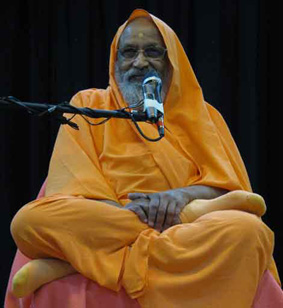
On April 26th 2012, the date of Adi Shankara’s birthday, the Shankaracharya of the Southern seat (Sringeri), Parama Pujya Bharati Tirtha Mahaswamiji, presented the first ever Adi Shankaracharya Award to Parama Pujya Sri Swami Dayananda Saraswati.

The Award states:

“His Holiness, Jagadguru Shankaracharya, Dakshinam Naya, Sri Shringeri Sharada Pitham, Sri Sri Bharati Tirtha Mahaswamiji is pleased to confer the Adi Shankaracharya Award on Sri Swami Dayananda Saraswati, Arsha Vidya Gurukulam, in recognition of the exemplary service rendered for the sustenance and propagation of Sanatana Dharma, Advaita philosophy, the Hindu cause and the welfare of mankind.”

I was struck by the speech from last year’s ceremony. It is a praise of Adi Shankara, but from my knowledge of Swami Dayananda Saraswati, it could be a description of his qualities:

” नानाम्नाय परिश्रमं कलयतां नास्त्येव शास्त्रेषु धीः
सत्योरप्यनयोर्न सुलभा सा हि क्षितौ साहिती
अप्येतासु सतीषु नास्ति विनयो नाचार-भक्ति-क्षमा-
चातुर्यः स च सा च सा च स च ताश्च आलम्ब्य खलेन्त्यमुम् || ”
from a text called “Vishwa Gunaadarsha Champu”

Rough translation (please excuse if there are errors):
“It is quite difficult to attain competence in learning and committing the Veda to memory, even more so discern their meaning with clarity. Among those who have these two abilities, it is still more difficult to find one who has the capability to compose prose and poetry with elegance. Still if a few such are to be found with these three abilities, the possibility that they are of good character, with devotion towards the Lord, and of a forgiving nature, is miniscule. However, all these four characteristics were expressed playfully in their full glory with Bhagavatpaada.”

Thanks for this are due to
Prasad Krishnan posted in Swami Paramarthananda Followers

satyam jn~Anam anantam Brahma Part 4

Go to Part 3

sat chit Ananda

satyam jn~Anam anantam is sometimes called as sat chit Ananda in the scriptures.

I am sat, independent existence, which provides existence to all names and forms. This existence is eternal. Just as a wave has no existence apart from water, water is the only existence of all wave forms, so also, I, sat, am the existence of all varied forms. Is-ness of all forms is existence; this unqualified existence am I.

I am awareness, chit. Any thought presupposes this awareness. Mind is rendered capable of generating thoughts due to the mere presence of consciousness. Consciousness gives me objective knowledge when thoughts are generated in the mind. It is present whether one is awake, dreaming or in deep sleep. This consciousness is me.

I am Ananda, nature of happiness. How can ananta and Ananda be the same? Whenever we experience any sensual pleasure, music, or a pleasant sight etc, what happens is, that the demanding, I , the wanting I, is satisfied temporarily; there is no more seeking for some time. That seeking being absent, I actually experience myself as being limitless. This limitlessness is fullness, where there are no inhibitions, no desires. It is my own self and in those rare moments I experience myself as the form of happiness. Happiness should not be taken as something that I experience. The absence of my limitedness is itself the manifestation of my being limitless, in that limitlessness there is no trace of divisions, sadness, etc. This Ananda, infinitude is my nature. I am Ananda. Continue reading