 3 poems, on Appearance and Reality, Truth and End of Seeking from the new book by Alan Jacobs, President of the Ramana Maharshi Foundation UK.
A popular mantra unfolded
 Om sahanāvavatu sahanaubhunaktu sahavīryaṃ karavāvahai
Tejasvināvadhitamastu mā vidviśāvahai
Om śāntiḥ śāntiḥ śāntiḥ
This mantra, found in the Taittiriya Upanishad, is most propitious for recitation before study with the teacher.
Here is one translation:
May He protect us both together. May he nourish us both together. May we both acquire strength together. Let our study be brilliant. May we not cavil at each other. Om! Peace! Peace! Peace!
(Translated by Swami Gambhirananda).
Unfolded by a traditional teacher, these simple statements reveal their inner meaning. Continue reading
Continuing Interview
The third part of my interview with John LeKay has now been posted.
New Book Extract
Common misunderstandings related to Vedanta
 Below is the view of a bright young friend, Prashant Parikh, a keen, enthusiastic student of traditional Vedanta…
There are some errors in understanding I come across routinely, so I’m addressing a few of them briefly.
1) The Self can’t be experienced: The human mind is designed to go outwards (or even inwards) to gain experience. That is good, it allows us to innovate and progress in our worldly lives. However, when it comes to gaining AtmA jñAnam, the mind again looks for experience of an object called AtmA. This will fail miserable. AtmA is the very Self, the subject. Only an object endowed with attributes can be experienced. The consciousness, which is the Self, cannot be known as an object of experience. The Self can only be understood through the process of acquiring jñAnam through the timeless veda utterances. Tat tvam ask [Thou art That] is the teaching of the Guru, aham brahman asmi [I am Absolute Reality] is the understanding of the student 🙂 Continue reading
New Book Extract

– Wayne Liquorman
Pleasure of Sex vs. Bliss of Self in Brain Scans
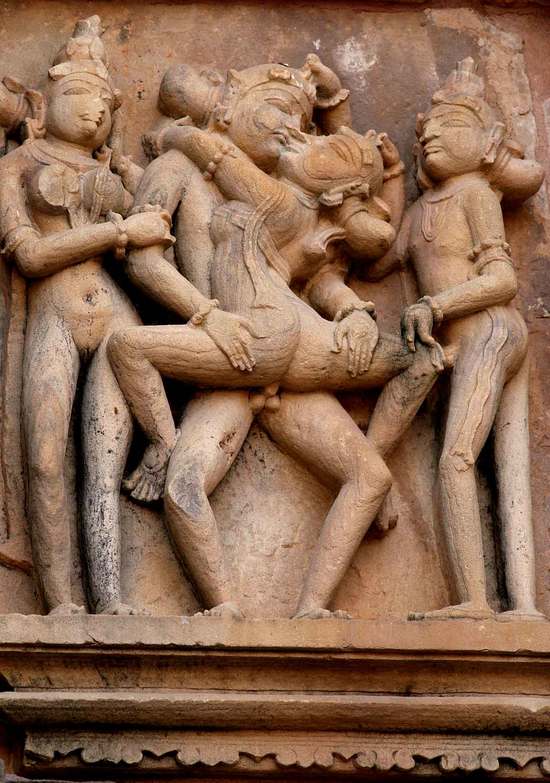
Khajuraho Temple Sculpture – 10th – 12th Century
Khajuraho and Kamasutra fire the fancy of any foreign tourist to India. Add Spirituality and the heady mix becomes a killer app for seekers of quick-fix salvation for paying a visit to India! Biologically sex evolved as a reproductive mechanism to possibly capture the advantageous heritable genetic traits from a partner. Only humans and a few animals like bonobos and dolphins indulge in recreational sex. Sex is closely tied to sensory perceptions and lies within the realms of the mind. Salvation transcends both senses and mind. “Rajneesh, the ‘horse’s mouth’ concerning the topic of enlightenment for Westerners for many years,” regrets James Swartz, “wedded two largely incompatible concepts, sense enjoyment and enlightenment.” One may lose ‘self identity’ and get enwrapped in an inexplicable joy in either of them as Brihadaranyaka Upanishad says. But the bliss of enlightenment and the pleasure of sensual gratification are totally different. Our brains can show it all very clearly!
Human brain is a mass of interlinked neurons piled up in three layers. At the bottom is the most primitive brain common to all animals. Continue reading
Prayer for Advaitins?
 In most Western Advaita circles prayer is an absolute anathema because it seems necessarily to imply duality. So with most seekers I have waited years until I introduced the topic. (As up to now I have only worked with people on a one on one basis, no-one has been exposed to something that he was not yet ready to digest.)
When finally I do introduce prayer people respond in a very similar way to it: with a mixture of scepticism („This certainly is something we are beyond, aren’t we?“), bad conscience (“Is not this a regressive step?”) and longing to allow themselves to pray.
God
The biggest obstacle to prayer is the Western notion of God. The God they know of is an entity different from them, meaning this God definitely is part of duality. No Western Advaitin wants to turn to that. Moreover – even though there is much talk about His benevolence – many people have developed a healthy kind of a mistrust concerning His expression of love and care. They associate God with shame, guilt and punishment and much rather live without Him. Continue reading
How can we know Advaita is right? (Q. 312)
Q: One thing that has been troubling me is how I can know that Advaita is not just another interpretation of the world and self. For example, and to put it simply, a psychologist might explain the world using concepts and ideas in the field of psychology; a physicist might explain the world using ideas and laws found in physics etc. How do we know that Advaita is essentially ‘right’? Yes, a psychologists interpretation of the world and a physicists interpretation of the world are both ‘right’ in their own context, but *ultimately* they are wrong because, if Advaita is right, Brahman cannot be conceptualised?? But how do I *know* that Advaita is correct and not just another interpretation, another ‘way’ of seeing the world? Continue reading
Clearing the mind (Q. 311)
Q: I come across a lot about clearing the mind….but if there is no person, no-one that can have a will of his/her own, surely a desire or will to clear the mind is a nonsense? The mind cannot be tamed because there is not a person to whom it belongs, someone with their own free will? Is that at all right? Surely a clear mind would only arise because it is the will of Brahman?
A: It’s only nonsense once you know that you are not a person!
Also, you have to be very clear when you are talking about Brahman. Strictly speaking, the term ‘brahman’ refers to the non-dual reality and, if you are using it in this sense, it is not meaningful to speak of ‘the will of brahman’ – brahman does not have any will; there are no ‘parts’ to brahman and there is nothing other than brahman.
If you are talking about the person (appearance) within the world (appearance), then you have to refer to Ishvara as the ‘creator’ and the dispenser of body-minds in accordance with accumulated karma from past lives.
You have to be clear in your own mind about this distinction because, for example, the Brahma Sutras uses the word ‘brahman’ in both senses and expects you to know which one is being referred to in any given instance!