Nisargadatta terminology

A frequent contributor to the site, Vijay Pargaonkar has provided the following valuable information rearding the terminology of Nisargadatta Maharaj:
When references to Nisargadatta Maharaj and his teachings come up at the AV forum during discussions, the arguments often seem to become tangential. I think this is mainly due to the differences in terminologies and definitions used by the followers of Nisragadatta and the ones used in traditional Advaita forums.

Last week I came across a rare Satsang tape in Marathi where Maharaj clearly lays out his version of the Creation Model and Prakriyas while explaining various Advaita terms according to his definitions. I have excerpts of this Satsang translation (as I heard and understood) below, where I have indicated the Sanskrit/Marathi terms along with the English terms used by the translator – the translator has actually chopped the live recording and inserted his English translation in between.

Creation Model

Prior to your waking is Nirguna, the substratum of Waking. The Nirguna is not at all bothered by this samara (samara = ‘war (of life)’). In Nirguna appeared knowledge (Bodha).  This is pure Consciousness or Beingness or the Sense “I am” that has no shape or form. In this pure Consciousness there appeared a slight perturbation or movement and the pure Consciousness then grabbed a body-form (deharupa). After wearing this body form it started calling itself a man or woman while bound by different concepts (I am this; I am that; I am going; I am coming etc.). These concepts are all imaginary (Kalpana) and not real. Continue reading
Vedanta the Solution – Part 27

venugopal_vedanta

VEDĀNTA the solution to our fundamental problem by D. Venugopal

Part 27 begins the enquiry into the nature of the jIva. It looks at the various explanations for how Consciousness manifests in the body-mind and the special role of the buddhi.

There is a complete Contents List, to which links are added as each new part appears.

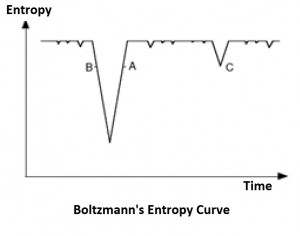
Hiranyagarbha – a Boltzmann Brain?

Boltzmann Brain The unequivocal and uncompromising declaration of Advaita is that ‘Nothing is ever born; there is no creation.’

If so, what is ‘all this’ that we see?

Well, if such a question arises, the scriptures invoke the IkShaNa shruti – to explain creation. It is just a conceptual model – a fact which the shruti itself affirms. A throb in brahman is said to have engendered a formless Hiranyagarbha, as the Creator, whose thought then projects a world. Sage Vasishta explains very clearly in the Chapter on Origination in Yogavasishta that “Hiranyagarbha is born within the Supreme Self. He has no form. His body comprises his mind only. There is no physical body for him. The five fundamental elements are born from Hiranyagarbha through his mentation (thought process). Hence the five elements and the subsequent products arising out of them like the gross worlds do not have reality. They lack Beingness. They are not really born. They are like the horns of a rabbit.”

While answering the question of “What is this universe?” the physicists too figured out from their calculations a similar mechanism. What they find is that there is a high probability of a vacuum fluctuation in an absolutely quiescent thermodynamic equilibrium giving rise to a single conscious brain (mind) within it rather than the entire gamut of universes, galaxies, livable planets, living creatures. us and so on.  Continue reading

The Mystery – Part 2

bimal_cover

Continuing this new, short series presenting the booklet by Bimal Prasad, in which he answers some ‘Rarely Asked Questions’ on Life. Primarily from the perspective of Advaita, questions addressed include the nature of happiness, consciousness, mind and ego. There is also practical guidance on meditation in the final chapter. Answers are relevant and succinct, so that many of the issues of interest to the seeker are covered.

This second part looks at the distinction between ‘I’ and the body-mind and identifes ‘Consciousness’ as being who we really are. See the Contents List or go straight to Part 2 of the series.

The complete (electronic form) booklet may also be purchased from Amazon.

The Relevance of Kant’s Transcendental Idealism to Advaita Vedanta, Part I

This the first of a three-part series discussing the relevance of Kant’s philosophy to Advaita. Kant-CPR

Immanuel Kant published the first edition of The Critique of Pure Reason in 1781, with an extensively rewritten second edition appearing in 1787. Between those editions he also published a shorter “easier” introduction to his philosophy, Prolegomena to Any Future Metaphysics (1783). With the later appearance of The Critique of Practical Reason (1788) and The Critique of Judgement (1790), Kant had articulated a complete system of philosophy of incredible depth and complexity, wholly original and unique in its solution to the age-old problems of reason, ethics, and logic. So great was the importance of this Prussian professor, we may justifiably think in terms of pre-Kantian and post-Kantian philosophy. Many have disagreed with his conclusions and offered refutations on one level or another, but all who have come after Kant have been required to address him. Continue reading

Vedanta the Solution – Part 26

venugopal_vedanta

VEDĀNTA the solution to our fundamental problem by D. Venugopal

Part 26 examines the nature of AtmA, utilising the ‘descriptions’ from the Brihadaranyaka, Kena and Mandukya Upanishads. How can we ‘know’ the Self, when it is not an object?

There is a complete Contents List, to which links are added as each new part appears.

The Brahman Experience

Let’s discuss the possibility that Brahman is nityaptasvarupa, no exceptions. Let’s talk about what it means to truly live from a place where Brahman is all that is – our ideas, experiences, loves, violence. I’ll start with some of the comments made on a previous post, ‘Consciousness of Choice’, because let’s face it, Dennis made some great points!

Continue reading

The Mystery – Part 1

bimal_coverA new, short series presenting the booklet by Bimal Prasad, in which he answers some ‘Rarely Asked Questions’ on Life. Primarily from the perspective of Advaita, questions addressed include the nature of happiness, consciousness, mind and ego. There is also practical guidance on meditation in the final chapter. Answers are relevant and succinct, so that many of the issues of interest to the seeker are covered.

See the Contents List or go straight to Part 1 of the series.

The complete (electronic form) booklet may also be purchased from Amazon.

Vedanta the Solution – Part 25

venugopal_vedanta

VEDĀNTA the solution to our fundamental problem by D. Venugopal

Part 25 continues to look at who we are, in relation to experience and consciousness. There is an especially useful analysis of the logical device of anvAya-vyatireka and an examination of the concept of witness-consciousness.

There is a complete Contents List, to which links are added as each new part appears.