
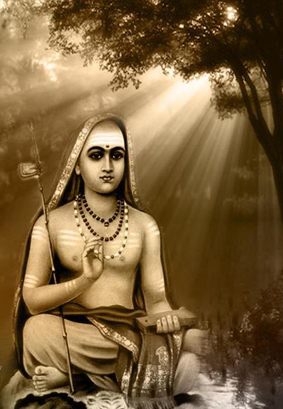
 There has been much healthy debate recently on the Advaita Vision Blog about Liberation, who or what is a jnani or jivanmukta, and what it means to follow traditional Advaita. The theme of this post is that we cannot resolve such questions without first gaining a clear understanding of the body-mind and its role in the context of Liberation. What follows are some reflections inspired by a spirited discussion with Ramesam, with due credit to him for stimulating many of the thoughts below. Any errors or possible misunderstandings are entirely my fault. Or perhaps not, since “Words fall back from it.” Continue reading
Tag Archives: consciousness
‘ego’, self, and metaphysics – Part lV
In the Buddhist perspective, the ego or self as ordinarily considered in Western traditions (i.e., as soul or person), is a non-self, actually a non-entity (anatta). Hence the suffering, which stems from an experience -ultimately illusory- of separation and vulnerability.
Here we have to consider two things. First, according to Mahayana Buddhism, Adi-Buddha, equivalent to Dharmakaya – the highest metaphysical, or divine, level – represents that unique Being or Divine ‘State’, pervading all manifestation as Buddha-nature; and second, the notion of the Self (Atman, derived from the Hindu Vedanta) is not only compatible with that view, but also with that of the Spirit in Christianity and in Islam.
As to the soul (metaphysics and theology), though intrinsically perfect or whole in itself (one could add: in ‘primordial man’ –the purusha or Hiranyagarbha of Hinduism)- it experiences imperfection, self-limitation, anxiety and doubt in its state of (aparent) separation -the ‘fallen state’. Being, not just potentially, a ‘focal point of the Universe’, yet it becomes, through ignorance and self-will, the subject of illusions, attachments, and passions which lead to that predicament. Its condition is thus ambivalent; it can orient itself upwards (or towards the centre) – to ‘holiness’ and integration – or downwards, pulled by its ‘lower nature’ (nafs in its lower stages, according to Sufism). The end result will be either self-denial, or self-assertion; self-giving, or ego-centeredness. Inevitably, this latter tendency, based on ignorance, can only lead to an unwanted result: dispersal, disintegration, and suffering. Alas!, on the whole, if not in principle, psychiatry is not interested in this distinction or dichotomy; but let not anything else be said about this at this point.
From the viewpoint of advaita vedanta, all of what is described in this paragraph – and what follows – pertains to the empirical, relative (ontological and epistemological) level: mithya (or vyavahara), in other words. Continue reading
The ontological status of concepts in Plato and Shankara
Concerning the theory of Forms or Ideas in Plato – and by extension that of perception – we can find an interesting parallel in the account given by Shankara’s Advaita Vedanta. The Idea of ‘the Good’ (the supreme Idea in Platonic metaphysics) would correspond to the highest ontological principle in advaita: Atman-Brahma; in fact, there is only one ontological principle, one primary, or ultimate, reality, in both philosophers.* Objects of external perception are illusory in both accounts. In Plato they are only images (ikones) of Ideas, which alone are real, whereas in Shankara these objects are also just representations in the mind, phenomena, and described as ‘names and forms’. For example, ‘pot’ is just a name, its underlying ‘substance’ being only clay (this is only an analogy or illustration, since there is no talk of substance in Shankara’s philosophy). There are no objects, and no world, having a separate (objective!) existence, the only reality being Atman-Brahman.
* This makes of Plato a non-dualist, which is contrary to the commonly-held idea that he was a dualist, due to the emphasis given throughout the ages to his doctrine of the two Worlds, Intelligible and Phenomenal (or ‘World of Appearances’).
Tom McFarlane (writing in Quora): ‘What concepts really are is a philosophical question about their ontological status. The answer will depend upon the philosophy you adopt. A materialist would regard concepts as ultimately reducible to the functioning of the material brain, while an idealist would regard concepts (and matter) as ultimately reducible to mind or consciousness.
The most famous idealist account of concepts was given by Plato in his theory of forms. According to Plato, a concept (or form) is a general abstract pattern that has various sensory objects as specific instantiations. The concept of a tree, for example, is an abstract idea that makes it possible for us to experience trees, as such. Without the concept of a tree, we may have experiences of images but they are not recognized as being an experience of a tree without the concept of a tree. In Plato’s view, the concept of the tree is more fundamental than any particular tree because the concept is a necessary precondition for trees to exist as objects of experience. Plato called the experiences of trees as instantiations of the concept of a tree. For more discussion, see What is a form in Plato’s metaphysical theory?’
Q. 378 – Existence and Experience
Q: Without hot, cold doesn’t exist. Without up there is no down, without in there is no out etc. The basic nature of duality. However if you apply this to the non-dual Brahman…
In the absence of that which is not (Brahman), that which is (Brahman), is not (doesn’t exist.)
My idea is that the Relative Reality is not only dependent on the Absolute (Brahman) but that actually both are interdependent on each other. I know this is counter to Advaita and forgive me and my lack of knowledge, especially of the Sanskrit terms, and I’m sure it makes your skin crawl to continually refer to things such as relativity as a reality.
Why do I say something can’t exist without it’s opposite? I will do my best to explain my ideas.
A thing cannot exist without it’s opposite because it cannot be experienced without it’s opposite, or rather awareness of it’s opposite. If a thing cannot be experienced then it does not exist, to the one experiencing it.
Ultimately, everything exists in one of two ways, either as a potential or possibility, or as a realized form. Continue reading
Vedanta the Solution – Part 22
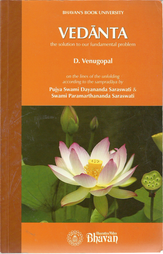
VEDĀNTA the solution to our fundamental problem by D. Venugopal
Part 22 concludes the chapter on ‘Enquiry into the Self as subject’, equating Consciousness and Existence and looking at the relationship between the body-mind-sense complex and Consciousness.
There is a complete Contents List, to which links are added as each new part appears.
How could we merge absurdist and Buddhist philosophies?
www.quora.com/How-could-we-merge-absurdist-and-Buddhist-philosophies
M. Provisionally we could put side by side ‘absurd’ (or illogical) and ‘unprovable’, even if they are not synonymous; and the main tenets of all religions are such. They are not ‘rational’. On the other hand, neither science, ‘common sense’, or rationality are the ‘end all’. There are many things that escape explanation with the current state of our knowledge and understanding.
Paradox is a term related, one way or another, to the above. Just consider the following:
i) “How wonderful that we have met with a paradox. Now we have some hope of making progress”. Niels Bohr (famous physicist)
ii) Is there anything more absurd to ordinary understanding of the world and us than the following (taken from my blog): “That truth, put into words, is paradoxical: you are all (as Consciousness) and ‘you’ (as perceived individual) are nothing, or a phantom; you are the final witness, but ‘you’ are not a witness; the world is illusory (as appearance), but in essence is reality itself. That revelatory, transcendental experience is non-transferable, not provable to another.”
GL. If by absurdism you mean acknowledging that there is no absolute truth, then zen buddhism when asked what is enlightenment, answers “6 pounds of flax”, which is, I believe, trying to point out that absolute truth is impossible.
M. You probably mean ‘impossible to demonstrate, or to know, with the ordinary mind’, but ask a zen buddhist if it (absolute reality or truth) is impossible to grasp, to grok.
GL. I think the point of the flax koan is that you can’t know satori with certainty.
M. Is it not rather that the experience cannot be explained – or transmitted – with words, being ineffable? Such is a transcendental experience, where there is no individual per se present.
GL. Isn’t “ineffable” the same as saying we can’t know with certainty?
M. No, it means ‘inexpressible’, the experience being overwhelming (rather than being too sacred – another meaning).
GL. If you can’t describe it, then it isn’t knowable.
If it is purely a matter of experience, then there is no way for me to know you are experiencing something the same way I am. Color is ineffable. You experience red and green the way you do, and I experience it the way I do. And unless we have an objective test for color blindness, there is no way to know if you see what I see. Some people see color when they hear sound. And as long as that experience is ineffable, there is no way to know if we see color the same way. Only when we establish some objective explanation and some objective testing can we know with certainty if we are experiencing similar things.
M. You refer to what are called qualia, but I am not sure how far you want to go (can nothing be known? In what sense?) Most empiricists/scientists tend to disregard this question or deny that it presents any problem for their physicalist stance. In non-duality, which is what interests me, there are not, cannot be, any objective tests referable to either external or internal experiences of what generally is understood as reality (the world and oneself) except, perhaps, in one’s facial expression and/or demeanor. That agrees with what you say about qualia but, aside from non-duality (or as a preliminary to it), it doesn’t mean that there cannot be agreement, concurrence, in the realm of thought, sensations, and feelings. Two people reading the same book or page – if they are on the same wave length (let’s say interest in non-duality, or in a particular modality of art, like Baroque or modern) – will have similar thoughts and feelings. Language is for communication – even about the understanding of non-duality (like zen) – but certain experiences cannot be communicated, such as particular intuitions or epiphanies, regardless of what we understand as qualia, though related to it.
Consciousness/Awareness, the brain, and memories
(Q&A published recently in QUORA)
Q. ‘Why wasn’t my consciousness generated by another brain? Why am I linked with this brain?’
I heard that everybody experiences consciousness, but then why am I my consciousness and not another person’s consciousness? It’s hard to explain.
Paul Bush. Yes, it’s hard to explain. Basically it’s because the most important part of consciousness, which is awareness*, is the same for everybody. There is only one awareness, and in fact nothing else. All the other aspects of consciousness, the contents, are projections of awareness as it identifies with small parts of reality such as bodies and minds. Such misidentification creates a perspective. From each perspective the part of reality not identified with is seen as the external world. The observer with a particular perspective and the world observed as a consequence of that perspective are both inferences created at the moment of identification.
So, there is only one awareness that is continually pulled into the illusion of being this or that observer. The ongoing personal identity that we think of as ourselves maintains coherence through the construction of the concepts of time and space; memory and an apparent (though not total) physical separation from the rest of reality. Awareness has no personal identity, it is exactly the same for you and everyone else, because it is singular awareness that creates each experience depending on the perspective of the entity that it is identifying with.
*(AM Awareness and Consciousness are generally taken as equivalent in Advaita Vedanta – no distinction being made) Continue reading
Q. 377 – Desire and suffering
(Also discusses Buddhism versus Advaita; analysis versus experience; need for practice)
Q: Your work is both beautiful and rigorous, and I’ve appreciated your continuous efforts to continue the much-beloved tradition of Advaita Vedanta.
As I consider devoting myself to the path of Advaita Vedanta, I find that I keep coming up against a few constant, nagging protests:
First, it seems that the tradition and methodology (although I also assume that there is quite a lot of variety of how Vedanta is taught and realized) is overly academic and scholastic, at least as I view it from the information that I’ve gleaned during my research. The unfolding of the teaching of Vedanta seems to leave the student engaging in a lot of analysis, rather than a deep exploration of how they genuinely experience the world, which lacks transformative power because it remains something objective.
Second, according to some of the sources that I’ve gleaned, it seems to place Vedanta on an extremely high pedestal, as something engaged in only following years of other preparatory practices. But modern practice appears to demonstrate that such preparation, while helpful, is not necessary. I cite websites like “Liberation Unleashed” and Scott Kiloby’s excellent work which show that directly exploring and inquiring into the truth of statements like, “All there is is pure awareness,” etc., can still be highly transformative outside of the context of a more robust regime of spiritual purification and development.
My fear is that if I follow the traditional route, I will end up entangled in these preparatory practices. I’ll just be getting the appetizer for years before getting the meal, in other words, but, in my opinion, why wait?
Is this perception true (given that there will be a lot of diversity)? Do most AchArya-s make their disciples engage in such practices for prolonged periods of time before discussing Vedanta?
I have heard you and many other teachers in the traditional Advaita lineage say things like, “Unless you have a very pure mind…” or “Unless you are highly developed…” etc., the practice of Vedanta will be fruitless. But, if you read the logs, for example, of the website “Liberation Unleashed,” you will find some very impure people – depressed, addicted, desperate, you know, the usual seeker lot!, who come out transformed after only a few days of directly looking into their experience.
I appreciate your thoughts on this and your generosity in helping so many confused seekers. Continue reading
Q. 375 – Conditions affecting next life
Q: I agree that Reincarnation, the next life, isn’t real. But it’s as real as this life…and, for most of us, this life seems pretty real, even if we know better.
And, as we all know, very, very few people are going to achieve Enlightenment (Liberation, Realization, Moksha) in this lifetime.
For the above 2 reasons, I suggest that Reincarnation is a reasonable thing to be concerned about and to ask a question about. That’s what this question is about. I’ll speak of Reincarnation as if it’s as real as this life seems.
It’s been said that one’s next incarnation depends greatly on one’s thoughts and state in their last moments of this life. I hope that isn’t true, because no one can know what condition they’ll be in when they’re dying. I mean, we aren’t always in the best of condition when we die, are we.
A person, at death, might be delirious, or heavily sedated at a hospital. What then? How does that affect that person’s next life?
Has there been discussion, from theory, regarding how this life—and, in particular, a person’s condition in the last moments of this life–affect that person’s next life?
Responses from , Sitara, Venkat and Dennis Continue reading
Q. 374 – Ramesh
Here is a question and answer from several years ago, which addresses a topic that I avoided getting involved with publically at the time.
Q: I recently bought a book called “Final Truth” by Ramesh Balsekar. I read the book and now see it as one of the most “deep” and “philosophical” books on Advaita. But then I read Balsekar had some sex scandals and preached “do whatever you want you are not responsible” philosophy and I`m shocked. Anyway…
I saw an idea in the book and it resonated with me so much. In my opinion, It even explains (for some level) why there is Maya or why the appearances exists or why there is “creation” in the first place. (or Why there seems to be creation) The idea is this: The formless Consciousness can be experienced only through the multitude of sentient bodies with names and forms, just as light can be seen only through refracting agents. It is thus not that the multitude of names and forms exist independently of Consciousness but that Consciousness can express itself only through these forms.
So the other way of saying is the God or the Brahman or the Consciousness experiences himself through us. We and the universe are God looking into himself.
Brihadarnyaka 2.5.19 has this verse
“He transformed Himself in accordance with each form; that form of His was for the sake of making Him known. The Lord on account of Maya (notions superimposed by ignorance) is perceived as manifold, for to Him are yoked ten organs, nay, hundreds of them. He is the organs; He is ten and thousands – many and infinite. That Brahman is without prior or posterior, without interior or exterior. This self, the perceiver of everything, is Brahman. This is the teaching.”
What do you think? I wanted to know if traditional Advaita accepts that idea or not.
A: As it seems with most questions I get these days, this one also revolves around the reality-appearance, paramArtha-vyavahAra question.
Who-you-really-are does not act, so cannot be ‘responsible’ in the sense that you mean here. The person, on the other hand, does act and is responsible, and gets puNya-papa as a result of those actions. It is especially the responsibility of the realized person to act in accordance with dharma – the awareness of right and wrong – since he is setting an example to others. However it is also possible that, because of insufficient prior mental preparation, an enlightened person is still attached to desires and fears. Even knowing that he is perfect and unlimited, he could still act in accordance with these feelings, which are called pratibandha-s (obstacles or impediments). These will go in time, with further nididhyAsana.
It has to be assumed that this was the position regarding Ramesh, as far as the ‘scandals’ are concerned. However, if it was the case that he was actually preaching “do whatever you want you are not responsible”, as you say, then this is not a clear presentation of the truth of the situation and should be condemned.
Regarding your second point about the ‘purpose’ for the seeming creation, this does not hold water either. There can be no meaningful attribution of purpose at all. Purpose implies some sort of deficiency in brahman, which is a contradiction. Experience of any sort is a limitation, so cannot be applied to brahman. Best just to think of everything as name and form, including the ignorance and the experience; the experienced and the experiencer. But, as an imaginative way of thinking about it, God looking into himself is fine, as long as you don’t take it literally.