
Q. 373 – Ego, soul and mithyAtva

Q: For the last few years I have been trying to develop a manuscript detailing a working model which marriages the teachings of Advaita Vedanta with contemporary research on NDE or “Near Death Experience” and similar fields of inquiry. There are several questions I have, but for now I will only bother you with one: Is it possible the Atman does possess a “spiritual ego”?

 Clearly the culprit for the ignorance of our real self as the Self is the wrongful identification with the body-mind. Shankara explains the identification with the kosha-s perpetuates the illusion, which is nothing more than a superimposition of the kosha(s) on brahman helped by mAyA.

 The way I see it, our greatest enemy is the ego, the human ego. This ego comes from the mind and is maintained alive by desires. But I have many reasons to suspect there is also a “spiritual ego” present in the Atman, which similarly perpetuates the ignorance of the wrongful identification by the so-called discarnate “spirit soul”.

 The metaphor I have used is this: there is an actor in the “spiritual world” (the Atman) which wrongfully identifies with a spiritual ego preventing it from realizing brahman. This actor goes through an induced amnesia, after agreeing to play the role of a character in the Grand Stage of the world. This is the incarnation stage. The human ego is the combination of the spiritual ego – which carries the saMskAra-s and the vAsanA-s – plus particular influences on the personality traits caused by internal factors such as the brain/mind of the new body, as well as external factors such as family, society, education, etc. This is the embodied Atman as the jIva. Continue reading
Vision Of Truth (sad darshanam) – Part 20

yadIshiturvIkshaNamIkshitAram

avIkshya tanmAnasikekshaNam syAt

na drashTuranyaH paramo hi tasya

vIkshA svamUle pravilIya niShThA—22


yadIshituH vIkshaNam = that (which)vision of Ishvara as an object; IkshitAram = Atma, the observer; avIkshya = not recognizing; tanmAnasikekshaNam syAt = will be a mental projection; drashTuranyaH paramaH na = No supreme other than seer; hi = indeed; tasya vIkshA = his vision; svamUle niShThA = abidance in one’s own nature; pravilIya = having resolved.


That vision of Ishvara (as an object), which is, without recognizing the observer Atma, is only a mental projection. There indeed is no supreme other than the seer. His vision is the abidance in one’s own nature having resolved the triad.


As long as Ishvara is considered as an entity separate from oneself, so long misery continues. Vision of Ishvara as an object, is merely a mental projection. If one has a vision, it is something other, external to him, meaning, the form of the vision has a beginning outside of him. Hence, there is a limited form to the Ishvara seen in a vision. Such an Ishvara is finite. How is that vision of any help?

Continue reading

Self – Presence-awareness

…what you are, really, is this shining, ever-present sense of being, awareness, presence, is-ness or whatever. The thought ‘I’ or the sense of being a person or ‘ego’ is only a thought or idea appearing in awareness. Just see that all the other binding thoughts and ideas spin around that idea of an ‘I’ – not your actual presence. Presence-awareness is not a limited person at all. It is the vast, mirror-like, awareness-space in which everything arises. This is you. This is your home.

John Wheeler, Awakening to The Natural State, Non-Duality Press, 2004. ISBN 0954779231. Extract Link, Review Link. Buy from Amazon US, Buy from Amazon UK

upadesha sAhasrI – part 16

upadesha16

Part 16 of the serialization of the  presentation (compiled by R. B. Athreya from the lectures given by Swami Paramarthananda) of upadesha sAhasrI. This is the prakaraNa grantha which is agreed by most experts to have been written by Shankara himself and is an elaborate unfoldment of the essence of Advaita.

Subscribers to Advaita Vision are also offered special rates on the journal and on books published by Tattvaloka. See the full introduction

Ego – Shadow

The ego cannot be subjugated by one that takes it to be real. It is just like one’s own shadow. Imagine a man who does not know the truth of his shadow. He sees it following him persistently, and wants to get rid of it. He tries to run away from it, but it still follows him. He digs a deep pit and tries to bury it, filling up the pit; but the shadow comes to the top and again follows him. He can get rid of it only by looking away from it, at himself, the original of the shadow. Then the shadow will not worry him. The seekers of Deliverance are like the man in this parable. They fail to see that the ego is but a shadow of the Self. What they have to do is to turn away from it, towards the Self, of which it is the shadow.

Ramana Maharshi, quoted in Maha Yoga or The Upanishadic Lore in the Light of the Teachings of Bhagavan Sri Ramana, K. Lakshmana Sarma, Sri Ramanasramam, 1937. ISBN 978-81-88018-20-8. Buy from Amazon US, Buy from Amazon UK

Ego – desire

Once the ego sees that it only seeks what it already knows, that its desires are conditioned and that its true desire is for permanent security and tranquility, it loses its dynamism to find itself in phenomenal things. Then what is behind the desire, the ego, the mind, is revealed. We are left in wonder and all dispersed activity dissolves in this wonderment.

I am, Jean Klein, compiled and edited by Emma Edwards, Non-Duality Press, 2006. ISBN 978-0-9551762-7-2. Buy from Amazon US, Buy from Amazon UK

Ego – Guardian

The ulterior agenda of the human ego is always one of control and the validation of separation and isolation. “I am alone, we (organization, community, race, etc.) are alone, and I or we will prove it to you.” The ego is not ‘bad’ for trying constantly to validate that it is alone and separate. That’s its job. It is a guardian that is meant to take care of the physical body by providing boundaries. That’s how it evolved long ago.

A Natural Awakening: Realizing the Self in Everyday Life, P. T. Mistlberger, TigerFyre Publishing, 2005. ISBN 0-9733419-0-4.

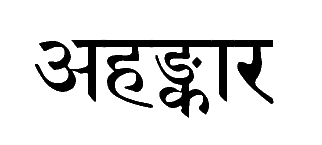
ahaMkAra – Killing the ego

However much you may try to kill the ego, it will only become stronger. So you have to approach it from the other end. Everybody understands in spite of the ego. The truth is that the ego automatically dies when you understand anything.

You will never succeed in bringing in light, if you insist upon removing all the darkness from your room before you do so. Therefore simply ignore the ego and try to understand, and the understanding itself will remove the ego. (Note 847)

Notes on Spiritual Discourses of Shri Atmananda, taken by Nitya Tripta, Vol. 2, Non-Duality Press, 2009. ISBN 978-0-9563091-3-6. Buy from Amazon US, Buy from Amazon UK

ahaMkAra – fixed quality

ahankaraWhen it comes to identity, we try to find something that we are, somewhere we can plant our flag and say: “This is me. ” The verb ‘to be’ implies a stationary, fixed quality. For instance, “I am a radio show host” has a very different quality from “I host a radio show.” The words ‘I am’ imply that whatever follows is a fixed quality of being, not something that comes and goes.

Nothing Personal: Seeing beyond the illusion of a separate self, Nirmala, Endless Satsang Foundation, 2001. ISBN 978-0-6151-8767-9. Buy from Amazon US, Buy from Amazon UK