
How Vedanta Works

OLYMPUS DIGITAL CAMERAHow words work in Vedanta
(based on essays from Sw. Dayananda and Ramji)

by Tan

Vedanta is a means of self knowledge through words called shabda pramANa.

It is able to give you direct knowledge of your eternal nature through words. In spiritual circles this will be generally criticized with the argument that the eternal self, enlightenment, the absolute, Brahman, the Tao or whatever you want to call it, is beyond words and indescribable. Therefore the conclusion is that it is impossible to get direct knowledge and know your “real” self through words. Continue reading
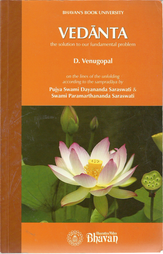
Self – Not an object of knowledge

Quote

The Sage is often loosely described as ‘one that knows
the Self’. But this is not intended to be taken in a literal sense.
It is a tentative description, intended for those that believe
ignorance to be something that exists; they are told that this
ignorance is to be got rid of by winning ‘Knowledge of the
Self’. There are two misconceptions in this. One is that the
Self is an object of knowledge. The other is that the Self is
unknown, and needs to be known. The Self being the sole
Reality, He cannot become an object of knowledge. Also being
the Self, He is never unknown. The ancient lore tells us that
He is neither known nor unknown, and the Sage confirms it.

Maha Yoga or The Upanishadic Lore in the Light of the Teachings of Bhagavan Sri Ramana, Who”, Sri Ramanashramam, No ISBN.

Atman- mirror

1.19. Just as a mirror exists within and without the image reflected in it, so the Supreme Self exists inside and outside this body.

The idea is this: The image in the mirror has no real existence. It is a mere appearance. Only the mirror exists. Similarly, only the Self exists. Body, mind, etc have no real existence. It is only by being superimposed on the Self that they appear to exist. Just as the reflection cannot affect the mirror, so body, mind etc cannot affect the Self.

aShTAvakra saMhitA, Swami Nityaswarupananda, Advaita Ashrama, No ISBN.

Vision Of Truth (sad darshanam) – Part 16

तद् युष्मदोरस्मदि सम्प्रतिष्ठा

तस्मिन् विनष्टे अस्मदि मूल बोधात्

तद् युष्मदस्मन् मति वर्जितैका

स्थितिर् ज्वलन्ती सहजात्मनः स्यात्—१६

tad yuShmadorasmadi sampratiShThA

tasmin vinaShThe asmadi mUla bodhAt

tad yuShmadasman mati varjitaikA

sthitir jvalantI sahajAtmanaH syAt—16


tad yuShmadoH = third person and second person; asmadi sampratiShThA = depend

on first person;tasmin vinaShThe asmadi = first person eliminated; mUla bodhAt =

by knowledge of the source;tad yuShmadasman mati varjitaikA= the one division-less

without the notion of‘that’,’thou’, and ‘I’;sthitir jvalantI sahajAtmanaH syAt = the self shines

and emerges

The third person and second person depend on the first person. By the knowledge of the source, the one division-less without the notion of ‘that’, ‘thou’ and ”I’, the self shines and emerges.

The words ‘you’, ‘that/he she’ etc (the third and second person) have their basis in the first person. The other becomes the second or third person only with reference to the first person.

Continue reading

Two Genres Of Thought

“The Problem is I can’t tell the difference between a deeply wise, nudge from the Universe and one of my own bone-headed ideas!”

(Copy right: Bradford Veley)

It looks to me that we are besieged by two genres of thought.

When I say two genres, I do not mean the yes- no- thoughts or being double minded and undecided in our view about things. Nor do I refer to split personalities. Actually it has NOTHING to do about the “content” of the thought.  What I have in mind is about the suite or family of thoughts – based on their possible source of origin (real or apparent).

As advaitin-s, we all know that everything is a manifestation of brahman. We shall use the term ‘Universal Self’ for It. The Universal Self is kUTastha – does not do or intend to do anything. It is changeless, actionless, eternal and It is Beingness-Consciousness-Infinity. We also know that we act, talk, walk, eat, breathe and live as an individual.  We shall use the term ‘self’ for this separate entity. Continue reading

Why Advaita Works

To explore the womb, or tomb, or dreams; all these are usual

Pastimes and drugs, and features of the press:

And always will be, some of them especially

When there is distress of nations and perplexity

Whether on the shores of Asia, or in the Edgware Road. (T. S. Eliot. Four Quartets, 3.5)

If you are reading this magazine*, I suggest that there is a high probability that you are not happy! It is an undeniable fact that the majority of people today are dissatisfied with what they perceive as being a mediocre existence. They may feel that they are limited by an unattractive and illness-prone body or by a mind that is imperfectly educated and unable to make intellectual leaps of understanding. There are very many things that we want – objects, partners, lifestyle, jobs etc – but few that we seem to be able to obtain. (And, even when we do obtain them, their rewards are invariably ephemeral.) Western society relies upon the media advertising all of these things, and thereby continually reinforcing the desires. Being repeatedly frustrated by this materialistic lifestyle, it should be hardly surprising that many turn towards the spiritual in the hope that this might bring about peace and a durable happiness. Continue reading