The ontological status of concepts in Plato and Shankara

Concerning the theory of Forms or Ideas in Plato – and by extension that of perception – we can find an interesting parallel in the account given by Shankara’s Advaita Vedanta. The Idea of ‘the Good’ (the supreme Idea in Platonic metaphysics) would correspond to the highest ontological principle in advaita: Atman-Brahma; in fact, there is only one ontological principle, one primary, or ultimate, reality, in both philosophers.* Objects of external perception are illusory in both accounts. In Plato they are only images (ikones) of Ideas, which alone are real, whereas in Shankara these objects are also just representations in the mind, phenomena, and described as ‘names and forms’. For example, ‘pot’ is just a name, its underlying ‘substance’ being only clay (this is only an analogy or illustration, since there is no talk of substance in Shankara’s philosophy). There are no objects, and no world, having a separate (objective!) existence, the only reality being Atman-Brahman.

* This makes of Plato a non-dualist, which is contrary to the commonly-held idea that he was a dualist, due to the emphasis given throughout the ages to his doctrine of the two Worlds, Intelligible and Phenomenal (or ‘World of Appearances’).

Tom McFarlane (writing in Quora): ‘What concepts really are is a philosophical question about their ontological status. The answer will depend upon the philosophy you adopt. A materialist would regard concepts as ultimately reducible to the functioning of the material brain, while an idealist would regard concepts (and matter) as ultimately reducible to mind or consciousness.

The most famous idealist account of concepts was given by Plato in his theory of forms. According to Plato, a concept (or form) is a general abstract pattern that has various sensory objects as specific instantiations. The concept of a tree, for example, is an abstract idea that makes it possible for us to experience trees, as such. Without the concept of a tree, we may have experiences of images but they are not recognized as being an experience of a tree without the concept of a tree. In Plato’s view, the concept of the tree is more fundamental than any particular tree because the concept is a necessary precondition for trees to exist as objects of experience. Plato called the experiences of trees as instantiations of the concept of a tree. For more discussion, see What is a form in Plato’s metaphysical theory?’
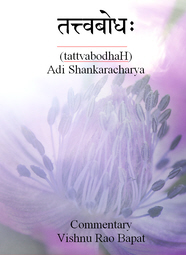
Tattvabodha – Part 7

OLYMPUS DIGITAL CAMERAPart 7 of the commentary by Dr. VIshnu Bapat on Shankara’s Tattvabodha.This is a key work which introduces all of the key concepts of Advaita in a systematic manner.

The commentary is based upon those by several other authors, together with the audio lectures of Swami Paramarthananda. It includes word-by-word breakdown of the Sanskrit shloka-s so should be of interest to everyone, from complete beginners to advanced students.

Part 7 begins the section on Atma vichAra – investigation into the nature of Atma – and in this part specifically asks the questions ‘What is true knowledge?’ and ‘Who is Self?’. There is also a hyperlinked Contents List, which is updated as each new part is published.

A-U-M Awakening to Reality – Review of book

‘Lucid and exhaustive of most important book in Advaita Vedanta’

The Mandukya Upanishad, the shortest (it has just 12 verses) and , according to a general opinion, the most important of the 12 main Upanishads, has the added interest in being associated with the authoritative karikas of Gaudapada, grand-mentor of Shankaracharia, the initiator of Advaita Vedanta. Of the former it has been said that his is ‘a rational analysis of the totality of our experience in all three states: waking, dreaming, and deep sleep. Incomplete and insufficient will be any philosophy that is based on the waking state alone’ (Swami Brahmananda).

‘When everything has been said, the fact remains that Vedanta is the only way of thinking that claims to study life in all its aspects in a scientific manner. It treats of truth, wisdom, and happiness, subjects of eternal interest to mankind. The credit of having brought to the notice of thinkers the value of its all-comprehensive method revealed in the Upanishads, and of having successfully built an impregnable system on that solid basis, will ever belong to Gaudapada.’ (Swami Satchidanandendra Saraswati).

This new book, authored by the well-known (and, one could say, prolific writer in the field of Advaita Vedanta – this is his 7th book), Dennis Waite, has several features that make of it an important addition to the literature in this specialized area, one that is becoming much better known than it was some 10-20 years ago.

Beginning with a few general remarks, something that strikes the reader is the clarity of the writing and the logic of the exposition of its contents which, at first sight, appears to be an introductory text for the un-initiated. Far from it! – and it is not a question of its length (420 pages) or even of the exhaustive coverage of everything that is relevant to the Upanishad itself and Gaudapada’s running commentary in the karikas. Clear and didactic it is, but the tools (armamentarium), organization of the work, and employment of many important Sanskrit words together with their English translation, plus a long Glossary (41 pp.), make of this book an indispensable reference for the modern reader of both this important Upanishad and Gaudapada’s contribution.

An important feature of the book consists in the numerous references (81 in all!) – most of them with short-to-medium length descriptions of the tenets or arguments of the, mostly modern, authors consulted when DW was in the process of preparing this work (Annotated Bibliography – 33 pp.)

Apart from the illuminating Introduction (36 pp.) and ‘What the Mandukya Upanishad is About’ at the beginning, the following 7 sections are: The World Appearance, Causality, Creation, Nature of Reality, Self-Knowledge, Practical Aspects, and Conclusion. They are all important, certainly, but I found ‘Nature of Reality’ to be like a centre-piece.

There are 7 Appendices at the end, comprising altogether 95 pp. To give one an idea of the completeness of the work, one of the Appendices (No. 5) deals with pronunciation and transliteration, using a recently proposed method: ITRANS. Lastly, a full Index, containing also a list of all the karikas mentioned in the book. AM

Tattvabodha – Part 6

OLYMPUS DIGITAL CAMERAPart 6 of the commentary by Dr. VIshnu Bapat on Shankara’s Tattvabodha.This is a key work which introduces all of the key concepts of Advaita in a systematic manner.

The commentary is based upon those by several other authors, together with the audio lectures of Swami Paramarthananda. It includes word-by-word breakdown of the Sanskrit shloka-s so should be of interest to everyone, from complete beginners to advanced students.

Part 6 concludes the look at the six sAdhanA-s (shamAdhi shakti sampatti), and in this part addresses samAdhAna (contemplation) and mumukShutva (desire for liberation). This also concludes the examination of sAdhana chatuShTAya, the fourfold spiritual path.There is also a hyperlinked Contents List, which will be updated as each new part is published.

Tattvabodha – Part 5

OLYMPUS DIGITAL CAMERAPart 5 of the commentary by Dr. VIshnu Bapat on Shankara’s Tattvabodha.This is a key work which introduces all of the key concepts of Advaita in a systematic manner.

The commentary is based upon those by several other authors, together with the audio lectures of Swami Paramarthananda. It includes word-by-word breakdown of the Sanskrit shloka-s so should be of interest to everyone, from complete beginners to advanced students.

Part 5 continues to look at the six sAdhanA-s (shamAdhi shakti sampatti), and in this part addresses uparama (observance of duty), titikshA (forbearance) and shraddhA (faith). There is also a hyperlinked Contents List, which will be updated as each new part is published.

Tattvabodha – Part 4

OLYMPUS DIGITAL CAMERAPart 4 of the commentary by Dr. VIshnu Bapat on Shankara’s Tattvabodha.This is a key work which introduces all of the key concepts of Advaita in a systematic manner.

The commentary is based upon those by several other authors, together with the audio lectures of Swami Paramarthananda. It includes word-by-word breakdown of the Sanskrit shloka-s so should be of interest to everyone, from complete beginners to advanced students.

Part 4 begins to look at the six sAdhanA-s (shamAdhi shakti sampatti), and in this part addresses shama (control of mind) and dama (control of senses). There is also a hyperlinked Contents List, which will be updated as each new part is published.

Tattvabodha – Part 3

OLYMPUS DIGITAL CAMERAPart 3 of the commentary by Dr. VIshnu Bapat on Shankara’s Tattvabodha.This is a key work which introduces all of the key concepts of Advaita in a systematic manner.

The commentary is based upon those by several other authors, together with the audio lectures of Swami Paramarthananda. It includes word-by-word breakdown of the Sanskrit shloka-s so should be of interest to everyone, from complete beginners to advanced students.

Part 3 discusses viveka (discrimination) and vairAgya (dispassion) in the ‘fourfold attainment’, sAdhana chatuShTAya sampatti. There is also a hyperlinked Contents List, which will be updated as each new part is published.

Atma vichAra

The Self cannot be ‘known’ in any objective sense because it is the ultimate subject – there is no other subject that could know it. This is why science can never tell us anything about the Self. Science works by collecting data and analyzing it; formulating theories and then using them to predict what will happen when data are gathered in a different situation. This can never be applied to Self/brahman, because brahman has no data.

Strictly speaking, vichAra refers to investigation into ‘things’ so that Atma vichAra is effectively a contradiction in terms; the Self is not a thing. Spiritual investigation has to be done rather differently. The correct term is shAstra mImAMsA and it is really scriptural ‘investigation’ that we must conduct in order to find out about the Self. Monier-Williams translates mImAMsA as “profound thought or reflection or consideration; investigation, examination, discussion”. The philosophical branch that studies the Upanishads etc at the end of the Vedas (Vedanta) is called uttara mImAMsA. (uttara means “later, following, subsequent, concluding” but also “superior, chief, excellent, dominant”.)

We ‘discover’ the Self by removing ignorance. If someone holds up a screen in front of our face and then brings an object to show us, but keeps it behind the screen, we can say nothing at all about the object. However, as soon as the screen is taken away, the object is revealed to our senses and the perception takes place automatically. Similarly, knowledge of the Self is obscured by ignorance but as soon as that ignorance is removed, the Self is immediately self-evident; we do not have to do anything to ‘investigate’ it.

Scripture functions like a mirror. When we look into a mirror, we do not literally see our face and body, we only see an image of it. Yet this enables us directly to perform whatever actions are required on the body itself – combing the hair, shaving and so on. We do not shave the image but the actual hair on the face. Similarly, the scriptures do not directly represent the Self but the information therein, when explained by a qualified teacher, directly enables the ignorance in our mind to be removed, revealing the Self-knowledge which is as though hidden beneath.

Actions will never bring about Self-knowledge, since action is not opposed to ignorance. Nor will practices such as meditation or prayer. As Swami Paramarthananda puts it, meditation will only bring about quiet ignorance.

As Shankara puts it (if he was the author of vivekachUDAmaNi v.13): “It is through reflection over the words of a truly benevolent soul that one comes to a knowledge of reality, and not through bathing at sacred places, charity or hundreds of breathing practices”. [1] I.e. it is through shravaNa, manana and nididhyAsana and not through asking ‘Who am I?’ that one gains Self-knowledge.

[1] The Crest Jewel of Wisdom; viveka-chUDAmaNi, commentary by Hari Prasad Shastri, Shanti Sadan, 1997. ISBN 0-85421-047-0.

Should I stop enquiring???????

ripplesShould I stop enquiring???????

Vijay Pargaonkar

(मुञ्डकोपनिषत्) MundakaUpanishat 3-2-9

“Anyone who knows that supreme Brahman becomes Brahman indeed……….”


My search for Brahman started with aparokshAnubhUti (supposedly written by Shankaracharya) where it is stated that knowledge of liberation is obtained through enquiry. It then goes on to explain what constitutes enquiry:                                                               (अपरोक्षानुभूती) aparokshaAnubhUti (Shloka #11 & #12) (translation by Vimuktananda)

“Knowledge is not brought about by any other means than Vichara (Enquiry), just as an object is nowhere perceived (seen) without the help of light”.

“Who am I? How is this (world) created? Who is its creator? Of what material is this (world) made? This is the way of that Vichara (Enquiry)”. Continue reading

Tattvabodha – Part 2

OLYMPUS DIGITAL CAMERAPart 2 of the commentary by Dr. VIshnu Bapat on Shankara’s Tattvabodha.This is a key work which introduces all of the key concepts of Advaita in a systematic manner.

The commentary is based upon those by several other authors, together with the audio lectures of Swami Paramarthananda. It includes word-by-word breakdown of the Sanskrit shloka-s so should be of interest to everyone, from complete beginners to advanced students.

Part 2 provides an introduction to the series and begins the discussion of sAdhana chatuShTAya sampatti. There is also a hyperlinked Contents List, which will be updated as each new part is published.