Kaṭha Upaniṣad Review

The Kaṭhopaniṣad with Śaṅkarabhāṣyam
Based on Swami Paramārthānanda’s lecture
Compiled by Divyajñāna Sarojini Varadarājan
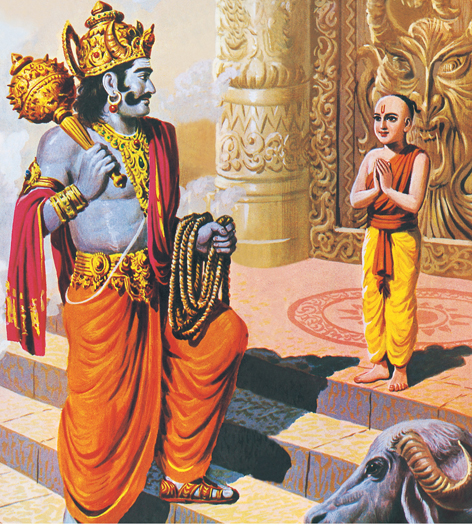
The main teaching of the Kaṭha Upaniṣad is Death’s response to the request by a young seeker, Naciketas, for Self-knowledge. Any serious student of advaita will want to know the answer as this is our own question too: using logic we may well be able to arrive at what we are not, but we still need to know clearly what we are. For this reason this book by Smt. Sarojini Varadarajan, based on Swami Paramarthananda’s traditional unfoldment of the Upaniṣad and Śaṅkara’s commentary theron, is a valuable addition to any seeker’s library.

One way of approaching this Upaniṣad is to note that Naciketas standing at Death’s door (literally) remained steady-minded enough to press his request for Self-knowledge – in spite of Death’s initial resistance to answer. And, by the end of the Upaniṣad, after Death finally gave in to the young man’s request, Naciketas ‘became pure and immortal’. Is it really possible that we can also reach the same point by closely following the teaching that Naciketas hears, especially as we are living lives grounded in fear? Continue reading

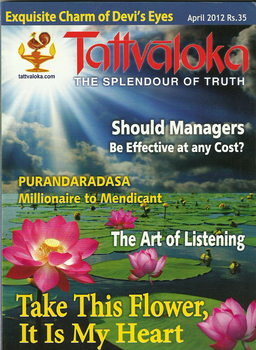
upadesha sAhasrI part 6

Part 6 of the serialization of the  presentation (compiled by R. B. Athreya from the lectures given by Swami Paramarthananda) of upadesha sAhasrI. This is the prakaraNa grantha which is agreed by most experts to have been written by Shankara himself and is an elaborate unfoldment of the essence of Advaita.

Subscribers to Advaita Vision are also offered special rates on the journal and on books published by Tattvaloka. See the full introduction and part 1 of the new series.

upadesha sAhasrI part 5

Part 5 of the serialization of the  presentation (compiled by R. B. Athreya from the lectures given by Swami Paramarthananda) of upadesha sAhasrI. This is the prakaraNa grantha which is agreed by most experts to have been written by Shankara himself and is an elaborate unfoldment of the essence of Advaita.

Subscribers to Advaita Vision are also offered special rates on the journal and on books published by Tattvaloka. See the full introduction and part 1 of the new series.

upadesha sAhasrI part 4

Part 4 of the serialization of the  presentation (compiled by R. B. Athreya from the lectures given by Swami Paramarthananda) of upadesha sAhasrI. This is the prakaraNa grantha which is agreed by most experts to have been written by Shankara himself and is an elaborate unfoldment of the essence of Advaita.

Subscribers to Advaita Vision are also offered special rates on the journal and on books published by Tattvaloka. See the full introduction and part 1 of the new series.

upadesha sAhasrI – Part 3

Part 3 of the serialization of the  presentation (compiled by R. B. Athreya from the lectures given by Swami Paramarthananda) of upadesha sAhasrI. This is the prakaraNa grantha which is agreed by most experts to have been written by Shankara himself and is an elaborate unfoldment of the essence of Advaita.

Subscribers to Advaita Vision are also offered special rates on the journal and on books published by Tattvaloka. See the full introduction and part 1 of the new series.

upadesha sAhasrI part 2

Part 2 of the serialization of the  presentation (compiled by R. B. Athreya from the lectures given by Swami Paramarthananda) of upadesha sAhasrI. This is the prakaraNa grantha which is agreed by most experts to have been written by Shankara himself and is an elaborate unfoldment of the essence of Advaita.

Subscribers to Advaita Vision are also offered special rates on the journal and on books published by Tattvaloka. See the full introduction and part 1 of the new series.

Apparent contradictions in Advaita (Q. 319)

Q: I read some serious critique of Advaita by a philosophy professor in a web page. If you have time, I`d like to know your thoughts about it.
 
Here it is:
 
. The View is Self-Contradictory: The first problem with the core of Sankara’s philosophy is that it seems to be self-contradictory. As advocates of the other Hindu schools of thought have pointed out, if the only reality is Brahman, and Brahman is pure, distinctionless consciousness, then there cannot exist any real distinctions in reality. But the claim that this world is an illusion already presupposes that there is an actual distinction between illusion and reality, just as the claim that something is a dream already presupposes the distinction between waking consciousness and dream consciousness. Moreover, Sankara’s idea of salvation–that is, enlightenment through recognition that all is Brahman–already presupposes a distinction between living in a state of unenlightenment (ignorance) and living in a state of enlightenment. So this view contradicts itself by, on the one hand, saying that reality (Brahman) is distinctionless, while on the other hand distinguishing between maya and the truth of Brahman, and by distinguishing between being enlightened and unenlightened. Continue reading

Tattvāloka at Advaita Vision

Advaita Vision is proud to announce a new collaboration with this prestigious journal from Sringeri Sharada Peetham, one of the four centres established by Sri Adi Shankara in the 9th century. Its principal objective is to spread the traditions and values taught in the scriptures. The journal is issued monthly and showcases Vedic knowledge and wisdom, with articles written in simple style by well-known authors from India and overseas. It has a readership of over 100,000.

Initially, we will be serializing a presentation of upadesha sAhasrI. This is the prakaraNa grantha which is agreed by most experts to have been written by Shankara himself and is an elaborate unfoldment of the essence of Advaita. This presentation is compiled by R. B. Athreya from the lectures given by Swami Paramarthananda in Chennai.

Subscribers to Advaita Vision are also offered special rates on the journal and on books published by Tattvaloka. See the full introduction and part 1 of the new series.

Science and the nature of absolute reality (Part 2)

Read Part 1

Although science is good at investigating objects, even there it is doomed to fail – because the essence of objects, too, is ultimately the same non-dual reality. As Atmananda Krishna Menon puts it, in his ‘Notes on Spiritual Discourses’: “As long as the least trace of subjectivity remains, objectivity cannot disappear. And until objectivity disappears completely, the real nature of the object can never be visualized. This is the fundamental error committed by science as well as philosophy, both in India and outside, in trying to approach the Truth through the medium of the mind.” (Vol 3 Notes, 1386)

Notes on Spiritual Discourses of Shri Atmananda: Volumes 1, 2 and 3, Shri Atmananda and Nitya Tripta, Non-Duality Press 2009, ISBN 978-0956309129 (Vol 1) Buy from Amazon US or Amazon UK. Continue reading