I Am Awareness

An article by Eaden Shantay
shantay2

Experience is awareness cast through karma.

Every sensation, emotion and thought is the direct result of past karma (action). In each incarnation we bring forth parabdha karma – that portion of sanchita karma, our total karmic bank account, meant to be experienced, learned from and neutralized in this life.

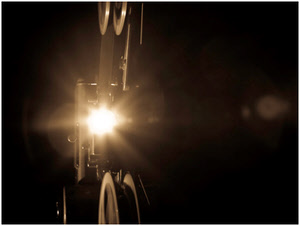
Think of parabdha karma as images on a film strip, vasanas (impressions) in consciousness left from past action. The light of true self, awareness, then shines through these impressions, creating a three dimensional, five sensory experience called me and my life.

Like any good movie, it’s easy to become hypnotized by the drama and lose touch with what is real. In realizing we are not the projected story but the awareness which animates it, we release the life or death grip we have on moment to moment experience. This is the process of dis-identification or non-attachment the Buddha spoke of.

Imagine the sky with clouds moving through it. The sky is a metaphor for awareness and clouds, the objects of sensation, emotion and thought. In meditation we practice welcoming the clouds, blessing them and then bringing our attention back to the breath. In time, we even let go of the breath and dwell in the space between the clouds – awareness, a reflection of our true nature appearing in the mind. Continue reading

Tattvabodha – Part 10

OLYMPUS DIGITAL CAMERA

Part 10 of the commentary by Dr. VIshnu Bapat on Shankara’s Tattvabodha.This is a key work which introduces all of the key concepts of Advaita in a systematic manner.

The commentary is based upon those by several other authors, together with the audio lectures of Swami Paramarthananda. It includes word-by-word breakdown of the Sanskrit shloka-s so should be of interest to everyone, from complete beginners to advanced students.

Part 10 looks at the five organs of perception and the six means of acquiring knowledge.

There is a hyperlinked Contents List, which is updated as each new part is published.

Consciousness of Choice

It is not uncommon to hear people speak of happiness as a choice, as a state of mind. But what happens when we make happiness a goal instead of an experience? And how can we know happiness through dedication, without attaching ourselves to the outcome itself? This is not a paradox. This is the nature of MokSha in the moment.

Although proponents of Advaita may conduct experiments, it is the wonder and glory of experimentation itself they have in mind. Choice is not used to bring about particular outcomes, for this would be manipulation of what is not into being; something a lived experience of Advaita cannot assume since the only ‘transition’ to be made is from not experiencing mokSha to a lived experience of mokSha.

Continue reading

The aim of Advaita VIsion

about2

If you click on ‘About’ in the menu bar at the top of the page, you will be taken to the page that lists the aims of this blog and the associated website at www.advaita.org.uk. This page was written by Peter Bonnici (with assistance from Ramesam), with whom I initiated Advaita Vision around 4 years ago. (As most readers will know, Peter is unfortunately no longer with us.) Despite its ease of accessibility, one wonders how many visitors actually read it. Certainly it would seem that some have never done so. Accordingly, I reproduce it below, since its content is so important.

*****************

This site provides a platform for all who are attracted to the vision of non-duality and like to share their views and their approaches.

Here’s why Advaita Vision will be an open platform for all committed to self-enquiry:

  1. People are at different points on their spiritual journeys.

Therefore different expressions of the fundamental principle of advaita are needed to meet their specific different needs. Continue reading

My Tuppence Worth

tuppenceIt was over two scores and a half years ago. I remember an experience when I was living in that part of India venerated by the name AryAvarta, the holy land. The cows and other cattle had a right of way even on the so-called main roads, affectionately christened ‘M.K. Gandhi Marg’ ‘P.C. Chatterji Panth’ or some such tongue twisters by the locals. The citizens or rather the bodies of the inhabitants have a natural agility and ability to automatically adopt all the tricks of an expert contortionist in walking on the road avoiding the animals or their heaps and spurts of fragrant fresh just-in-time  deliveries – made, as though, just for you.  When you are all focused on keeping your balance as you never know where your next step may have to land, a hearty greeting jolts your auditory senses. You take time to locate the source of that sound, because there is obviously no face visible nearby. You see at a distance a half raised single hand, as a mark of showing respect for you. Adept practitioners of Zen may not know the clap of a single hand, but every one over there knows a salutation by one hand. Their shout says ‘su prabhAtaM,’ a literal translation for “Good Morning.” Continue reading

‘Ego’, self, and metaphysics – Part V

From these considerations it may be seen that the boundaries between the normal and the abnormal, psychology and spirituality, medicine and metaphysics are not so well defined after all; they are not so (separate and apart) in principle, despite the attempts of modern Western science at so dividing and separating them. Our age is one in which empiricism, along with individualism and humanism (these last two almost equivalent, interchangeable terms), its ideological or philosophical underpinnings, still holds sway, although perhaps in its last, declining, phase. Continue reading

Tattvabodha – Part 9

OLYMPUS DIGITAL CAMERAPart 9 of the commentary by Dr. VIshnu Bapat on Shankara’s Tattvabodha.This is a key work which introduces all of the key concepts of Advaita in a systematic manner.

The commentary is based upon those by several other authors, together with the audio lectures of Swami Paramarthananda. It includes word-by-word breakdown of the Sanskrit shloka-s so should be of interest to everyone, from complete beginners to advanced students.

Part 9 looks at the makeup of the subtle body, its functions and purpose, from one birth to the next.

There is a hyperlinked Contents List, which is updated as each new part is published.

Dreaming of God

Here is an article I was asked to write recently for my publisher’s blog. It discusses my approach to writing about Advaita, with particular emphasis on my last book, ‘A-U-M: Awakening to Reaility’. It also touches upon that perennially thorny issue – experience versus knowledge!

Topaz-P1040197A philosophically-inclined wit once inquired into the difference between having God speak to one in a dream and dreaming about God. This metaphysical query is the basis of this article on Mind-Body-Spirit books in general and my own writing in particular.

Let’s assume for a moment that I am a ‘successful’ author (by which I mean that I have written books that are acknowledged as ‘worthy’ rather than that I have made much money from the pursuit!) There are effectively two elements to this success:
A) being able to write, and
B) being knowledgeable about the subject-matter of the books.

If I am deemed to have achieved those accomplishments, what were the principal factors? Continue reading

Serialization of Yogavasishta

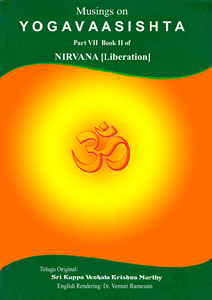
part7 cover300Professor Sri Kuppa Venkata Krishna Murthy, Chairman and Managing Trustee of I-SERVE, the Institute of Scientific Research on Vedas, has kindly given permission for Advaita Vision to serialize his 6-volume ‘Musings on Yogavasishta’. Written in Telugu, the work has been painstakingly translated by our Dr. Ramesam Vemuri and published by Avadhoota Datta Peetham.

Rather than reproducing successive extracts from the books each month, as has been done with our other two serializations, the books themselves will be made available for download in PDF format. Each part will be associated with a page at the main website, which will contain a Contents List for that volume. Links to all of the volumes will be provided on a general Contents Page.

The first part to be published is Part VII Book – II of NIRVANA (LIBERATION). We begin with Part 7 of the Series as it provides an overall summary of the Non-dual teaching and is a better introduction than simply jumping in at Part – 1. This (first posted) part also contains the Author’s submission and the Word Glossary. These will not be repeated in the other parts.

Please go to the Contents Page to read the Announcement and general introduction from Ramesam. The page for this First Volume, Part VII Book – II of NIRVANA (LIBERATION) also contains the download link for the PDF file (1.4MB).