Homage to Pujya Swamiji

swamiday

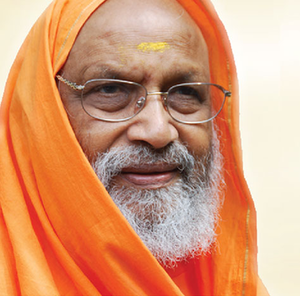
Homage to Pujya Swamiji

D.Venugopal

Pujya Swamiji’s uniqueness has already been the subject matter of a book by that name, published in October 2008 and released by Pujya Swamiji himself. However, certain very significant details of his life and teaching need to be highlighted.


I

Right from his childhood, Pujya Swamiji was distinctively different from others. He was fearless by nature. He did things that others never dared to do, like catching any snake by its tail. During those days, owing to the anti-Brahmin movement, the school boys used to rag the Brahmin boys, who were conspicuous with their tufts. Pujya Swamiji also had a tuft. He once caught off guard a tough ragger and punched him so hard that he fell into a ditch. Also, for fear of being ragged, the Brahmin boys would not opt for Sanskrit as the second language. Unmindful of the repercussions, Pujya Swamiji chose Sanskrit. He did not also take lying down the ridiculing of religious practices by his class mates but countered them by thinking out the plausible reasons for those practices. They could never outwit him in the arguments that ensued. Continue reading
ekajIvavAda, jnAni, jnAna niShTha, jIvanmukta

eka jIva vAda – Part – VI

Several times in the past we have had detailed discussions in these columns on the question whether a jnAni needed to continue the observation of some or other ‘practices’ after gaining jnAna (Self-Knowledge).  We had also seen that there is a divergence of opinion on ‘ekajIva vAda’ both in the theoretics of the doctrine and also its relevance  as a ‘prakriya‘ (a process system) for an earnest seeker.

At one of the popular traditionally oriented Advaita fora, I found a very significant Post that simultaneously touches on both the issues of (i) The ‘need’ of practices in the post-jnAna phase and (ii) ekajIva vAda as a prakriya. Without further ado, I reproduce below the authentic words of the Poster:  Continue reading

Tattvabodha – Part 16

Part 16 of the commentary by Dr. VIshnu Bapat on Shankara’s Tattvabodha.This is a key work which introduces all of the key concepts of Advaita in a systematic manner.

The commentary is based upon those by several other authors, together with the audio lectures of Swami Paramarthananda. It includes word-by-word breakdown of the Sanskrit shloka-s so should be of interest to everyone, from complete beginners to advanced students.

Part 16 looks at the ‘definition’ of Atman as sat-chit-ananda – existence-consciousness-bliss and concludes the section on Atma vichAra.

There is a hyperlinked Contents List, which is updated as each new part is published.

The Mystery – Part 6

Continuing this new, short series presenting the booklet by Bimal Prasad, in which he answers some ‘Rarely Asked Questions’ on Life. Primarily from the perspective of Advaita, questions addressed include the nature of happiness, consciousness, mind and ego. There is also practical guidance on meditation in the final chapter. Answers are relevant and succinct, so that many of the issues of interest to the seeker are covered.

This sixth part looks at the relationship between Consciousness, witness and ego, at the nature of the Self and reality, and asks what we mean by Self-knowledge. See the Contents List or go straight to Part 6 of the series.

The complete (electronic form) booklet may also be purchased from Amazon.