
Chaki: A Vedantic Perspective

  Chaki – by Bimal Prasad

This is a household grinding machine called a ‘Chaki’, made of stone.  It has two parts:an upper plate and a lower plate. The upper plate is rotated over the stationary lower plate with the help of a handle fixed at its periphery.

There is a small vertical rod fixed at the centre of the lower plate which passes through a hole at the centre of the upper plate.  The rod serves as an axis around which the upper plate is rotated with the help of the handle. There is sufficient gap in the hole through which grain is poured.

While the grain is poured by one hand, the upper plate is rotated by the other hand with the help of the handle. The grain is pressed between the plates and is ground and powdered. After some time, the upper plate is removed and the grain powder is collected from the surface of the lower plate along with the powder which has come out through the gap between the plates in the course of manual grinding.

The chaki was a common sight in Indian households; no more now. Though physically out of sight, it has left a lasting imprint on the Indian mind because of its  metaphorical association with some Hindi couplets conveying deep meanings related to life and living. Continue reading
Q.443 A ‘simple summary of advaita’

Q: Based on your own search and discoveries over all of these years, and the writing of all of the books and blogs, if you had to summarize all of this, the truth of life, what would you say? 

A: Not sure what you are looking for here. My ‘personal’ view is surely not important and I could scarcely find any better summary than Shankara’s. Anyway, I spent an hour thinking about it (while washing up and vacuuming) and here is my one line summary:

The form does not matter – it is the substance that is important.

Q: How do we know that energy/matter is Consciousness and not just what it is as energy/matter? And why does it matter? Can’t Consciousness just be what it is by itself and simply aware?

A: Energy and matter are both objects of experience. They are transient and finite, changing one into the other and ultimately ending in Absolute zero. Consciousness is the non-dual, unchanging, eternal and infinite reality.

It does not matter from the standpoint of absolute reality. It does not even matter to most jIva-s, since they just get on with the usual pleasure-seeking aims. It matters to one who is seeking Self-knowledge.

Consciousness DOES just be what it is (there is nothing else) but is not ‘aware’ in the usual meaning of the word, since there is nothing else of which to be aware. Continue reading

Q.442 Witnessing and the Self

Q: Seeing-feeling that ‘I’ am not this body (aggregate of cells) and not this external world (job, house, possessions) is much easier for me than seeing that I am not this mind (thoughts, memories, personal history, feelings). The body seems like a suit of clothes, and the external world like a bunch of random stuff. But the mind seems real. At a deep level, I identify with it, feel I am it.

It’s hard to see mental ‘arisings’, particularly those that have strong emotional resonance, as impersonal objects. It feels like my internal, mental life is the ‘real’ me.

A: If you are the mind, what happens to you in the deep sleep state?

Q: I’ve been on the direct path for a few months, limiting the scope of ‘what I know’ to what I directly experience. Speaking from that point of view, I have no clue what happens to ‘me’ in deep sleep. I don’t even know there is such a state as deep sleep, because I have no memory of having experienced it.

A: Presumably there is elapsed time between waking/dream periods. Since you have no experience or knowledge of it, do you think the Self ceases to exist during that period? Continue reading

Q.441 Creation and Morality

Q: I’ve heard/read from multiple sources that the universe/non-dual everything there is/whatever you want to call it is ‘love’. How do we know that, and why couldn’t it be hateful/evil/neutral/any other way?

A: This is the sort of statement made by ‘new-agey’ teachers. Nowhere in the scriptures (to my knowledge) is this expression used. There is ONLY brahman/Consciousness. The ‘universe’ is mithyA, which means it is not real in itself; it is just name and form of brahman. Brahman is said to be unlimited (anantam) existence (sat) Consciousness (chit) but these are only for the sake of definition/pointers. See also Q. 100 and 120.

Q: In answer to Q.120, you said: “Indeed, according to traditional advaita, part of your preparation for enlightenment involves acting unselfishly, not harming others, living a moral life etc. All the opposites do exist at this level and, if you act knowing your action to be wrong, you will incur the lawful penalty (karma).

I’m having trouble understanding why one should act ‘morally’ or ‘good’; i.e. why does karma exist at this level? Why is it set up this way?

A: The ‘bottom line’ of advaita is that there has never been any ‘creation’; no jIva has ever been born etc – there is only brahman. Obviously it does not seem like this; there is the appearance of duality and we initially believe this to be real. Accordingly, traditional advaita has a progression of teaching to accommodate this appearance. For those who still believe in duality, the teaching is aimed at the preparation of the mind to accept the more advanced teaching. This includes a world, a creator and laws applicable to the operation of the world and the action of the jIva. And the operation of cause and effect is one of these laws. If you act purposefully, you will reap the fruit of that action; if not in this life, then in the next.

Vedanta the Solution – Part 55

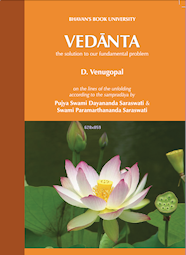
VEDĀNTA the solution to our fundamental problem by D. Venugopal

Part 55 looks at two serious misconceptions about the ‘process of enlightenment’. FIrst is the idea that the koSha-s need to be ‘cleaned’ in order to ‘reveal’ the Atman that they have been ‘covering’. The second is the idea that the Self-knowledge gained from shAstra is only ‘intellectual’ and that some further ‘experience’ of Atman must be acquired.

There is a complete Contents List, to which links are added as each new part appears.