upadeSha sAhasrI – part 18

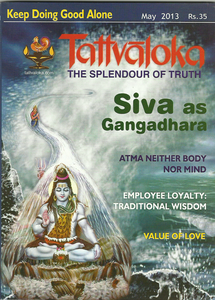
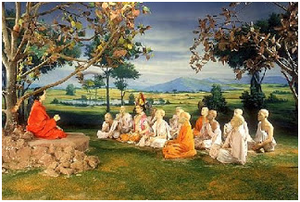
Part 18 of the serialization of the  presentation (compiled by R. B. Athreya from the lectures given by Swami Paramarthananda) of upadesha sAhasrI. This is the prakaraNa grantha which is agreed by most experts to have been written by Shankara himself and is an elaborate unfoldment of the essence of Advaita.

Subscribers to Advaita Vision are also offered special rates on the journal and on books published by Tattvaloka. See the full introduction

Nothing you can do

The point is, if you want to know what you can do, what I will say is that you can do a virtually endless number of things, none of which will necessarily provide that which you are seeking, but it may. If it happens, you causally link the two; you ignore the 10,000 other cases in which it didn’t. You say: ‘But I did that and then I got this – therefore I am living testimony! I did this and then got that, therefore there’s a connection!’ The connection’s notional of course.

Wayne Liquorman in conversation with Paula Marvelly. ‘The Teachers of One. Living Advaita. Conversations on the Nature of Non-duality‘, Paula Marvelly, Watkins Publishing
ISBN: 1842930281. Extract Link. Buy from Amazon US; Buy from Amazon UK

Who Slept Well – Part 4

This is the final part of the series from AchArya Sadananda, (only edited by myself).

Deep-Sleep State

When we go into the deep sleep state, we start withdrawing each of the kosha-s, one by one, with the desire or thought of going to sleep. The ‘I want to sleep’ thought forms the contents of the vij~nAnamaya kosha or the intellect, when it goes to sleep or when it goes into an unmanifested state.  In the process of sleeping, there is a withdrawal of each of the grosser kosha-s into the subtler ones: annamayakosha to prANamayakosha, prANamaya to manomaya, manomaya to vij~nAnamaya.  At the time of sleep, the vij~nAnamaya or intellectual sheath becomes unmanifested with all the kosha-s as part of its ingredients, but in undifferentiated form. That unmanifested state of the intellectual sheath with all its constituent kosha-s is now called Anandamayakosha, since there is absence of any discriminative thoughts and associated relationships, other than the homogeneous thought of ignorance or avidya. This is referred to as avidya vRitti.  It is, in a sense, an experience involving the knowledge of the absence of anything and everything.  Hence the Mandukya (mantra 5) says – na ki~nchana kAmam kAmayate – there is absence of desire for any object, since there is no perception or recognition of any particular object of any kind in that unmanifested state. Continue reading

Three neo-Advaitin Quotes

Three quotes from neo-Advaitin teachers on the value of seeking, and finding the truth (or not):

Spiritual seeking is the art of walking in very small circles. This does two things: it creates the illusion of motion, of getting somewhere; and it prevents one from stopping, from becoming still, which is where one would look around and see the futility of it all. David Carse

We all have a deep longing and a deep fear of the discovery of what we are, and the mind devises any way it can to avoid this discovery. The most effective way it avoids awakening is to seek it. Tony Parsons

Spiritual seekers do not become finders. Nathan Gill

Who Slept Well – part 3

OLYMPUS DIGITAL CAMERAExperiencer of the Deep-Sleep-State

As noted in Part 2, we have three experiences in the deep-sleep state: 1. I exist, since I say I slept well; 2. I have the knowledge of homogeneous ignorance, since I say I did not know anything; 3. I was happy or I did not experience the pains of BMI, since I am not conscious of the BMI or any duality. The question remains: if the mind is not there, then who experiences these and who recollects these experiences on waking up, since the experiencer and the recollector have to be one and the same? These appear to be puzzling questions that need to be addressed. Who is going to provide the answer to this – a sleeper or a waker? For this, scripture alone becomes a pramAna, or means of knowledge, since the mind that uses logic cannot provide the answers. No objective tools can be used or would be valid to analyze the deep sleep state, since all objective entities (apart from ignorance) are absent in that state. Hence, objective scientists also have no tools available for investigation. These aspects have to be clear even when we are studying the opinions of other philosophers such as Shree Atmananda-ji , unless these opinions are shruti based. Continue reading

How Vedanta Works

OLYMPUS DIGITAL CAMERAHow words work in Vedanta
(based on essays from Sw. Dayananda and Ramji)

by Tan

Vedanta is a means of self knowledge through words called shabda pramANa.

It is able to give you direct knowledge of your eternal nature through words. In spiritual circles this will be generally criticized with the argument that the eternal self, enlightenment, the absolute, Brahman, the Tao or whatever you want to call it, is beyond words and indescribable. Therefore the conclusion is that it is impossible to get direct knowledge and know your “real” self through words. Continue reading

Topic of the Month – adhikArI

adhikariThe topic for March is adhikArI – meaning a qualified seeker, i.e. someone who is mentally ready and has the desire to learn from a qualified teacher. (The ‘qualifications’ are those identified by Shankara as sAdhana chatuShTaya sampatti.)

Please submit your quotes, short extracts or personal blogs on this topic!

Sanskrit for Seekers

sanskrit_for_seekers

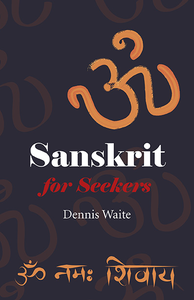
Since you are reading this blog, you are presumably a spiritual seeker interested in Advaita. It is also very probable that your knowledge of Sanskrit is minimal or non-existent. I receive occasional complaints about the use of ITRANS – the transliterated ‘English’ form of Sanskrit words – so even that causes problems for many, let alone the original script (called Devanagari) which Sanskrit uses. So why would you want to learn anything at all about the language? Well, if you really are interested in Advaita (or Buddhism, if it comes to that), it is a fact of life that most of the original material from which these teachings derive was written in Sanskrit. Without any knowledge of the language, without even the ability to look up a word in a dictionary, you are forced to rely upon the abilities, and the integrity, of whichever author happened to ‘translate’ the original text on which he or she is commenting. I am currently writing a book on the Mandukya Upanishad and Gaudapada kArikA-s, and this has involved me in referencing many different translations of the original text. [Note that this is a good example why you need to know some Sanskrit. The word kArikA means ‘a verse, commentary or treatise’ but if you ignore the capitals and write this as ‘karika’, it means ‘an elephant’!] And it would amaze you how it is possible to render quite different meanings. Whether this is because of language ability or because the author has a vested interest in propagating a particular point of view is not always possible to say. What I can say, is that is essential to be able to check specific words from time to time to ensure one gleans original intent rather than a modern, possibly biased interpretation. And, before I continue, here is a confession from the introduction to the book: Continue reading