
Who Slept Well – part 2

OLYMPUS DIGITAL CAMERAThis is the second of a four-part article by Acharya Sadananda of Chinmaya Mission Washington (edited by myself) clarifying the nature of the deep-sleep state and addressing a number of problems which frequently cause confusion in seekers.

When I enter into a pitch dark room I cannot see the presence of any object there as it is too dark. I need a light to illumine the objects. In a pitch dark room, the existence or non-existence of any object cannot be established; they may be there or they may not. In essence, their existence becomes indeterminate or anirvachanIyam. On the other hand, I can see that the room is pitch dark and understand that it is because of this that I do not see the presence or absence of any object. Darkness envelops both the known and the unknown.  However, I do not need a light to see the darkness.  In addition, I know that I am there even when the room is pitch dark.  I do not need a light to know that I am there. I am a self existent entity and therefore a self revealing entity, and hence I do not need any pramANa to know that I am present in the dark room. It is similar to saying that I do not need a light in order to see another light.  Being a conscious-existent entity, I am also a self-revealing entity or self-luminous entity or I am aprameyam, not an object of knowledge for which a pramANa is required. In addition, my presence as a self-luminous or self-conscious entity is required to illumine any other object – tasya bhAsA sarvam idam vibhUti; it is by that light of consciousness alone that all objects get revealed. Therefore, the light of consciousness that I am can illumine the darkness as well as the light that opposes the darkness.  Thus I am the light of lights, since I light the lights and darkness too – jyotir jyotiH. Therefore, I say that I see it is pitch dark which is covering the existence as well the absence of all objects. Continue reading
Who Slept Well?

OLYMPUS DIGITAL CAMERAThis is the first of a four-part article by Acharya Sadananda of Chinmaya Mission Washington (edited by myself) clarifying the nature of the deep-sleep state and addressing a number of problems which frequently cause confusion in seekers.

I wish to express my appreciation to Pujya Sastriji and Shree Subbuji for directing me to the Panchadashi Ch.11, where the deep-sleep aspects are discussed extensively by Shree Vidyaranya.  This article is in response to a question posed by a sincere seeker in a private mail. His question focused on the following:  Who is the experiencer, knower, and the recollector of the deep-sleep state, when the mind is not there? In essence, who slept well and knows that he slept well and is now recollecting that information when he is awake.  This response to the question is based on my understanding of the 11th Chapter, together with a private communication from Shree Sastriji the post to Advaitin by Shree Subbuji.

In searching for answers, I came across the article by Shree Ananda Wood on the topic of Shree Atmananda Krishna Menon’s understanding of the deep sleep state. Given the fact that all descriptions of the deep-sleep state are necessarily from the vantage point of the waking state, we can only rely for analysis on 1) shaastra pramANa and 2) those experiences that are universally common.  The problems with Shree Atmanandaji’s interpretation of the deep–sleep state are noted at the end, since there are many people that I see on Facebook, as well as elsewhere, who follow Atmanandaji writings relating to deep sleep state. Continue reading

Self – Not an object of knowledge

Quote

The Sage is often loosely described as ‘one that knows
the Self’. But this is not intended to be taken in a literal sense.
It is a tentative description, intended for those that believe
ignorance to be something that exists; they are told that this
ignorance is to be got rid of by winning ‘Knowledge of the
Self’. There are two misconceptions in this. One is that the
Self is an object of knowledge. The other is that the Self is
unknown, and needs to be known. The Self being the sole
Reality, He cannot become an object of knowledge. Also being
the Self, He is never unknown. The ancient lore tells us that
He is neither known nor unknown, and the Sage confirms it.

Maha Yoga or The Upanishadic Lore in the Light of the Teachings of Bhagavan Sri Ramana, Who”, Sri Ramanashramam, No ISBN.

upadeSha sAhasrI – part 17

upadesha17

Part 17 of the serialization of the  presentation (compiled by R. B. Athreya from the lectures given by Swami Paramarthananda) of upadesha sAhasrI. This is the prakaraNa grantha which is agreed by most experts to have been written by Shankara himself and is an elaborate unfoldment of the essence of Advaita.

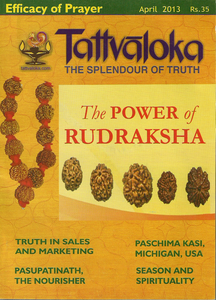
Subscribers to Advaita Vision are also offered special rates on the journal and on books published by Tattvaloka. See the full introduction

Self – Presence-awareness

…what you are, really, is this shining, ever-present sense of being, awareness, presence, is-ness or whatever. The thought ‘I’ or the sense of being a person or ‘ego’ is only a thought or idea appearing in awareness. Just see that all the other binding thoughts and ideas spin around that idea of an ‘I’ – not your actual presence. Presence-awareness is not a limited person at all. It is the vast, mirror-like, awareness-space in which everything arises. This is you. This is your home.

John Wheeler, Awakening to The Natural State, Non-Duality Press, 2004. ISBN 0954779231. Extract Link, Review Link. Buy from Amazon US, Buy from Amazon UK

More on ekajIva vAda

Rather than add more comments to the ‘mokSha for All’ thread, I thought it better to make this a separate post. It is the same topic but here I posed a question to AchArya Dr. Sadananda of Chinmaya Mission, Washington, whom I have known for a long time. I have interposed comments in his response and his follow-up comments have been added in green.

Dennis:

 Obviously any statement about the ‘nature’ of absolute  reality can only be made from the jIva’s standpoint; i.e. an  ‘as though’ pAramArthika statement made in vyavahAra. Thus, any talk about a world is clearly a vyAvahArika statement;  aham brahmAsmi is an ‘as though’ pAramArthika statement.

Sada:

Dennis – aham brahmaasmi is statement of understanding of the truth – it is recognition of that paaramaarthika state but expressed using the instruments available in vyavhaaha that is the BMI. It is not just vyaavahaarika statement about paramaarthika state. It is like when I say sugar is sweet – it is statement which may not mean much to a listener who may not know what sweetness means, but it means a lot to one who knows and is the statement born of direct experiential understanding – or aparoxaanubhuti. Continue reading

Atman- mirror

1.19. Just as a mirror exists within and without the image reflected in it, so the Supreme Self exists inside and outside this body.

The idea is this: The image in the mirror has no real existence. It is a mere appearance. Only the mirror exists. Similarly, only the Self exists. Body, mind, etc have no real existence. It is only by being superimposed on the Self that they appear to exist. Just as the reflection cannot affect the mirror, so body, mind etc cannot affect the Self.

aShTAvakra saMhitA, Swami Nityaswarupananda, Advaita Ashrama, No ISBN.

Some Thoughts And Questions On ‘mokSha for all’

Our last ‘Thoughts and Questions’ proved so popular that we are offering a new topic for your consideration:

I received an interesting Question that touches on several aspects of creation and liberation for ‘everyone’. I posted the question at Advaitin discussion group because of my doubt about its value in gaining Self-Knowledge which is after all the one that matters for us here. The question is this:

“Is there any teaching anywhere in the scriptures regarding the enlightenment and ‘freeing’ of all jIva-s? What the questioner is getting at is: will the cycle of sRRiShTi – sthiti – laya ever come to an end, namely when there are no more jIva-s left to be enlightened? Or even: if this does occur at some point, will the process start all over again with a new set of jIva-s? If not, what happens then?”

My initial apprehension was that any ‘answer’ is clearly going to be in the same category as the various creation myths that we can find scattered about in the scriptures. However, a lively discussion ensued that eventually led to eka jIva vAda, a powerful but contentious theory that describes liberation of the jIva and the simultaneous end of creation.

I give below some of the salient points that have come up in those discussions: Continue reading

Q. 358 – mAyA and avidyA

Q:
1) If Atman is perfect, how can it ever be deluded by mAyA?

2) What is the source of avidyA? If there is only brahman, how and why does avidyA exist?

Answers are provided by: Ted, Martin, Shuka, and Dennis.

A (Ted):
1) Atman (i.e. pure limitless awareness) is never really deluded by mAyA (i.e. ignorance), but rather only apparently so.  Given the non-dual nature of reality and, thus, the fact that Brahman-Atma is the only thing — though, of course, pure awareness cannot be said to be a “thing” at all due to its attributeless and unobjectifiable nature — that exists, mAyA is nothing other than Brahman-Atma itself.  That is, it is a power inherent in the very nature of Brahman-Atma.  Ironically, if Brahman-Atma, whose nature is limitless, were limited by the inability to apparently delude itself, it would not be limitless and, therefore, would not be Brahman-Atma :-). Continue reading

Topic of the Month – Atman derivation

The word Atman is derived from the root Ad which means to pervade (Ad vyApane). Atman thus means the invisible reality or substance that pervades the individuated visible forms, just as gold is the substance that pervades the visible form of an ornament. This visible form in the case of living beings includes in it the physical phenomenon called body as well as the phenomenon known as the soul.

From Karma and Reincarnation, Swami Muni Naryanana Prasad, D.K. Printworld (P) Ltd., 1993, ISBN 81-246-0022-8. Buy from Amazon US, Buy from Amazon UK