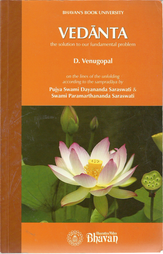
 VEDĀNTA the solution to our fundamental problem by D. Venugopal
Part 2 discusses the basic problems of insecurity that we experience from the moment of birth.
There is a complete Contents List, to which links are added as each new part appears.
VEDĀNTA the solution to our fundamental problem by D. Venugopal
Part 2 discusses the basic problems of insecurity that we experience from the moment of birth.
There is a complete Contents List, to which links are added as each new part appears.
Q: I have read the book ‘How to Meet Yourself’. I understand I think about desire; that it is a searching for a return to our natural state of happiness. I understand that we are already that, but when around women or just bored I start moving toward pornography to get relief from the desire. How exactly can I just access this happiness? Do I not take the desire seriously and not look at women, or do I need a more practical way to cope and not go down this spiritual route so to speak?
Answers are provided by: Ramesam, Sitara, Ted, Martin and Dennis. Continue reading
 Part 16 of the New Book Serialization! Vasishta explains to the dreamer why the scientific method can never ‘explain’ the nature of reality.
Q: Advaita says that ‘sarvam khalvidam brahma – all this (including all objects, which have form) is brahman’. Therefore, how can we say that brahman is without any attributes at all (including form)? Surely brahman must be both with and without form? Isn’t this what neti, neti means (not this, not that)?
Q: In Advaita, it is said that the heaven and the hell are mithya. They are just ideas for bhakti-natured people. But Advaita says this world is mithya too. So even though heaven and the hell are mithya, we are still gonna go there just as this world is mithya but it is still real enough for us? I mean the idea of heaven and hell is mithya but it is still as real as this world. So they indeed exist just as this world. Is that the correct interpretation?
A (Ramesam): Firstly the simple and straightforward answer: Yes, you are right, heaven and hell are mithya and are ideas for bhakti-natured people, in the sense that they are experienced by the people who believe in them but these loka-s (worlds) lack a substantive reality by themselves. However, we have to note that they are the second degree imaginations – imaginations of the already imaginary worldly people! By this logic, perhaps they will be strictly comparable to dreams in their order of reality. (The word mithya includes both the empirical (vyavaharika) reality and the dream world (prAtibhAsika) reality). Continue reading
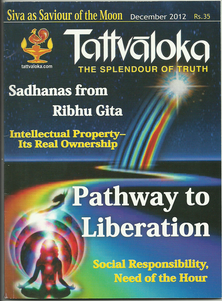
Part 13 of the serialization of the presentation (compiled by R. B. Athreya from the lectures given by Swami Paramarthananda) of upadesha sAhasrI. This is the prakaraNa grantha which is agreed by most experts to have been written by Shankara himself and is an elaborate unfoldment of the essence of Advaita.
Subscribers to Advaita Vision are also offered special rates on the journal and on books published by Tattvaloka. See the full introduction
VEDĀNTA the solution to our fundamental problem by D. Venugopal
This excellent book begins its serialization today. Apologies for the delay since its announcement but we were clarifying the copyright issue.
There is a complete Contents List, to which links will be added as each new part appears.
Part 1 is the Introduction to the book.
Q: Do you have any comments on the concept of “guru’s grace” or ‘shaktipat guru’; the idea that some teachers are able to ‘induce’ experience in seekers or ‘transmit’ knowledge or ‘spiritual power’? Numerous reports of this sort of thing abound in the literature, and I myself have experienced something along these lines many years ago from a “mystical teacher” I followed for a couple of years in 1978-1980. I wonder what is actually going on in this sort of incident. Is it just 100% psychology at work, pure self-deception? Such “transmission” experiences can often be the seed or catalyst which spurs further effort on the path. There are so many examples of an aspirant “feeling something” in the presence of a teacher or guru that it seems inappropriate to just dismiss such claims outright.
A (Ted): It is true that some teachers can “induce” experiences in seekers. The teacher’s ability to do this might be called a “spiritual” power in the sense that is seems both extraordinary – i.e. something most people can’t do – and mystical – i.e. beyond the normal range of mundane or worldly occurrences. The qualitative effect of this energy transmission on the seeker might, as well, be referred to as “spiritual power” in the sense that it powers up one’s mind-body-sense complex – most specifically the subtle body – in the same way that an influx of warm air heats up a room or the blare of dance music livens up a party. Continue reading
Part 15 of the New Book Serialization! Vasishta explains to the dreamer how the waking and dream states come into existence.
Q: Can you explain how it is possible that anything lifeless, for example a stone, a corpse or space, does not have consciousness. Yet all of this is consciousness.
A (Shuka): The svarūpa (intrinsic nature) of fire is both heat and light. However, when it expresses through water (when water is heated), only the heat principle is expressed (water does not glow, but becomes hot); however when it expresses through an iron ball (when an iron ball is heated), both heat and light principles are expressed (the iron ball both glows and is hot). This is the limitation of the upādhī (medium) through which fire expresses, and is not reflective of the true nature of fire. So also, Brahman whose svarūpa is existence, consciousness and limitlessness, expresses only its existential principle when reflected through the upādhi-s such as stone, whereas it expresses both existential and conscious principles when expressed through a living being, and as īśvara (God), it expresses in all dimensions of its svarūpa. Continue reading