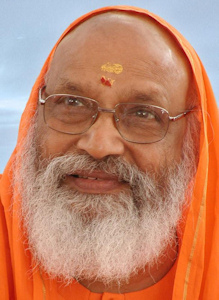
 In case anyone has not yet heard, Swami Dayananda passed away yesterday, the 23rd September, at 22.18 IST in Rishikesh. Unquestionably the greatest teacher of Advaita in our lifetimes, he must certainly rank as one of the most important ever. Fortunately the legacy of his own writings and transcriptions, and that of the institutions he founded and the teachers he taught, will live on to the benefit of future seekers.
As a topical example of his teaching, I would like to reproduce the following pieces on the subject of manonAsha. These are extracted from the excellent book already recommended in these pages: ‘Pujya Swami Dayananda Saraswati – his uniqueness in the vedanta sampradaya’ by D. Venugopal.
manonaSha or Thought-free-mind Confusion
There is also a widespread contention among the adherents of aShTANga-yoga that the truth of the self is covered by vRRittis (thought-forms) and it has to be uncovered by stoppage of thoughts (citta-vRRitti-nirodha). Pujya Swamiji clarifies that thought is not the problem. He says:
“The confusion comes from the statement that AtmA is undivided (nirvikalpa). The vision of the ShAstra is that while the knower, known, and knowledge are not separate from AtmA, AtmA is independent of all of them. In MANDukya UpaniShad and in the kArikA, the dreamer is cited as proof that there is no real division (vikalpa) such as dreamer, dream and dreamt, even though during the dream, the division was taken to be real. Continue reading →

 Part 7 of the commentary by Dr. VIshnu Bapat on Shankara’s Tattvabodha.This is a key work which introduces all of the key concepts of Advaita in a systematic manner.