Free Will Again

Scan317

Isn’t free will an endlessly fascinating topic? When is an action voluntary? On the face of it, if I want to do something and I do it, the related action is clearly voluntary. But, on analysis, we find that there is a whole spectrum of relationships between actions and the so-called volition that triggers them.

In the book ‘The Questions of Life’ (Ref. 1), Fernando Savater suggests the following scenario. I am on a train and, with my mind elsewhere (contemplating the thorny problem of free will versus determinism perhaps), I am absentmindedly playing with my rail ticket. Having been bending and re-bending it, twisting it here and there, I eventually screw it up and throw it out of the open window. Eventually, the ticket inspector arrives and asks for my ticket. Upon emerging from my intellectual reverie, I realize what has happened and I’m forced to tell the inspector that I threw it away unintentionally. Continue reading

Adi Shankara

lamp and grassMost people (or at least those who visit this website!) will be aware that the dates for Shankara’s birth and death are a trifle hazy. It is generally assumed that he lived around the ninth century A.D. and had a fairly short life, dying at around the age of 32. Fewer people will know, however, that one of the principal Maths – namely that at Sringeri – actually has his date of birth as 44 BCE. And 509–477 BCE are the dates based on records from other Maths!

In fact, there are endless discussions in the academic world over details such as these. The sort of argument that is used takes a quotation from some writing attributed to Shankara, in which another person, place or quotation is used. If the date of that cited material is known, then it can be concluded that Shankara must have been living at a time later than this. (Such arguments enable the BCE dates to be discounted.) Unfortunately, in most cases, the dates of the cited person or place are not known either! Basically, Indians in the past have not been particularly good at recording their historical events. Plus, enlightened sages are not in the slightest bit interested in having their name associated with any recorded words or in having anyone record their biographies. Continue reading

Teasing Apart Maya’s Tricks – Black Hole Complementarity and Observer-Dependent Reality

blackhole This article was previously published in two parts on the Beyond Advaita blog maintained by our Dr. Ramesam Vemuri, in continuation of an ongoing series of articles exploring the relevance to Advaita of some of the latest research in theoretical physics. Science is converging to a view that no description of reality can be complete without the observer, and that so-called “objective reality” is really more of a holographic illusion than anything truly solid or substantial. Today’s scientists are busy trying to tease apart Maya’s tricks to see how this illusion works. Leonard Susskind’s theory of Black Hole Complementarity (BHC) — the topic of this article — provides a good example of this driving curiosity in action.

Continue reading

Vision Of Truth (sad darshanam – Part 22)

धिये प्रकाशं परमो वितीर्य
स्वयं धियोSन्त: प्रविभाति गुप्त:
धियं परावर्त्य धियोSन्तरेSत्र
संयोजनान्नेश्वर दृष्टिरन्या—-२४

dhiye prakAsham paramH vitIrya
svayam dhiyaH antaH pravibhAti guptaH
dhiyam parAvartya dhiyaH antare atra
samyojanAt na ishvara dRiShTiH anyA

धिये प्रकाशं परमो वितीर्य = the self after having given sentiency to the mind;
स्वयं धियोSन्त: प्रविभाति गुप्त: = is itself hidden, as it were, and shines in the mind;
धियं परावर्त्य धियोSन्तरेSत्र = having turned the mind inward, here within the intellect
संयोजनान्नेश्वर दृष्टिरन्या = because of uniting, ishvara darshana takes place, not otherwise

The self, after having given sentiency to the mind is itself hidden, as it were, and shines in the mind . Having turned the mind inward, here within the intellect, because of uniting, ishvara darshana takes place, not otherwise

The mind which is a product of matter does not clearly have a sentiency of its own. The different states that the mind fluctuates into are enough to substantiate the fact that mind by itself is lifeless. In the waking state, the mind is fully aware, gaining impulses, reacting, reporting etc. It is alive to the world. In the dream state, the mind is partially awake. It has the capacity to manifest a dream world out of its own self; yet is oblivious to the outside world. It is in a semi -active condition. In the deep sleep, the mind is fully resolved. There is no interaction with the world nor is there a manifested dream world from the stuff of the mind. A mind which fluctuates into these conditions has to depend on something, since something that fluctuates can never be the absolute. This absolute which provides it with the aliveness is the self.
Continue reading

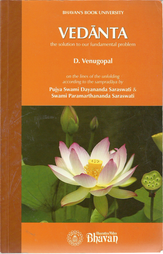
Vedanta the Solution – Part 25

venugopal_vedanta

VEDĀNTA the solution to our fundamental problem by D. Venugopal

Part 25 continues to look at who we are, in relation to experience and consciousness. There is an especially useful analysis of the logical device of anvAya-vyatireka and an examination of the concept of witness-consciousness.

There is a complete Contents List, to which links are added as each new part appears.

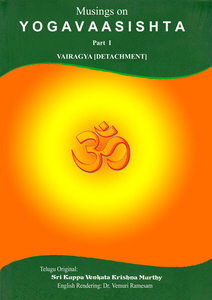
Serialization of Yogavasishta 2

part1_cover300

Professor Sri Kuppa Venkata Krishna Murthy, Chairman and Managing Trustee of I-SERVE, the Institute of Scientific Research on Vedas, has kindly given permission for Advaita Vision to serialize his 6-volume ‘Musings on Yogavasishta’. Written in Telugu, the work has been painstakingly translated by our Dr. Ramesam Vemuri and published by Avadhoota Datta Peetham.

Rather than reproducing successive extracts from the books each month, as has been done with our other two serializations, the books themselves will be made available for download in PDF format. Each part will be associated with a page at the main website, which will contain a Contents List for that volume. Links to all of the volumes will be provided on a general Contents Page.

The second part to be published is Part I (DETACHMENT). (We began with Part 7 of the Series as it provides an overall summary of the Non-dual teaching and is a better introduction than simply jumping in at Part 1.)

Please go to the Contents Page to read the Announcement and general introduction from Ramesam. The page for this Second Volume, Part I VAIRAGYA (DETACHMENT) also contains the download link for the PDF file (0.4MB).

I Am Awareness

An article by Eaden Shantay

shantay2

Experience is awareness cast through karma.

Every sensation, emotion and thought is the direct result of past karma (action). In each incarnation we bring forth parabdha karma – that portion of sanchita karma, our total karmic bank account, meant to be experienced, learned from and neutralized in this life.

Think of parabdha karma as images on a film strip, vasanas (impressions) in consciousness left from past action. The light of true self, awareness, then shines through these impressions, creating a three dimensional, five sensory experience called me and my life.

Like any good movie, it’s easy to become hypnotized by the drama and lose touch with what is real. In realizing we are not the projected story but the awareness which animates it, we release the life or death grip we have on moment to moment experience. This is the process of dis-identification or non-attachment the Buddha spoke of.

Imagine the sky with clouds moving through it. The sky is a metaphor for awareness and clouds, the objects of sensation, emotion and thought. In meditation we practice welcoming the clouds, blessing them and then bringing our attention back to the breath. In time, we even let go of the breath and dwell in the space between the clouds – awareness, a reflection of our true nature appearing in the mind. Continue reading

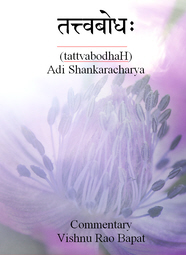
Tattvabodha – Part 10

OLYMPUS DIGITAL CAMERA

Part 10 of the commentary by Dr. VIshnu Bapat on Shankara’s Tattvabodha.This is a key work which introduces all of the key concepts of Advaita in a systematic manner.

The commentary is based upon those by several other authors, together with the audio lectures of Swami Paramarthananda. It includes word-by-word breakdown of the Sanskrit shloka-s so should be of interest to everyone, from complete beginners to advanced students.

Part 10 looks at the five organs of perception and the six means of acquiring knowledge.

There is a hyperlinked Contents List, which is updated as each new part is published.

Consciousness of Choice

It is not uncommon to hear people speak of happiness as a choice, as a state of mind. But what happens when we make happiness a goal instead of an experience? And how can we know happiness through dedication, without attaching ourselves to the outcome itself? This is not a paradox. This is the nature of MokSha in the moment.

Although proponents of Advaita may conduct experiments, it is the wonder and glory of experimentation itself they have in mind. Choice is not used to bring about particular outcomes, for this would be manipulation of what is not into being; something a lived experience of Advaita cannot assume since the only ‘transition’ to be made is from not experiencing mokSha to a lived experience of mokSha.

Continue reading

The aim of Advaita VIsion

about2

If you click on ‘About’ in the menu bar at the top of the page, you will be taken to the page that lists the aims of this blog and the associated website at www.advaita.org.uk. This page was written by Peter Bonnici (with assistance from Ramesam), with whom I initiated Advaita Vision around 4 years ago. (As most readers will know, Peter is unfortunately no longer with us.) Despite its ease of accessibility, one wonders how many visitors actually read it. Certainly it would seem that some have never done so. Accordingly, I reproduce it below, since its content is so important.

*****************

This site provides a platform for all who are attracted to the vision of non-duality and like to share their views and their approaches.

Here’s why Advaita Vision will be an open platform for all committed to self-enquiry:

  1. People are at different points on their spiritual journeys.

Therefore different expressions of the fundamental principle of advaita are needed to meet their specific different needs. Continue reading