S N Sastri

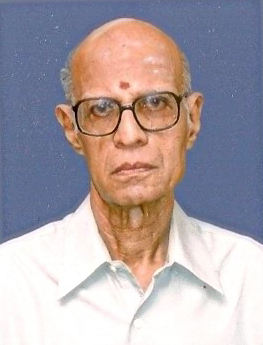
SNSastriSri S. N. Sastri (1922 – 2015)

It is with sadness and regret that we have to announce the death of Sri S. N. Sastri, one of the oldest and most respected scholars of Advaita. Sri Sastri was a moderator of the Advaitin forum for as long as I can remember. Recently, he had mostly ceased to participate in discussions as he found them very tiring but he remained an authority to whom we often turned for guidance – I consulted him on the topic of eka jIva vAda earlier this year and we were last in touch regarding ‘A-U-M’ only a couple of months ago.

To read a brief biography, bibliography and a selection of his writing, see http://www.advaita.org.uk/discourses/s_n_sastri/s_n_sastri.htm.

Vedanta the Solution – Part 23

venugopal_vedanta
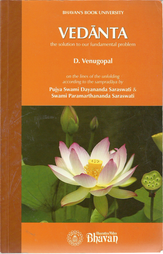
VEDĀNTA the solution to our fundamental problem by D. Venugopal

Part 23 begins the chapter on ‘Analysis of the subject in its three states of experience’. This first part looks at the three aspects of the body-mind-sense complex – the causal, subtle and gross bodies.

There is a complete Contents List, to which links are added as each new part appears.

Tattvabodha – Part 8

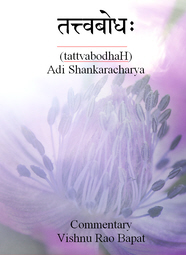
OLYMPUS DIGITAL CAMERAPart 8 of the commentary by Dr. VIshnu Bapat on Shankara’s Tattvabodha.This is a key work which introduces all of the key concepts of Advaita in a systematic manner.

The commentary is based upon those by several other authors, together with the audio lectures of Swami Paramarthananda. It includes word-by-word breakdown of the Sanskrit shloka-s so should be of interest to everyone, from complete beginners to advanced students.

Part 8 looks at the makeup of the gross body, its functions and purpose, and the modifications that it undergoes.

There is a hyperlinked Contents List, which is updated as each new part is published.

The ontological status of concepts in Plato and Shankara

Concerning the theory of Forms or Ideas in Plato – and by extension that of perception – we can find an interesting parallel in the account given by Shankara’s Advaita Vedanta. The Idea of ‘the Good’ (the supreme Idea in Platonic metaphysics) would correspond to the highest ontological principle in advaita: Atman-Brahma; in fact, there is only one ontological principle, one primary, or ultimate, reality, in both philosophers.* Objects of external perception are illusory in both accounts. In Plato they are only images (ikones) of Ideas, which alone are real, whereas in Shankara these objects are also just representations in the mind, phenomena, and described as ‘names and forms’. For example, ‘pot’ is just a name, its underlying ‘substance’ being only clay (this is only an analogy or illustration, since there is no talk of substance in Shankara’s philosophy). There are no objects, and no world, having a separate (objective!) existence, the only reality being Atman-Brahman.

* This makes of Plato a non-dualist, which is contrary to the commonly-held idea that he was a dualist, due to the emphasis given throughout the ages to his doctrine of the two Worlds, Intelligible and Phenomenal (or ‘World of Appearances’).

Tom McFarlane (writing in Quora): ‘What concepts really are is a philosophical question about their ontological status. The answer will depend upon the philosophy you adopt. A materialist would regard concepts as ultimately reducible to the functioning of the material brain, while an idealist would regard concepts (and matter) as ultimately reducible to mind or consciousness.

The most famous idealist account of concepts was given by Plato in his theory of forms. According to Plato, a concept (or form) is a general abstract pattern that has various sensory objects as specific instantiations. The concept of a tree, for example, is an abstract idea that makes it possible for us to experience trees, as such. Without the concept of a tree, we may have experiences of images but they are not recognized as being an experience of a tree without the concept of a tree. In Plato’s view, the concept of the tree is more fundamental than any particular tree because the concept is a necessary precondition for trees to exist as objects of experience. Plato called the experiences of trees as instantiations of the concept of a tree. For more discussion, see What is a form in Plato’s metaphysical theory?’

dUra

VenicedUra

Continuing the reposting of blogs from Advaita Academy, here is one from 2010. It is interesting to note that I have not further encountered this word since then! So it was a one-off. Nevertheless, it remains an interesting one and has a useful message.

I encountered a new Sanskrit word recently and its use and interpretation are quite enlightening. No doubt we are all familiar with those statements in the Upanishads which extol the extreme virtues of brahman. For example, in the Katha Upanishad, we have “the self is lesser than the least, greater than the greatest” (I.ii.20). And in the Isha Upanishad, we have “Unmoving, it moves faster than the mind” and “unmoving, it moves; is far away, yet near; within all, outside all” (verses 4 and 5). (These quotes are from ‘The Ten Principal Upanishads’ by Shree Purohit Swami and W. B. Yeats – a poetic rendering.) Then again, in the Kaivalya Upanishad (v.20), it is said “I am smaller than the smallest; I am the biggest, I am everything…Continue reading

Q. 378 – Existence and Experience

Q: Without hot, cold doesn’t exist. Without up there is no down, without in there is no out etc. The basic nature of duality. However if you apply this to the non-dual Brahman…

In the absence of that which is not (Brahman), that which is (Brahman), is not (doesn’t exist.)

My idea is that the Relative Reality is not only dependent on the Absolute (Brahman) but that actually both are interdependent on each other. I know this is counter to Advaita and forgive me and my lack of knowledge, especially of the Sanskrit terms, and I’m sure it makes your skin crawl to continually refer to things such as relativity as a reality.

Why do I say something can’t exist without it’s opposite? I will do my best to explain my ideas.

A thing cannot exist without it’s opposite because it cannot be experienced without it’s opposite, or rather awareness of it’s opposite. If a thing cannot be experienced then it does not exist, to the one experiencing it.

Ultimately, everything exists in one of two ways, either as a potential or possibility, or as a realized form. Continue reading

The demeaning of Sanatana Dharma

Over a year ago, there was a push by authorities in India to censor a book by a US professor, that they deemed did not properly appreciate, and distorted, Hinduism.  There was even a group called the Hindu Intellectual Warriors . . . the name says it all.  And rather than being condemned for their antics, they were even given succour by Vedantic ‘scholars’ including some moderators on the yahoo advaitin list.

The presumption that censorship is justified is based on assumptions which are antithetical to what Advaita means.  Firstly it presupposes that my interpretation is right, not anyone else’s.  Secondly that you are not capable of making up your own mind on such matters, and therefore need to be told what you can read.  If differentiates between those who think they know truth and those who they think don’t know the truth.  It is simply a power play.

And anyone with any sense of history knows that it inevitably presages a descent down a slippery slope.  The article today in the New York Times amply demonstrates this.

http://www.nytimes.com/2015/10/04/opinion/sunday/sonia-faleiro-india-free-speech-kalburgi-pansare-dabholkar.html?action=click&pgtype=Homepage&module=opinion-c-col-top-region&region=opinion-c-col-top-region&WT.nav=opinion-c-col-top-region

Ironic that those who, because of their insecurity, set out to defend and promote Sanatana Dharma, end up through their antics demeaning it.

Ramana, Nisargadatta, Krishnamurti, never sought to impose their views on anyone.  If people came to them they were free to smell their flower, and either linger or tear it apart.  It mattered little to them.  That is the difference between two cent scholars and jnanis.

Vedanta the Solution – Part 22

venugopal_vedanta

VEDĀNTA the solution to our fundamental problem by D. Venugopal

Part 22 concludes the chapter on ‘Enquiry into the Self as subject’, equating Consciousness and Existence and looking at the relationship between the body-mind-sense complex and Consciousness.

There is a complete Contents List, to which links are added as each new part appears.

Non-duality exchange within Internet group

A. Well….I’m done seeking. Truly now for the past few years, I have watched, listened, contemplated and glimpsed and whatever else.; relief would come and go a lot. Now that I’ve watched and re-watched Tony Parsons, Jim Newman, Robert Wolfe, Sailor Bob, Paul Smit and many more (of the radical nonduality type)….there’s just nothing left to look at..I have to admit now that I’ve let go of seeking on the computer (or seeking has dissolved mostly), I experience depression….

B. I am in the same place/state, A. Some days I just wish it would all just end as soon as possible. On those days I take comfort from something Richard Sylvester said.”All are liberated at death, it just seems more chic to do it before !!”. Love and peace to all the lost and lonely ones who are crying out for release. I have been reliable informed that I will laugh about this all one day. Its the apparent time in between now and that day that gets me.lol.

C. A, depression is an invitation of watching it without touching it. It is energy. Maybe it’s time you apply what you read and embody non-duality.

A. Thanks for the comment…but, (always a but lol) I would like to see your instructions for ‘applying what you read and embody non-duality’…just sayin’

D. I can totally identify; A seemed to get a fix from reading or watching nonduality speakers of the radical type… i’m going to see Lisa Cairns in november but the fix is very short lived and i wish it would all end. Sending big hugs to you xx

A. I don’t understand myself….lol…and also not lol…