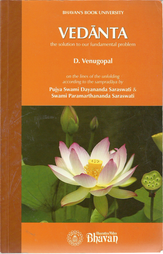
VEDĀNTA the solution to our fundamental problem by D. Venugopal
Part 11 discusses the qualifications required for commencing Self-inquiry.
There is a complete Contents List, to which links are added as each new part appears.

VEDĀNTA the solution to our fundamental problem by D. Venugopal
Part 11 discusses the qualifications required for commencing Self-inquiry.
There is a complete Contents List, to which links are added as each new part appears.
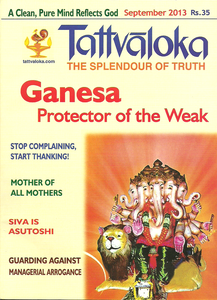 Part 22 of the serialization of the presentation (compiled by R. B. Athreya from the lectures given by Swami Paramarthananda) of upadesha sAhasrI. This is the prakaraNa grantha which is agreed by most experts to have been written by Shankara himself and is an elaborate unfoldment of the essence of Advaita. Note that this is the concluding part of the series.
Subscribers to Advaita Vision are also offered special rates on the journal and on books published by Tattvaloka. See the full introduction
All things exist. We cannot conceive of non-existence as different from existence, for even non-existence, in order that it may convey any sense, must become a content of consciousness. And consciousness must be.
Existence is the minimum to which things can be reduced, without which even thought is impossible. Everything relates to existence of some kind, and there is no thought of non-existence. To argue along the lines of Parmenides, existence is that which does not admit of any change. We cannot think what is not, for what is not cannot come into being, either from what is or from what is not.
If what is comes from what is, we would be stating something which we ourselves do not understand, for what is includes all things, and there is no such thing as the production of what is from what is. What is, again, cannot come from what is not, for what is not has no meaningful value. To posit the relation of what is to what is by way of causation involves a tautology, and to conceive of the coming into being of what is from what is not, is absurd.
There cannot be something other than what is, for what is, is the all. Even supposing that there is such a thing as the coming into being of one thing from another thing, we would have to admit that nothing other than what is can come into being, for we cannot add anything to what is, and anything added must itself be a part of what is.
There cannot be anything exceeding what is, and what is not, again, cannot come into being. That which is cannot increase, and cannot also decrease, for it is always. If something is to be removed from what is, so that the latter may be lessened, what is removed should be either what is or what is not. What is cannot be removed from what is, and what is not cannot, again, be removed from what is, for it means nothing at all.
The concept of dimension, again, is possible only when there is spatial separation of one thing from another. But even space is included in what is. So what is cannot be diminished in any way. And it cannot be increased, because we cannot add anything to it other than itself.
Existence is the whole reality. It does not admit of either addition or subtraction, production or change of any kind. In order that it may move or change, there should be space; but space is not outside it. True being has no origination, no change, and so no end. This being must be equally present everywhere, with no less or more of it anywhere. It is that which is.
As being is indivisible, it cannot conceive of a real distinction of things in it. All things are being. If there are things other than being, they must be non-being. Even becoming has meaning only when it has being. If being is to be divided, we may have to introduce some other distinguishable and distinguishing element in it, which would be nothing but non-being.
Being is reality.
from The Philosophy of Life by Swami Krishnananda, The Divine Life Society.
Janaka said:
In me, the boundless ocean, the ark of the universe moves hither and thither, impelled by this wind of its own inherent nature. I am not impatient [affected].
In me, the limitless ocean, let the wave of the world rise or vanish of itself. I neither increase not decrease thereby.
In me, the boundless ocean, is the imagination of the universe. I am quite tranquil and formless. In this alone do I abide.
The Self is not in the object, nor is the object in the Self which is infinite and stainless. Thus It is free from attachment and desire, and tranquil. I this alone do I abide.
Oh, I am really consciousness itself. The world is like a juggler’s show. So how and where can there be any thought of rejection and acceptance in me?
Chapter VII “Nature of self-realisation”, Astavakra Samhita, Swami Nityaswarupananda
Some interesting contrast and parallels can be made between the non-duality of the Indian subcontinent and the philosophical thought of the greatest Western philosopher, Plato. The concept of Becoming is a case in point. This term has, for the latter, both epistemic and ontological connotations. Its primary meaning – as doxa – is opinion, in particular true opinion (epistemology), but it is also akin to the Shankhyan concept of prakrity – underlying matter, material cause, or matrix (ontology).
On the other hand, the Platonic Becoming resembles ‘mithya’ (not true, not false): a mistaken identification, mistaking resemblance (or appearance) for identity, that is, sensible appearance for true reality. Doxa or opinion usually refers, in the Greek philosopher, to a state of indiscriminate cognition, mixing the particular with the ideal or universal, the unreal with the real, reminiscent of the double notion of avidya-adhyasa or mutual superimposition of the unreal and the real of Shankara’s philosophy.
From the stand-point of advaita Becoming is related to the vyavaharika view-point, where it has practical validity in the empirical realm. It is applicable to the disciplines of psychology, biology, and the process of knowledge/knowing, etc.
What about the notions of apparent transformation (Vivarta-vada) and real transformation (Parinama-vada), which appear to be related to Becoming one way or another? The latter, promoted by Shankhya philosophy, is refuted by Shankara and his followers as a metaphysical theory related to the cause of the world; this leaves aside the frequently quoted example of milk turning into curds of phenomenal reality, which is taken to be a real ransformation.
Concerning change and Becoming, which are practically equivalent metaphysical concepts, the final word lies with Shankara (and Gaudapada): “What is never ceases to be; what is not never comes into being”. At this level of understanding there is neither time, space nor causation.
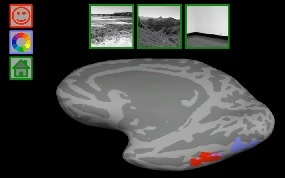 Can one day the brain science tell us “Who we truly are?”
And show the difference between ‘becoming’ and ‘Being’ in a brain scan?
Can a scan possibly differentiate a “Knower of Truth” vs an “Expert on Truth”?
Please watch this Talk (17:40 min) of Nancy Kanwisher, a Professor of Cognitive Neuroscience at MIT. Nancy’s Talk is supported by excellent graphics.
“All our thinking and activity is based on becoming, is it not? I am using that word becoming very simply, not philosophically, but in the ordinary sense of wanting to become something either in this world or in the so-called spiritual world. If we can understand this process of wanting to become something, then I think we shall have understood what sorrow is, because it is the desire to become that gives to the mind the soil in which sorrow can grow . . . We have never a moment when there is no ‘becoming’ and only ‘being’ – that ‘being’ which is nothing. But that ‘being’ which is nothing cannot possibly be understood if we do not fully grasp the significance of ‘becoming'”
“Is there not a difference between the flowering mind and the becoming mind? The becoming mind is a mind that is always growing, becoming, enlarging, gathering experience as knowledge. We know that process full well in our daily life, with all its results, with all its conflicts, its miseries and strife, but we do not know the life of flowering. And is there not a difference between the two which we have to discover – not by trying to demarcate, to separate, but to discover – in the process of our living? When we discover this, we may perhaps be able to set aside this ambition, the way of choice, and discover a flowering, which is the way of life, which may be true action.”
-J Krishnamurti
 “Becoming” seems to be an ensnaring urge for human beings the world over. This drive to “become” better or different from ‘what Is’ is not merely confined to mundane matters; it pervades the spiritual scene as well. Accordingly most of the spiritual/religious approaches cater to or focus on this human need for betterment: improving this quality or eliminating that one, mastering siddhi-s, strengthening faith, deepening some trait or transcending another one etc. And all of this “becoming” is supposed to lead us to a preset goal – whatever this may be in the respective context.
Advaita is the only philosophy that goes beyond this ubiquitous orientation towards ‘becoming.’ Not that the acquisition of certain skills or the elimination of certain identifications would be devalued but advaita points out that becoming by itself will not lead anyone to the True Knowledge, the only goal of every pursuit – simply because that goal is never away in space or time from the seeker.
Advaita’s fundamental teaching that “You are That” means that everyone in essence is already the perfection, the sat – cit- Ananda, that he/she strives to attain. In fact the only missing thing is the recognition of that simple fact. Yes, in order to gain the understanding of who you truly are, usually you will have to invest some time and effort. But at least you need not struggle to become something different from what you already are. Advaita provides the signposts towards this understanding.
Please submit your quotes, short extracts or personal blogs on this topic.
Photo credits: johnnyb@pixelio.de
Leo Hartong also uses the metaphor of clouds, as thoughts, in the blue sky of ‘I am’ awareness:
“Ramana Maharshi recommended that one investigates by asking the question ‘ Who am I?’ When asked who you are, there might be a hesitation as to what to answer; but when asked if you exist, there is no such doubt. The answer is a resounding, ‘ Yes, of course I exist.’ When the answer to the first question is as clear as the answer to the second question, there is understanding.
“The realization is that both questions have in fact the same answer. That which is sure of its existence –the innermost certainty of I Am- is what you essentially are. In other words: I Am this knowing that knows that I Am. The Hindus say Tat Tvam Asi (Thou Art That). In the Old Testament, God says, ‘ I Am that I Am.’ This undeniable ‘ I Am’ is not you in the personal sense, but the universal Self. Ramana Maharshi called the fundamental oneness of ‘ I Am’ and the universal Self ‘ I-I.’ Continue reading
 There are very many versions of the Bhagavad Gita in print, although you will have to look to Indian bookstores to obtain most of these. This can be very worthwhile. Not only are they a lot cheaper there but it is not necessarily the case that the best versions are those which are most popular and are therefore available through Amazon.
You really need to look at each of them yourself to decide which ones appeal most. I can make a few general observations but only you know what your priorities are. (It goes without saying, of course, that the Bhagavad Gita is a ‘must read’ for anyone seriously interested in Advaita!) If you want to see original Devanagari, you are restricted in choice. If you want Romanised transliteration, again not all will provide this.
If you want word-by-word translations, only a few give this (see Refs. 1 – 3 below). If you are interested in the Sanskrit – parts of speech and which verses contain which words, you want Ref. 16 (but this contains neither the text nor a commentary).
If you want the most comprehensive, understandable commentary and expense and time are no hindrance, then Ref. 15 is a no-brainer!
Finally, there is the all-Devanagari version with Shankara’s bhAshya (Ref. 18). This is a huge, hardback book, beautifully produced but, of course, totally useless unless you can read Sanskrit very well indeed. I have a spare copy of this and hereby offer to send it to anyone in the UK free of charge (or anyone elsewhere in the world if they pay the postage) in exchange for the following: you agree to be available to provide a literal translation of any (short) text by email from time to time if I need this for my writing. Email me if you are interested in this offer. Continue reading