असतो मा सद्गमय
तमसो मा ज्योतिर्गमय
मृत्योर्माऽमृतं गमय
Lead me from the unreal to the real,
Lead me from darkness into light,
Lead me from death to immortality.
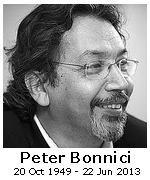
It is with great sadness that Advaita Vision has to announce the death of one of its founder members – Peter Bonnici. I first met Peter 2-3 years ago when he was recruited as a trustee for Advaita Academy but, since then, he had become a very dear friend and invaluable at helping with the site and discussing problems in Advaita. The new name for advaita.org.uk was his idea as was the basic redesign of the new site. He was also responsible for checking through and partially rewriting sections of my ‘Sanskrit for Seekers’ book which is about to be published. I have now dedicated this book to his memory.
Peter’s presence on the site will be sorely missed – he was so good at explaining Advaita. His answers to questions from visitors were consistently clear and to the point, and could be relied upon for authenticity. If he was ever in doubt (rarely), he would consult his teacher, Swamini Atmaprakasananda for clarification. I was trying to persuade him to write a book. I think I would have succeeded eventually and it would certainly have been essential reading. Dennis Waite
Until recently, Peter was also secretary of Arsha Vidya UK and an announcement is also made at that website.
Most who knew Peter through Advaita will probably be unaware of his ‘worldly’ pursuits. His bio at D&AD reads: “Peter Bonnici is an Independent Branding Consultant with over 30 years’ experience. He started as an entrepreneur running his own design consultancy, then as Director of Creative Strategy in a WPP Group agency, and currently as Brand Guardian on the management teams of client companies and Consultant to others.
“He has written popular books on design: “Visual Language: the hidden medium of communication” and “Designing with Photographs”. Brand Positioning Strategist, hands-on Designer and Writer, Peter is also author of over 30 children’s books, Chairman of a dance company and Trustee of an educational charity committed to advancing the understanding of Indian philosophy.”
The ‘Educational Charity’ was Advaita Academy, which Peter and I helped to establish and acted as trustees for its first two years. Kiran Vadlamani, its owner, comments: “He was a friend and advisor whom I respected a lot. I will remember him fondly for many things that we shared so passionately.”
The following comments have been received from the other bloggers:
“I am really grieved by this loss, so sudden and unexpected. I too felt much respect for Peter, not only on account of his knowledge and competence in explaining with great clarity and rigor difficult points of doctrinal advaita, but also for his attentive and respectful demeanor. My acquaintance with him has been all too short, but it developed into a kind of personal affinity, I think I can say, and affection on my part. As you know, we recently had an (unpublished) long exchange on ‘The Garden of Eden’, which included different aspects, such as mythology, non-duality, and alternative approaches, such as traditionalism (or perennialism). I learned a great deal from Peter and, sadly, was looking forward to a continuance in our dialogue, so fruitful for myself and, as you indicate, extensive to all of us. It is with deep feeling that I express these words in remembrance of him.” Alberto Martin Garcia
“It is beyond words what I owe to Peter. I am immensely thankful to what we shared over the last two and half years. His death is a huge loss but his life has been a gift to me.” Sitara
“Paula (Marvelly) used to write to me in high praise of Peter, but my own exchange of mails with him had been only for the last year or so. Even in this short time he leaves an impression of a close loving friend extremely humble and polite, and forever looking at the positive side of a situation. He was never arrogant or imposing in his interactions, and he was always eager to learn from everyone, though there was hardly anything for him to know anew. He undoubtedly ingested the philosophy he wrote about with inimitable clarity and he never lost a moment to put to test whether his own actions conformed to what our scriptures taught.
“The potspace that had the name Peter is now permeating us all and I hope the vasana-s it carried will have a lasting influence on us all.” Ramesam
“I was deeply saddened to hear about the death of Peter Bonnici. I have known him for about two years and in this little time have shared a priceless rapport with him. We have communicated on topics like ‘How To Create Thumbnails’ to ‘How To Celebrate Christmas Holidays With Kids’ and not to mention the highest tenets of Vedanta. The communications I have had with Peter have left an indelible impression of him being helpful, forthcoming, optimistic, humble and pure at heart. He had a good insight of vedanta and lived up to the teaching.
“His life was a gift for all those he directly or indirectly interacted with. Peter’s death is indeed a great loss. He will always be remembered.” Meenakshi
The demise of Sri Peter Bonnici is a great loss not only to us, but to the whole community of sincere seekers. It is a great loss because there are only a few that I have seen that have his sincerity, open-mindedness and patience; his blogs and comments stand testimony to this fact.
Personally, I shall always remain grateful to Peter for identifying, introducing and encouraging me as a blogger in this esteemed site. In Peter I miss a resourceful satsaṅgi.
I sincerely hope and pray that Peter’s understandings of the teaching are with his family at this juncture, without which they will feel devastated. Shuka
At first when I heard the news I was too shocked to write anything about Peterji. It took some time for me to assimilate the fact that he had gone. Death is a strange phenomenon in our world. One minute the person is alive and available, and the next minute totally gone.
I first ‘met’ Peter on-line in September of 2010, when I was at Swami Dayananda’s ashram in Pennsylvania. Peter was in London organizing Swamiji’s upcoming visit and series of talks there.
Peter and I had many wonderful Skype conversations during that time. He urged me to come to London to attend Swamiji’s program, telling me that all of my needs would be taken care of, and I would only have to pay for the plane ticket. Although I was very tempted to go, I didn’t feel that I could afford the air ticket, thus I missed my one chance to meet Peter in person.
He and I had many long Skype conversations during our sojourn at Advaita Academy. He helped me to compose the article I wrote on the subject of happiness for Yoga International Magazine. It seemed to me, we worked so well together as a team that it would be fun to collaborate on other topics, but again and alas that never happened.
Sometimes when I was in California I would see that Peter was on the computer because his Skype icon light was on. When I figured out what the time difference was between our locations, I realized that it was the middle of the night in London. Then I would send him a quick message via Skype saying, “Peter this is your mother. Go to bed!” He would write back ‘Yes, Mom.’ I don’t know if he went to bed or not, but his Skype light would go off.
Dennis, Peter, and Paula (whom I knew quite well from her visit to California) would sometimes meet and have lunch at Peter’s club in London. Those lunches sounded like a lot of fun, and really delicious, and I wished I could have been there with them. Peter’s poetic description of the ‘bread and butter pudding’ served would make my mouth water, and I hoped some day to be able to go to his club and share some with him. But again, alas, it never happened.
As our involvement in Advaita Academy began to fall apart and become problematic, Peter and I often spoke by Skype. When I got busy packing up and selling my house in California our conversations became less and less.
Luckily just this past April, after I had moved to Maui, we had another one of our long marathon Skype conversations lasting over an hour. I’m glad we had the chance to touch base one last time.
I always valued Peter’s clear knowledge about Vedanta, as well as his sense of humor, his recall of Shakespearean quotes, and his constancy as a friend. He was always there for me in whatever way was needed at the time, and I am very sorry that he is gone.
I don’t know what else to add. The teachings help us in many ways. They give us the self as the stable base of all changing experience, a safe place to rest and abide in. May Peterji always know and rest and abide as That. May he ever be free from all sorrow. Om!
Dhanya
I am shocked to learn about the sudden demise of Peter. We were in frequent touch after he responded to my query about Ishopanishad. We exchanged emails on many topics and I was impressed by the depth of his knowledge on Advaita. He was keen that I should meet Swamini Atmaprakashanada and reminded me recently that as she was to leave for India on 24th June and would be away for a while, I should get in touch with him so that he could arrange an appointment. However, due to my many preoccupations, I could not phone him before that date. I thought he would be less busy after her departure and was thinking of phoning him one of these days to arrange a meeting with him to learn more about him and the organisation of which he was Secretary. I found him kind, very helpful and erudite. i was eagerly looking forward to meeting him. Sadly, that was not to be. I would like to join you and others in paying my tributes to a lovely man, who was snatched away far too soon. Please convey my condolences to his family. Gurudas Bailur
Below is, as far as I know, Peter’s last written communication, on 19th June, in answer to a question regarding the varNa Ashrama and whether a shUdra was qualified to study Vedanta:
If you accept that the castes can be spoken of at three levels – birth, occupation and temperament (guṇa) – then it should be clear to you that a person who, by temperament, is primarily tamasic, secondarily rajasic and with sattva weakest is going to find it difficult to apply him or herself to study (as Dennis has pointed out too). This guṇa balance is given the name’ śūdra’. I’m sure we will all agree that, with this understanding of the term śūdra, you will have little quarrel with the assertion that a ‘śūdra’ mentality is unqualified for the very subtle teachings of śruti.
But, as you point out, Śaṅkara appears to be referring to the social designation of śūdra by bringing in the matter of the upanayana ceremony, saying that only those that have gone through this ceremony are fit for knowledge. And, as the śūdra has not gone through this ceremony, he/she has no competence for knowledge.
But here is a commentary to 4.2.3 from my copy of the Chāndogya Upaniṣad where the story of Jānaśuti and Raikva occurs:
According to Śrī Śaṅkara and the Brahmasūtra (1.3.34-35) the word ‘śūdra’ is to be taken in the etymological sense, meaning one who is affected by sorrow (śucā) and runs towards Raikva (ādravati) on hearing the glory of Raikva, or one who hastens (to Raikva) because of sorrow. Or (Raikva calling Jānaśuti a śūdra) may express displeasure at the king having come to him for acquiring knowledge through gifts only and not through service; or at his having come with little wealth thus behaving improperly like a śūdra. So Jānaśuti is not a śūdra by caste. According to Śrī Śaṅkara he was a kṣatriya king for he has a kṣattā (charioteer) under him.
( Chāndogya Upaniṣad, translation and annotation by Swami Swahananda, Sri Ramakrisna Math publication, p226)
The main point, however, is to be like Alexander the Great who just sliced the infamous Gordian Knot in two with his sword, unlike others who struggled to undo it by hand (and failed). Why break one’s head over answering these questions? All one can do is pursue one’s own sādhana as best one can and leave others to argue about such matters as whether or not a śūdra is fit for knowledge.
I, for one, have not been through the upanayana ceremony and yet my teacher, Swamini Ātmaprakāśanandaji, who is very, very traditional in many respects, has no problem in accepting me as her student. So, may you have the good fortune to find a teacher who can guide your understanding and lead you out of the self-ignorance that holds all of us under its oppressive grip.
*****
A poem by Alberto Martin Garcia, re-worked and translated in memory of Peter:
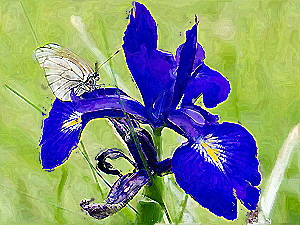
Are our lives like the life of a flower – A promise A hope A passing beauty?
And what are that promise
And that hope?
How do they find fulfillment –
Their time being ever so short?
As to beauty, does ours fade away
Like the beauty of the flower?
Fear not, for time is not involved:
The Beauty and Essence of the flower
And of our Soul
Are timeless, Infinite.