One with All

antique_blue_and_white_stoneware_salt_crock__lid_1_thumb2_lgw

A little story…

On the kitchen shelf of an apartment shared by students, there’s a colourful mixture of containers – a large box of teabags, a coffee tin, smaller jars with spices, a high glass with spaghetti, a blue and white saltshaker, a big muesli jar, etc.

The muesli jar squints at the glass with the spaghetti and sighs, feeling much too fat once again. But after a while, he realizes that the glass with the spaghetti is used a lot less frequently, which gives him a boost. Then he glances at the box with teabags, which is even more popular and moreover has an exotic design. His mood sinks. But luckily he remembers that actually the inner values count; he recognizes that he has a great variety of things to offer, exceeding all others, and he feels better immediately. But once he is placed back on the shelf, entirely empty after breakfast, the muesli jar falls into a deep depression. Continue reading

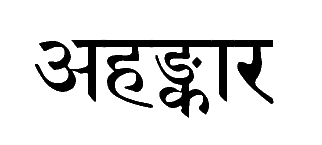
ahaMkAra – fixed quality

ahankaraWhen it comes to identity, we try to find something that we are, somewhere we can plant our flag and say: “This is me. ” The verb ‘to be’ implies a stationary, fixed quality. For instance, “I am a radio show host” has a very different quality from “I host a radio show.” The words ‘I am’ imply that whatever follows is a fixed quality of being, not something that comes and goes.

Nothing Personal: Seeing beyond the illusion of a separate self, Nirmala, Endless Satsang Foundation, 2001. ISBN 978-0-6151-8767-9. Buy from Amazon US, Buy from Amazon UK

The Ego – Walls

616712_web_R_K_B_by_pogobuschel_pixelio.de

He whom I enclose with my name

is weeping in this dungeon.

I am ever busy building this wall all around;

 and as this wall goes up into the sky day by day

I lose sight of my true being in its dark shadow.

I take pride in this great wall,

and I plaster it with dust and sand –

lest a least hole should be left in this name;

and for all the care I take

I lose sight of my true being.


Rabindranath Tagore

(title by Sitara)

Poem source: http://www.saieditor.com/stars/tag.html

Photo credits: pogobuschel@pixelio.de

Action – Enlightenment

Results of action are of four types:

1) utpAdya – a result in the form of a product, like a pot.
2) Apya – a result in the form of reaching, like going abroad or to heaven.
3) saMskArya – a result in the form of removal of impurity and imparting a good qualiity.
4) vikArya – a result in the form of modification, e.g. milk to yoghurt.

Making, reaching, purifying and modifying are the four results obtained by karma. mokSha (enlightenment) is not a product because it is nitya (eternal). It cannot be reached because it is you. It cannot be purified because it is free from blemish. It cannot be modified because it is one whole. Hence, nitya-mokSha is not a product or by-product of karma.

muNDakopaniShad (Vol. 1), Swam Dayananda Saraswati, Arsha Vidya Centre. ISBN 81-903636-3-8.

The Male Chauvinist Pig in Us!

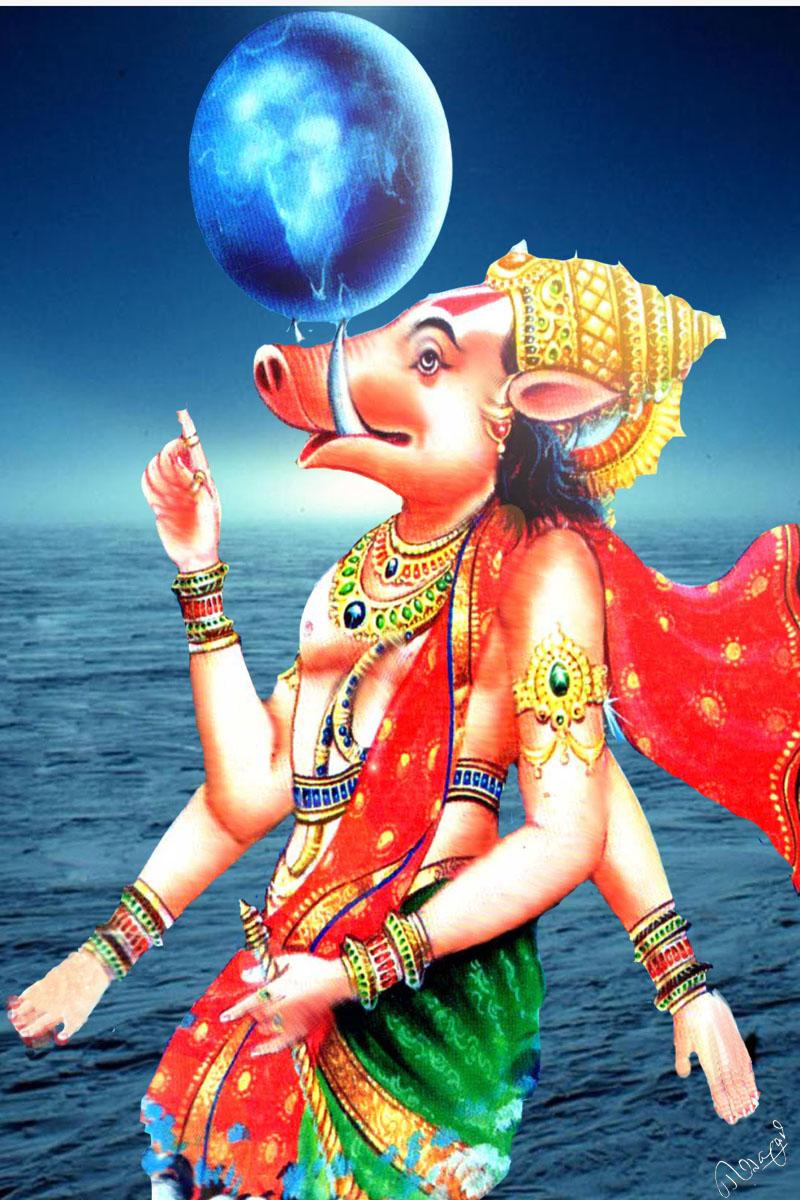
varahavatara

Varaha avatar – Vishnu’s Incarnation as a Boar

vivekacUDAmaNi is a famous text on advaita teaching, usually  ascribed to Shankara. The very first verse, after the formal salutation for auspiciousness, speaks of the rarity to be born as a male human being. It says:

jantUnAm narajanma durlabham atah pumstvam tato vipratA …

(For all beings, the human birth is difficult to obtain; much more so is a male body; rarer than that is brahminhood…)

Now we have genetic support!

Dr. E.M. McCarthy, a Georgia University geneticist, comes up with a controversial new hypothesis of humans evolution. He says that the genetic evidence overwhelmingly suggests that we are a rare cross between  a male Pig and a female Chimp.

Can 48/2 of Chimps chromosomes + 38/2 of pig = 46 of a man? Well, don’t ask such silly math questions. Who  can remember  what happened after all over 80 million years ago?

So Sitara, Dhanya and Meenakshi, Don’t blame us if we are boastful of ourselves!

(If you are more curious see: http://www.macroevolution.net/human-origins.html#.Upoej8RDuSr)

upadesha sAhasrI – part 15

upadesha15

Part 15 of the serialization of the  presentation (compiled by R. B. Athreya from the lectures given by Swami Paramarthananda) of upadesha sAhasrI. This is the prakaraNa grantha which is agreed by most experts to have been written by Shankara himself and is an elaborate unfoldment of the essence of Advaita.

Subscribers to Advaita Vision are also offered special rates on the journal and on books published by Tattvaloka. See the full introduction

Difference

differenceVive la difference!

I am still in the process of writing my next book on the Mandukya Upanishad and kArikA-s. I have just written the following section on the concept of ‘difference’. Since I posted a query to the Advaitin group, relating to what Swami Paramarthananda had said on the topic, I concluded by sending the completed section to the group. Accordingly, I am also posting this here.

In his commentary on this kArikA (2.34), Shankara touches on the logic of this concept of ‘difference’ and Swami Paramarthananda expands upon this. What, he asks provocatively, is the color of the difference between red and blue? Clearly, it is potentially a very important topic since, if it could be proven logically that the idea of ‘difference’ is incoherent on examination, it would effectively demonstrate the non-dual nature of reality. Numerous post-Shankara philosophers have looked into this and formulated involved arguments. There is extensive material in the post-Shankara texts of brahmasiddhi, iShTasiddhi, tattvashuddhi, khaNDanakhaNDakhAdya and chitsukhI/tattvadIpikA but, having looked at these, they seem too impenetrable to study in detail. (No references are given for these – you really don’t want to read them!) Continue reading