Q. 358 – mAyA and avidyA

Q:
1) If Atman is perfect, how can it ever be deluded by mAyA?

2) What is the source of avidyA? If there is only brahman, how and why does avidyA exist?

Answers are provided by: Ted, Martin, Shuka, and Dennis.

A (Ted):
1) Atman (i.e. pure limitless awareness) is never really deluded by mAyA (i.e. ignorance), but rather only apparently so.  Given the non-dual nature of reality and, thus, the fact that Brahman-Atma is the only thing — though, of course, pure awareness cannot be said to be a “thing” at all due to its attributeless and unobjectifiable nature — that exists, mAyA is nothing other than Brahman-Atma itself.  That is, it is a power inherent in the very nature of Brahman-Atma.  Ironically, if Brahman-Atma, whose nature is limitless, were limited by the inability to apparently delude itself, it would not be limitless and, therefore, would not be Brahman-Atma :-). Continue reading

The Purpose of Life, Part 5

Inquiry 5:  What Validity Has Vedanta?


The root problem is that in the end, even Advaitic teachings finally rely on ‘blind faith’ to put their point across. There’s nothing wrong in having faith. All religions ask for blind belief in the almighty to get you your promised ‘Kingdom of God’. It’s only in Advaita that folks try to push their case by saying: “No, it’s not pure faith, it’s by reason and discourse that we reach the truth etc”.

To quote Gaudapada in his Mandukya Upanishad kArikA, “That which is stated in the scriptures ‘and is supported by reason’ is true and nothing else”. The ‘reason/discourse’ argument for following Advaita is pure bunkum, in my opinion. It relies on blind faith not on a deity, but in an obscure ‘Self’.


The implication of this series of questions is that the self is wholly theoretical, that it is some philosophical conjecture cooked up and served to the mindless masses as a means of pacifying their angst over an apparently purposeless existence.  It further suggests that the self is either a half-baked notion to be accepted on blind faith or an intricate intellectual construct whose validity is so be settled through argument alone.


Vedanta, however, is neither a faith-based religion nor a theoretical philosophy.  True, its method of self-inquiry does require faith in its initial stages because the student’s understanding is still clouded by ignorance.  But the truth revealed by Vedanta is verifiable through a conscientious examination of one’s own experience.  This isn’t to say, of course, that self-knowledge is a discrete experience, but rather that the knowledge contained in experience and which can be culled from it through thoughtful, logical inquiry does serve to reveal the truth when it is properly understood and assimilated.


Actually, according to Vedanta, the quest for a discrete experience of the self is completely gratuitous.  The fact of the matter is that we are already experiencing the self every moment of our lives.  If reality is non-dual – which it is – then quite obviously there exists nothing other than the self that can be, ever has been, or ever will be experienced.


This assertion, of course, voicing as it does the fundamental understanding upon which the whole science of self-inquiry is based, begs an answer to the question, “How do we know that the nature of reality is non-dual?”

Continue reading

Topic of the Month – Atman derivation

The word Atman is derived from the root Ad which means to pervade (Ad vyApane). Atman thus means the invisible reality or substance that pervades the individuated visible forms, just as gold is the substance that pervades the visible form of an ornament. This visible form in the case of living beings includes in it the physical phenomenon called body as well as the phenomenon known as the soul.

From Karma and Reincarnation, Swami Muni Naryanana Prasad, D.K. Printworld (P) Ltd., 1993, ISBN 81-246-0022-8. Buy from Amazon US, Buy from Amazon UK

Vision Of Truth (sad darshanam) – Part 16

तद् युष्मदोरस्मदि सम्प्रतिष्ठा

तस्मिन् विनष्टे अस्मदि मूल बोधात्

तद् युष्मदस्मन् मति वर्जितैका

स्थितिर् ज्वलन्ती सहजात्मनः स्यात्—१६

tad yuShmadorasmadi sampratiShThA

tasmin vinaShThe asmadi mUla bodhAt

tad yuShmadasman mati varjitaikA

sthitir jvalantI sahajAtmanaH syAt—16


tad yuShmadoH = third person and second person; asmadi sampratiShThA = depend

on first person;tasmin vinaShThe asmadi = first person eliminated; mUla bodhAt =

by knowledge of the source;tad yuShmadasman mati varjitaikA= the one division-less

without the notion of‘that’,’thou’, and ‘I’;sthitir jvalantI sahajAtmanaH syAt = the self shines

and emerges

The third person and second person depend on the first person. By the knowledge of the source, the one division-less without the notion of ‘that’, ‘thou’ and ”I’, the self shines and emerges.

The words ‘you’, ‘that/he she’ etc (the third and second person) have their basis in the first person. The other becomes the second or third person only with reference to the first person.

Continue reading

Some Thoughts and Questions on Free Will

From: Peregrinus the Nihilist

I finished reading your five-part series on free will yesterday evening, after several sittings over dinner. It was an interesting and informative presentation indeed. The question of free will has occupied my mind for some years now. In fact, one of the things that drew me to Advaita Vedanta was its position on free will — it seems that more than a few of the arguments closely resemble my own.

Reading your case against free will in HOW TO MEET YOURSELF (pages 170-174), I was struck at how similar it was to the one made roughly 80 years ago by the 20th century English scholar Joseph McCabe. I think the passage is worth quoting in full, as you might find it interesting:

“When you say that you are free to choose—say, between the train and the surface car, or between the movies and the theater—you are using rather ambiguous language. All common speech for expressing mental experiences is loose and ambiguous. You have the two alternatives—movies or theater—in your mind. You hover between them. You do not feel any compulsion to choose one or the other. Then you deliberately say to yourself—not realizing that you have thereby proved the spirituality of the soul, which has made apologists perspire for centuries—‘I choose Norma Talmadge.’ Continue reading

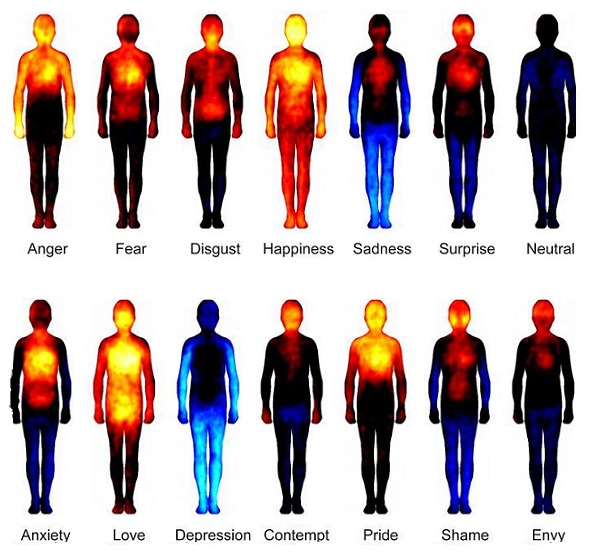
Mapping Emotions

Bodily Maps of Emotions (after Prof. L.  Nummenmaa et al, Dec 2013)

Bodily Maps of Emotions
(after Prof. L. Nummenmaa et al, Dec 2013)

Imagine yourself to be the Sun God.

Think that your entire body — the face, limbs and all – is made out of the Sun-stuff, as though you are a 3-D cutout of the Sun disc.

Visualize yourself as the brilliantly shining, dazzling-to-the-eyes, bright person with boundless effulgence all around with an intensely white lustrous contour line along the edges to your shape.

(Hint:  As a first step, you may think of yourself as an astronaut completely covered in a space suit. Then imagine the suit shining like the Sun). Continue reading

upadesha sAhasrI – part 16

upadesha16

Part 16 of the serialization of the  presentation (compiled by R. B. Athreya from the lectures given by Swami Paramarthananda) of upadesha sAhasrI. This is the prakaraNa grantha which is agreed by most experts to have been written by Shankara himself and is an elaborate unfoldment of the essence of Advaita.

Subscribers to Advaita Vision are also offered special rates on the journal and on books published by Tattvaloka. See the full introduction

Q. 357 – Existence of Objects

Q.  Dear Dennis,
 
I bought and read two of your ebooks and liked them so much then I looked at your blog and came across this:

http://advaita-academy.org/blogs/DennisWaite.ashx?Y=2010&M=November

You say objects really exists, Advaita is not idealism, it is realism. I don`t understand this, in your book you use dream metaphor, you use “cinema” metaphor you even said in your book:
 
“He goes on to explain that our normal states of consciousness – waking, dream and deep sleep – are at the level of appearance. Reality is the non-dual background to these states. Just as our dreams seem real to the dreamer, so this world-appearance seem real to the waker. But, on waking, it is realized that those dreams are nothing but an illusion generated by the mind.
 
Similarly only on awakening to god-consciousness will you appreciate and realize the staggering truth that there exists nothing other than Brahman everywhere. Until that supreme state is reached, the universe will appear real. Living in your present state of ignorance you will have to accept the world that you experience. But at the same time try to contemplate and realize the truth proclaimed by Self-realized souls that Brahman alone exists.”
 
  So you changed your mind after writing the book and now you say World-appearance is real, Advaita is realism and there is no illusion at all?
 
I`m confused, can you explain? Continue reading