 Extract: Happiness is Here Right Now
from the book ‘Embracing the Now: Finding Peace and Happiness in What Is‘ by Gina Lake.

Extract: Happiness is Here Right Now
from the book ‘Embracing the Now: Finding Peace and Happiness in What Is‘ by Gina Lake.
Q: I can see I need to live more austerely, and I am prepared to sacrifice much to bring about a more lucid and disciplined spiritual practice, but if I am honest, sacrificing those pleasures will have their cost and I will miss them. I would give up nearly anything to find a way forward, but I have heard that unless giving up pleasures is seen as so necessary it isn’t actually a sacrifice, it won’t produce any progress, making it pointless. I am confused. Living austerely definitely means sacrifice, and I could do it, but what’s the point in doing it if it won’t work? I hope I have been clear. If you could tell me what you think, I would be most grateful.
A (Sitara): Your emphasis on austerities and sacrifice indicates that you are influenced by a tradition other than Advaita Vedanta. While following dharma (an ethical lifestyle) has its place in Advaita Vedanta, it does not require austerities. It just means “be fair”, i.e. treat others the way you yourself would like to be treated. Also following a spiritual practice of meditation and prayer is thought of as beneficial for the seeker; but there is no need for much sacrifice here either, except for remaining with it even if sometimes inconvenient – having to get up a little earlier for example. Continue reading
We have Sankara exhorting us in Vivekachudamani: “The first step to Liberation is the extreme aversion to all perishable things, then follow calmness, self-control, forbearance, and the utter relinquishment of all work enjoined in the Scriptures.” And a little later he added: “He who is free from the terrible snare of the hankering after sense-objects, so very difficult to get rid of, is alone fit for Liberation, and none else even though he be versed in all the six Shastras.”
“Mind control is self-control,” said the highly revered Swami Krishnananda of Divine Life Society. And self-control is the way to awakening, he added.
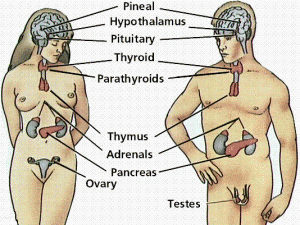
Fig 1. Endocrine Glands
Six passions of the mind called Arishadvargas were depicted as the internal enemies of the man on the path to attaining moksha (liberation). These correspond to the hormones produced at the six major nerve plexuses as shown in the figures 1 and 2 and Table 1.
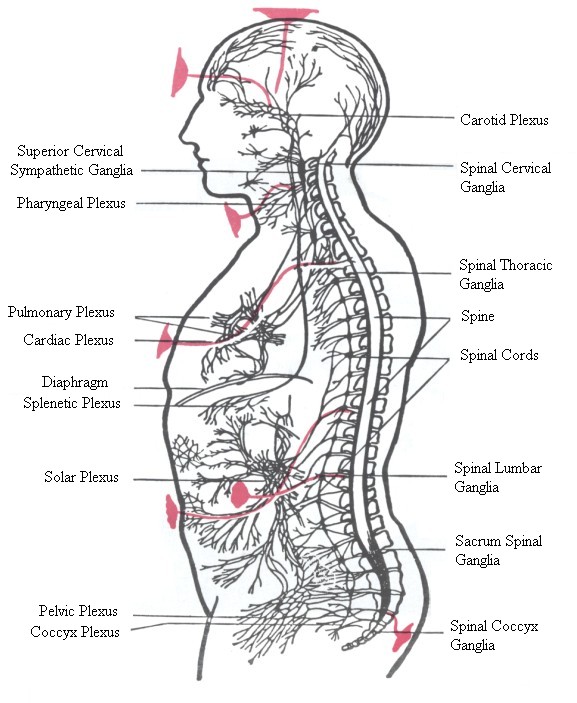
Fig 2. Nerve Plexuses
Psychologist Piercarlo Valdesolo writes “The power to resist temptation has been extolled by philosophers, psychologists, teachers, coaches, and mothers.” And then he adds, “Of course, this assumes that our natural urges are a thing to be resisted – that there is a devil inside, luring you to cheat, offend, err, and annoy. New research has begun to question this assumption.”

Part 5 of the New Book Serialization!
The dreamer asks the dream-Sage Vasishta about the planes of existence after death and about escape from all planes (kaivalya mokSha). He goes on to enquire as to how his own dream creation can be teaching him.
Q: ‘Experiential’, seemingly, is becoming a stumbling block in current discussions within spirituality and non-duality. There are the ‘experiential’, usually ‘anti-intellectual’ types (who deprecate ‘merely intellectual’, or ‘conceptual’ approaches), and those who defend the proper use of mind and the intellect, without denying the validity of experience.
Would it be possible, though, to dispense with either of the two concepts: ‘knowledge’ and ‘experience’?; they appear to overlap, practically being synonyms and, indeed, one can say “I know pain in the belly”, or, “I know such and such emotion”, “I know (I am acquainted with) life”, etc., without resorting to the word ‘experience’ – the word ‘acquaint’, conveniently, is derived from the Latin via old French: cognoscere, gnoscere. The other alternative would be to dispense with the word ‘knowledge’ and use instead ‘real’/’unreal’, ‘reality’, which is, precisely, sat/asat in sanskrit – and expressions using these terms are quite frequent, as everybody… realizes (‘is cognizant with’, then, would have to be ruled out). Just today I wrote in a comment that true understanding is an experience, but now I have my doubts. Ultimately, certainly, the only Experiencer/Knower is brahman/atman (though he remains ever unmoved). Continue reading
Verse 1 continued…
Ramana Maharshi then puts down a question; “How can we remember this un objectifiable, one truth”. He goes on to answer in the same breath. Remembering it is abiding in it as one’s own self.
ABIDANCE itself is REMEMBRANCE. One cannot remember it as an object. Remembering is a thought; remembering constantly is repeated thought; forgetting is also a thought. The self is not an object of remembrance and forgetfulness. The constant abidance in it as non different from one’s own self is real remembrance.
It is not mentally repeating “I am Brahman”. Instead it is a firm, unshakeable conviction of one’s own true identity. Come what may, objective experiences, within and without keep changing but the truth is apprehended as is. If there is repetition of words in the form of remembrance then it is a mind- based transaction. Any mind based transaction has a beginning and an end (it also being an action). Hence, prior to the beginning of the action and post the action, the identity of Atma and Brahman, then, has to discontinue. If this is so, the eternality of Atma will be in question. Hence, it cannot be a mind-based transaction. Continue reading
 The aim of my previous blog on this topic was to clarify the term mithyā and thereby bridge the apparent gap between everyone’s perception of a diverse and ‘real’ universe and the advaita teaching that says that there is only one single non-dual Reality. Mithyā is that which cannot be dismissed as unreal nor can it be accepted as absolutely real. Due to a mistranslation of the word, many declare the mithyā universe to be an illusion and consequently act as though it can be discounted as if it was absolutely non-existent. Through the analogy of water and wave we are led to understand that, whilst still perceiving the wave, we nevertheless know that what we’re seeing is nothing but water. Similarly when looking out at the mithyā universe the wise person knows that what’s being seen is nothing but Brahman, pure existence-consciousness without limit.
This is not such an easy achievement. Continue reading
 A series of posts, presenting a new translation and commentary by James Swartz on the Panchadasi. This was presented by James as a week-long course during July 2012 and was very well received.
This is Part 2 and contains the teaching on the pa~nchikaraNa (‘quintuplication’ of the elements), macrocosm and microcosm, pa~ncha kosha (five sheaths) and the ‘elimination’ of these.

The teachings of nonduality are very popular in the West these days. One of the reasons I feel many people are attracted to these teachings is because they assume the teachings circumvent or do away with the idea of ‘God.’ I mean if there is only one thing here, one thing that truly exists, that does way with the troublesome God concept, right?
The word God itself is used and defined so variously these days as perhaps to be rendered useless anyway. However, when one examines the dual world of experience, there is one thing that cannot be denied. It seems to be put together and functioning in an intelligent manner. Continue reading
Q: I read about the above topics in your book and struggled with them, not only because there are a number of things to remember, but also because how exactly they function is complex.
I thought about what you said regarding svadharma and how not going with it, with the example of Arjuna in the Bhagavad Gita, would have been bad for ones karma and thought about Hitler.
You might say that it was Hitler’s svadharma to do as he did and that to go against that, in other words, to be an ordinary politician or something for example, would have given rise to bad karma for him, the same way as going against his duty would have caused Arjuna bad karma, as explained by Krishna: ‘slay thy foes’. But then that seems unfair to him (Hitler), since surely his ‘bad actions’ (genocide, etc.) that his svadharma would have had him following would have brought him bad karma any way, so either way, things, from that perspective, looked pretty bleak for him? Then one might say that what Hitler did was not really his svadharma, but this I personally would agree with, as a ‘person’ cannot act outside of Brahman, that is, everything we do, feel, think is Brahman, so even Hitler’s ‘evils’ were also Brahman? Continue reading