Three stages to the advaita vision

1. Recognising: “I alone, the Self, the knower, am consciousness.” Consciousness is known to be the Self in one’s own mind, i.e. as the svarūpam [intrinsic nature] of the knower, distinct from the body-mind-sense complex and the external world. 
Various analytical methodologies, prakrīyas, are used (in conjunction with studying with the teacher) to arrive at this step of understanding: logic and scriptural study are both employed. The prakrīyas include dṛg dṛśya prakrīya [seer-seen analysis], avastā traiya prakrīya [analysis of the three states of experience: waking, dream and sleep], pañca koṣa prakrīya [‘5-sheaths’ analysis]…

2. Understanding: “I, the consciousness behind the mind, is one and the same in all the minds, and behind everything in the universe.” (This is like understanding that H2O, the truth of the name and form ‘wave’, is the same as the truth of every wave and also the truth of the entire ocean.)
The prakrīya used to arrive at this is the pañca koṣa prakrīya [‘5-sheaths’ analysis]…

 After these two stages, jīva-Īśvara aikyam [oneness of individual and Lord, the cause of the universe] is firmly established. This is arrived at by understanding that the truth of the individual is consciousness, and that this consciousness is nothing but Īśvara at the cosmic level.

3. Seeing: “I, the consciousness alone, am satyam, and everything apart from consciousness is mithyā [not non-existent, not absolutely existent, but ‘as though’ existent]” And that mithyā is ultimately nothing but consciousness itself. This creation is nothing but ‘I’, the consciousness + name and form ‘universe’.
The prakrīya used to arrive at this is the kāraṇa kārya prakrīya [cause-effect analysis]…

 After this stage, jagat-Brahma aikyam [oneness of the universe and Brahman, the absolute Reality] is established, i.e. everything is resolved into the one-without-a-second Reality. Brahman alone exists.

This is the advaita vision.


Repetition of practices (Q. 316)

Q: I can see that whatever is seen cannot possibly be me, the seer, the perceiver. The perceiver cannot be perceived because it is perceiving. That seems really obvious and clear (usually, not always, don’t need to claim any more than is really the truth at present.)
 
Whatever practices, meditations I’ve ever done always end up at the same place: I come back to I/me, the perceiver. Whatever experiences of bliss, ecstasy, I’ve had always end up going away. I come back to: I, the perceiver. I’ve gotten to the point where I don’t care whether some bliss state occurs because I know it won’t last, and, ha, it took many years of going through the same thing over and over again. I’d have that bliss state, or whatever we might want to call it, try to hold on to it, be disappointed when it went away and then “work”
to get it back again!!! Seems absurd now…
 
…the question is: I guess I continue to understand that I can’t be what I perceive, whether outwardly, in the world, or inwardly, persona maybe….just continue to come back to “I” perceiving all this? There is no particular joy in this or happiness, in the sense that I know all these experiences don’t last. But there seems to be some bed-rock perceiver which doesn’t go away except in deep, dreamless sleep…As I’m writing this I think again that I really need a teacher, but don’t see that happening anytime soon. In the mean time….books, being the perceiver and not the perceived…I guess!!! Thanks. Continue reading

Truth versus Truth or Apples versus Oranges

The other night I had dinner with a young friend.  She is someone whom I would describe as a sincere spiritual seeker.

She isn’t familiar with the traditional teachings of Advaita/Vedanta.  She asked me a lot of questions about my life and journey, and I began to speak about the importance of a teaching which uses a methodology, versus satsang teachers who may or may not have recognized the truth, but who do not have methodology to use when they teach.

When I tried to explain to her that the value of Advaita/Vedanta is that it has a very clear teaching methodology—a way of pointing to the truth of one’s being that works for the student—right away and much to my surprise I found myself engaged in an argument.  What I was saying sounded to her like the dogmatic teachings of the Catholic Church, the religion in which she was raised.  She took my words to mean, ‘My way is the only way to the truth, and everything else is false.’ Continue reading

Spiritual progress and the j~nAnI

Much of the Brahma Sutra can be extremely tedious. In particular the fourth section of the third chapter is really only of interest to the pUrva mImAMsaka, since it discusses the finer points of various rituals prescribed in the Upanishads. I have to confess that, when listening to this in the talks of Swami Paramarthananda, I eventually had to give up and move onto chapter 4! Only to discover that the first few adhikaraNa-s of chapter 4 really ought to have been included in the previous section!

But I persevered and am very pleased that I did so. It does so often happen that, in the midst of some particularly sleep-inducing material, something really interesting crops up! And verse 4.1.2 is no exception. This topic is discussing the practice of shravaNa, manana, and nididhyAsana (i.e. j~nAna yoga, Atma vichAra etc) and, in particular, whether this needs to be done once only or repeatedly. But the interesting aspect dealt with by Swami Paramarthananda relates to the spiritual path in general. Continue reading

Meditation

Most spiritual seekers, Western as well as Eastern, meditate. Therefore countless forms of meditation have developed: still and in motion, silent, with chanting, with prayer, concentrating on something or seeking the opposite of concentration. In Advaita Vedanta meditation plays an important role, too. There are two forms: Meditation on an object and meditation without an object. Continue reading

Does practice make any difference? (Q. 315)

Q. Dennis–I have read your books( and appreciate them) and many books and tapes from many teachers on advaita and “neoadvaita” .  There have been glimpses and experiencing here in the last 15 years  resulting in much lightness in this life. The real freedom came when it was realized there was no more need to “decide” “who to listen to or follow” and “I” have followed them all.   I have one question which seems to separate your views from Parsons yet he, you and the others all state that “the bottom line is “nothing matters”  and whether or not an apparent person “gains” self knowledge makes not the slightest difference to reality-oneness.  The question is this: 

If the truth is ultimately only oneness always present, what difference does it make whether “I” as a separate individual meditates or doesn’t, “prepares myself for awakening or doesn’t etc, etc or does whatever “I” thinks it is doing??.  If I rob a store which seems to be out of the nature of this ‘I’,  why do you( or the traditional Advaita scriptures) say this is “dangerous” if not prepared??.  Whatever apparently  happens is going to apparently happen anyway with no “doing” by “me”  The freedom here has come from having intuitive trust and let life guide. Continue reading

ANESTHESIA, DEEP SLEEP, DEATH AND CONSCIOUSNESS – Part 3/3

[Part 1/3         Part 2/3]

To eff the ineffable:

We travelled the depths of Non-duality in Part 2/3.

As Jeff would put it, “I am realized, you are not” is a silly game. There’s no one – none – that’s not Brahman. You are already realized! So relax.

And let’s know what the brainy brain-scientists say consciousness is.

What consciousness is and how the brain produces it (if it does), is still one of the great challenges to science. Until a few decades ago, science was averse to dabble into this subject for lack of adequate investigative tools (both conceptual and instrumental). “Today consciousness research has become a passion for many scientists.”

But what is consciousness? It’s like asking what life is or what energy is. You know it when you see it. We say that “a brain that is fully awake and constructing experiences is fully conscious.” The thalamus, a sort of hub located deep in the brain for information flows from the senses to the upper reaches of the brain is crucial for consciousness. A person turns into a vegetative state if the thalamus is damaged or the information flows are inhibited. This does not mean that thalamus produces consciousness; it may just show that one is conscious – much like a thermometer which doesn’t actually make the heat, but tells you how hot it is.

Dr.Giulio Tononi of the University of Wisconsin–Madison and his colleagues are studying

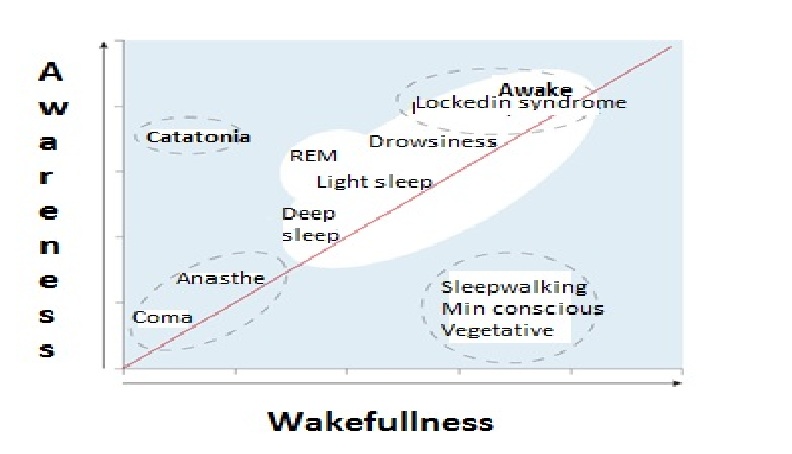
States of consciousness (After L. Saunders, 2012)

brains that are deeply asleep, under anesthesia or in comas to understand consciousness. As shown in the figure at the right, “awareness typically tracks with wakefulness — especially in normal states of consciousness. People in coma or under general anesthesia score low on both measures, appearing asleep with no signs of awareness. Sometimes, wakefulness and awareness become uncoupled, Continue reading