Advaita, Yoga Advaita and Manonigraha of Gaudapada – Part 1

Introduction – You are That/ Tat Tvam Asi

One of the five great sayings (mahavakyas) of Vedanta which proclaims the highest truth of Non-Duality or Advaita is “Thou art That” – Tat Tvam Asi, occurring in the Chandogya Upanishad in 6.8.7. Here “Tat” refers to Brahman/Self. So in the most common sense rendering of the statement, it means – “You are Brahman”. This saying is not saying, “You must ‘become’ Brahman”. What it says is that one is already Brahman. Such is the case and one just has to know it to be so.  

I had to bold and italicize the last lines of this paragraph because even when it is clearly stated, people are not able to overcome this notion of “becoming”. This is seen in the most advanced ‘practitioners’ of Advaita. In fact this notion of “becoming” is actually Maya, which keeps one tied to doership. This Maya is extremely hard to overcome, a fact which was anticipated and stated, both by Gaudapada and Shankaracharya, whom I shall be quoting in articles coming subsequently in this series.

In fact, this sense of Maya or “becoming” or “doership” is so powerful and so blinding that even after the Mahavakya says this to be the case; even after I shall show that all forms of doing are Maya; after giving all forms of quotes, logic and arguments: the notion of Maya/becoming/doership is very hard to root out. The Bhagavad Gita gives words to this predicament in the verse,

Among thousands of men, one perchance strives for perfection; even among those successful strivers, only one perchance knows Me in essence

Bhagavad Gita, Chapter 7.3 Continue reading

Brhadaranyaka Upanishad 3.5.1 – Attaining Self-Knowledge: Panditya and Mouna

In “The Essential Adi Sankara”, D.B.Gangolli tranliterates a work by Sri Satchidanandendra Saraswati Swamiji.  In note 207, he provides a superb commentary on Brhad Up 3.5.1, which I have set out below.  He starts of saying that sravana can be sufficient for a qualified seeker.  But then goes on to detail what should be done if sravana does not yield jnana nishtha.  By imputation then, these practices are already inherent in the qualified seeker, who merely needs sravana but once.

Continue reading

pratibandha-s – part 8 of 10

Read Part 7

Yogic Advaita

This is a term, which I had not encountered before, coined by Fort in Ref. 200. He uses it to refer to those teachers and texts that incorporate elements of sAMkhya and yoga philosophy into their supposedly Advaitic teaching. This applies to texts such as yogavAsiShTha and jIvanmukti viveka, as was already indicated in the discussion on vidyAraNya above. There are also 20 of the later, minor Upanishads that relate to Yoga (see https://en.wikipedia.org/wiki/Yoga_Upanishads) and there is a danger of referring to these to support ideas that are actually alien to traditional Advaita. These ideas are characterized by the notion that Self-knowledge gained through the usual route has to be supplemented by something else before liberation is achieved. Typically, this might be samAdhi or destruction of ego/mind, as discussed above (and below) but even ideas from other traditions might be incorporated. The yogavAsiShTha also has much emphasis on the ‘illusory’ nature of the world. The j~nAnI acts or does not act without any attachment, according to circumstances.

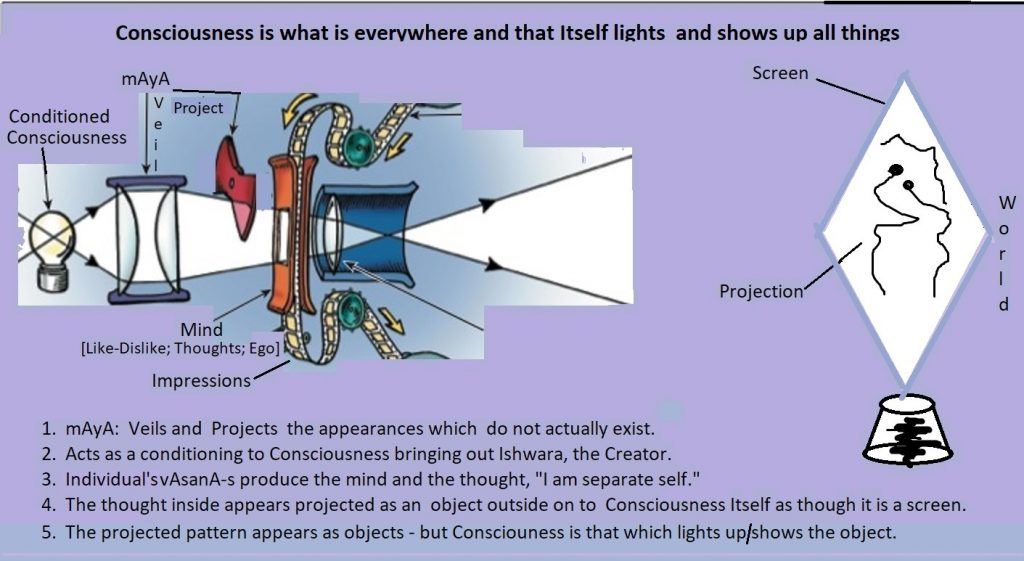
Rather than prArabdha, yogic Advaita tends to refer to vAsanA-s as being the key ‘obstruction’ to mokSha. While we have them, we are bound to the body; once they are purified, we are freed from saMsAra. When destroyed, we gain videha mukti. Continue reading

pratibandha-s – part 7 of 10

Read Part 6 1/2

Apologies for the delay in continution of this series. I had to do some more background research and I have also been switching to Windows 10 and a new PC for the past 3 weeks!

Post-Shankara contributions to the concept

(I am indebted to Ref. 195 for many of the scriptural citations in this section.)

It is certainly true that there are few references to the word pratibandha in prasthAna traya and Shankara bhAShya, although a number of discussions can be interpreted as referring to the concept. One can certainly argue that the idea of jIvanmukti itself strongly implies that of pratibandha-s. Being ‘in a body’ is clearly a limitation compared to not being so constrained. Indeed, having a body to begin with is said to be the result of ignorance, so the fact that there is still one present implies that there must be some aspect of ignorance still present.

Accordingly, whether or not you accept the idea of prArabdha karma being the reason for the j~nAnI continuing to inhabit a body, it seems that ‘freedom’ cannot be total until the body drops. It is therefore reasonable to think that this body-mind might be susceptible to ‘obstructions’ of various types, while this embodiment continues. The body has needs, after all, and even though there is no longer any identification with the body post-enlightenment, the mind is still very likely to be affected. And the j~nAnI still continues to utilize the Atman-animated-buddhi, as described above.  I.e. pratibandha-s are implicit in the differentiation between jIvanmukti and videha mukti.  Continue reading

Desirelessness and renunciation in Advaita Vedanta – a postscript

Therefore the knowledge of this Self by the process of ‘Not this, not this’ and the renunciation of everything are the only means of attaining immortality . . . The discussion of the knowledge of Brahman, culminating in renunciation, is finished. This much is the instruction, this is the teaching of the Vedas, this is the ultimate goal, this is the end of what a man should do to achieve his highest good.

– Sankara’s Bhasya on Brhadaranyaka Up 4.5.15


I can think of no better contemporary commentary on the essence of Sankara’s meaning than the words of Sri Nisargadatta Maharaj.

Continue reading

Answers (reminder)

Just a reminder that my new book – ‘Answers… to the Difficult Questions‘ is available from the 27th of this month (March 2020).

You can see all of the Content details here.

The links to purchase are as follows (Electronic versions also now available). Prices from Amazon are currently as follow:-
UK: Book – £32.99; Kindle – £16.31; US: Book – $48.95; Kindle – $20.02. Apologies for high price; there are 735 pages (I wanted it to be 3 volumes!)

Purchase Book format: Amazon UK; Amazon US

Purchase Electronic format: Amazon UK; Amazon US


Debate with a crypto-buddhist – 7

S. Letting go of ideas includes letting go of ’emptiness’. If you discover this emptiness, its reification is almost certain except in the cases of very deep realization. Why? Because of the latent tendencies of consciousness (not separable from mentation and all other sensory perceptions and modes) to re-create from habit energy. The letting go of all ideation continues. There is no thing called consciousness to hold on to or live inside of. It is all dependent origination. There is nothing that is uncaused that you can separate out from anything. It is impossible. There is just the stopping of all effort to change or transform what arises because the very nature of what arises is the same as this emptiness, which is not empty. It is free of all extremes including non-duality and oneness. It is a realization, no position, no attachment, no grasping. It is beyond imagination. There is no easy way to discuss it. Maybe it’s better to say nothing at all.

………………………..

I wanted to interject another thought into our conversation. I find that you keep reducing our chat to a debate of Advaita vs Buddhism. This is not my intention. I am trying to speak from my actual experience and not throw in all the quotes of various scriptures, etc. After all, it is only through our own direct experience of the way things are that will have any meaning for us. Quoting the Buddha will not make me more right or more certain about some things if I don’t actualize them. I can even quote other sources that point to the same thing, but I don’t see the point. l don’t need to convince you of any of this. It’s not possible. An intellectual understanding will not suffice in these matters. It has to be in your bones.


Desirelessness and Renunciation in Advaita Vedanta – part 2 of 2

Renunciation / samnyAsa – enjoined on the aspirant and inevitable for the jnani

The inevitable conclusion of the foregoing considerations, is that renunciation is a prerequisite for jnana.  In a sense, it is preparatory modelling of how a jnani-jivanmukta is: for how one thinks, affects how one acts; and how one acts, affects how one thinks.

With regard to the seekers of Liberation, renunciation of all actions has been prescribed as an accessory of Knowledge by all the Upanishads, History, Puranas and Yoga scriptures.

– Bhagavad Gita Bhasya, 3 introduction

Continue reading

Desirelessness and Renunciation in Advaita Vedanta – part 1 of 2

The purport is that It is not gained through knowledge unassociated with monasticism (samnyAsa).

– Mundaka Up Bhasya, 3.2.4


Introduction

The purpose of this article is to explore the evidence – and rationale – for renunciation in Advaita, as exemplified in Sankara’s own words.  I have focused on sharing a plethora of extracts, that make the argument for themselves.  The quotes are primarily drawn from Swami Gambhirananda’s translations of Sankara’s commentaries on various scriptures – unless otherwise stated.  With thanks to Ramesam for reading and correcting an earlier draft; and to Dennis for prompting me to research this topic and synthesise my findings.

Continue reading