Logical enquiry into ‘Who I am’ (3/4)

Who I am 3When we analysed the world of objects in the waking state we came to the understanding that our experience of the variety of objects is due to the variety of corresponding mental impressions (covered in Part 2 of this series). If there isn’t a mental impression ‘this is a pot’ then, despite fully-functioning senses, the pot will be as good as non-existent. The perception of ‘is-ness’ is the single, unchanging common thread in all our worldly experiences. This perception is given the name, ‘consciousness’.

When we analysed our dream state experience we realised that the same observation holds true for the dream universe as for the universe we encounter when awake. This experience gives an added dimension to our understanding of consciousness: not only is it the one, unchanging basis of the varied, changing objects (gross and subtle), but now we see that it is also continuous through the changing states of experience. The ‘I’ that is awake is the same ‘I’ that dreamt: ‘I am awake, I had a dream’. Continue reading

mAyA and Ishvara – Q.325

Q: My understanding of  original consciousness, mAyA, Ishvara is follows:

. Ishvara is the reflected conscious.
. mAyA( shudha satva prakRRiti) is the reflecting medium of original consciousness-Brahman.
. Ishvara controls or has full control over mAyA.

 My question is how can the reflection (Ishvara) have control over the reflecting medium, mAyA? For example, if I see myself in a mirror how can my reflection (image) control the reflecting medium, the mirror?

 Please let me know whether my understanding is correct and throw some light on this. Continue reading

What is Moksha and what does Science say?

[A few friends asked me about Moksha to be explained in simple words without any mystifying scriptural references, quotations and citations. This is what I wrote to them.

The points are made accordingly with no hyperbole, no mystique but merely as barebones facts without any frills – bibliographic references, supporting evidence etc. for the sake of brevity. I thought of sharing it here so that it can be corrected / sharpened in expression and  improved in an overall way. ]

1. Moksha:

There is nothing mysterious about it. It goads the spirit of inquiry in us.

Our ancients’ inquiry was on:

i) Who am I? and ii) What is this world around?

Continue reading

ANESTHESIA, DEEP SLEEP, DEATH AND CONSCIOUSNESS – Part 1/3

Recently there was an interesting question about the disappearance of ‘me’ when a patient is administered anesthesia in preparation for a major surgery.  It is quite intriguing where the missing ‘self’ has gone and when under anesthesia (Q. 313).

Peter, Sitara and Dennis answered the question very ably explaining the Vedantic philosophy behind the various states of consciousness (as we usually understand the term).  The false concept of the sense of a separate ‘self’ we think we possess and the reality of an eternal Self; the misunderstanding that arises if we take the word Consciousness to mean the same in psychology (& medicine) and Advaita;  the possible existence of multiple ‘minds’ which derive their illumination from an unchanging, everlasting, self-effulgent One Brahman were dealt with by them. Hardly can anything be added to their clear exposition made from the stance of Non-duality beyond saying a word of our appreciation and gratefulness to them.

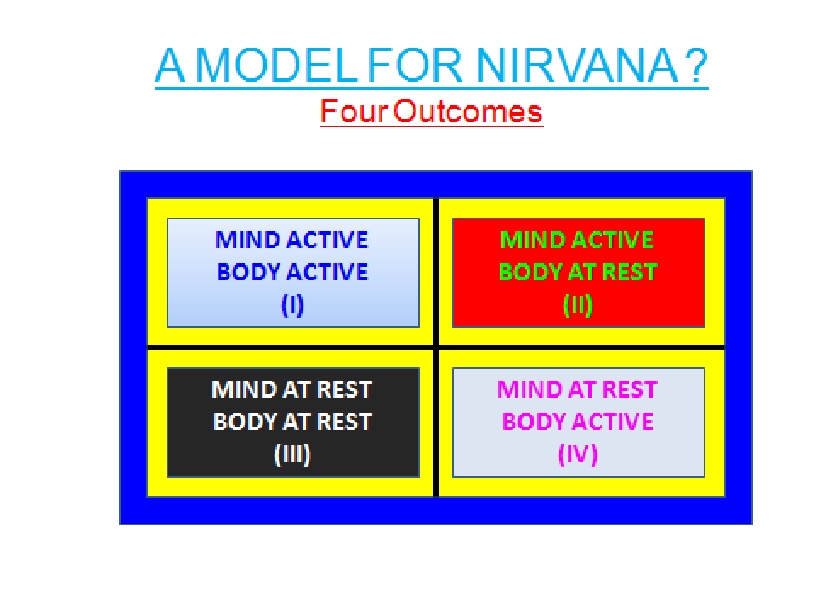
I would like to use this opportunity, if I may, to bring to the notice of a wider audience an approach I developed in 2004 relating the state of our alertness to our body-mind system in order to understand who we really are. We shall also in the process examine what are Deep Sleep and Death and what is the condition of the brain under different states, including awake, dream, deep sleep, death, coma, anesthesia etc.

Let me call this as “A Model for Nirvana.”

Four Outcomes

Four Outcomes


Continue reading

Objectification (Q. 310)

Q. I’ve been thinking about two things.

 To determine that awareness is my true self and that my true self is not my ‘I’ concept, I’ve been looking into the ‘I’ concept. It is not my mind, because I can say ‘my mind’. It is not my body, because I can say ‘my body’, but could it be the mind body complex? Most would say no, because the mind and body are plural and the self cannot be plural. However, I’m confused because I don’t see it this way. I see the mind and body as acting as one, which means that the ‘I’ could possibly be it. It is difficult to determine where the mind begins and the body ends, and vice versa, so I see them as one, like the Yin Yang symbol. How do I know that the true self is not the ‘I’ concept that arises within me? Is it because I can make the ‘I’ concept the object of awareness, thus it cannot be the subject? Continue reading

Nothing Dies (Q. 308)

Q. I’ve been thinking about death for a long while and last night something came to me that I wanted to share with you. It’s not so much a question, though. Rather, I’m just wondering whether my thinking is ‘on the right lines’.

 Ok, imagine a dead body lying in a coffin. Let’s say that this person lying there is called John Doe. Many people would believe that now John Doe is dead, something would have left the body, that this ‘John Doe’ identity is no longer there. My thinking from what I’ve learned about Vedanta so far, is that this ‘John Doe’ was probably never there as was perceived in the first place. Continue reading

Why do I Feel Unhappy? Why do I Feel Depressed?

Questioner: “I am Brahman” is the simple and straightforward message of Advaita. Brahman is synonymous with Beingness, Consciousness and Happiness. If I = Happiness, I should be always happy, should never be depressed. But I am overcome by the feelings of unhappiness, I get depressed. How come?

***

Well, the answer is “You” (I) can never not be Happy.

Out of Beingness – Consciousness – Happiness, the first two are self-evident. We do not require an external proof to tell me that I exist or that I am conscious. Can you ever say “I am not here” or “I am not conscious”? You have to be there and be present to say, “I am not here.” Similarly, I have to be conscious to say, “I am not conscious.”

In the same way, “I” can never ever be other than Happiness.

What is then the “feel” of unhappiness or depression that arises?

The “feel” cannot be “I” nor can it belong to “I”. That “feel” must obviously be something other than “I”. That is to say that such a feeling cannot be real because Brahman is the only “thing” that is Real. If the feeling is not real, it has to be an imaginary thing for, “I” would never say: “I am unhappy.”

But a Ramesam or a Tom or Dick do “feel” unhappy and say: “I am unhappy; I feel depressed. I am suffering.”

Continue reading