Living In The Moment Eternally – 1

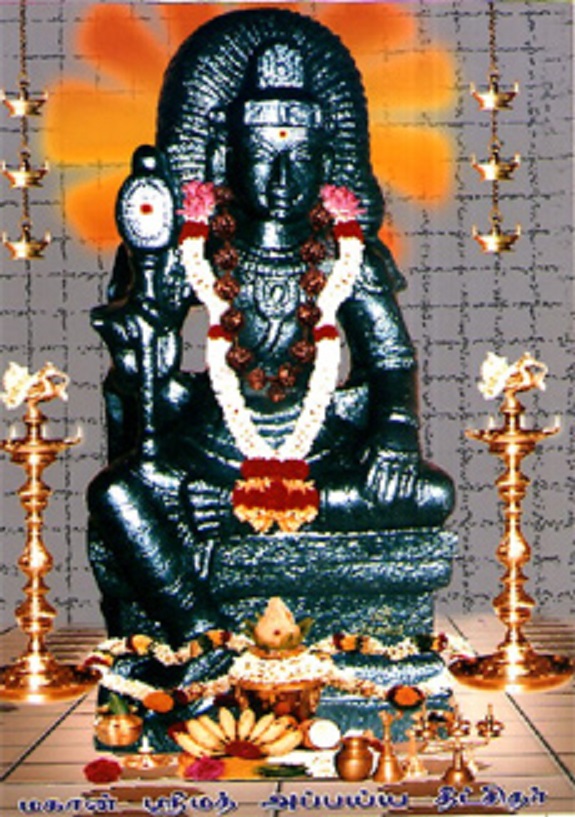
Appayya Dikshitar - (1520-93)

Appayya Dikshitar – (1520-93)

We, the traditional Advaitins, are a prejudicial lot – aren’t we?  Appayya Dikshitar’s words uttered in delirium when his brain was under the influence of the hallucinogenic Datura seeds are for us a beautiful AtmArpaNastuti in praise of Lord Shiva. But the mutterings of some other ordinary mortal with a differently affected brain is mere meaningless chatter unworthy of any notice. Let us not forget that both are actions done under conditions of an altered brain. And in both cases, an external agency is responsible for causing the change in the brain.

It was UG who famously said once that whether it was Beethoven’s 9th Symphony or pulling the chain in the WC sounded the same to him.  Some of the Zen Masters used to respond to the simple questions like “What is the time now?” with an answer that the mountain was running or some such response – totally frivolous and meaningless on the face of it. But their effort was to draw our attention to the way our mind functions in assigning ‘meaning and significance’ (which are actually not there) ever caught up in a habituated pattern which we  normally fail to detect.

Over six years ago, I prepared a comparative statement of the characteristics of an ordinary person and a ‘Self-realized’ man. I used the information  collated from many sources  that I could lay my hands on in preparing this tabulated compilation — almost like what a Purchase Officer does with the quotations (s)he obtains. There were several reasons behind this exercise of mine. Continue reading

Q.347 – Stone Consciousness

Q: Can you explain how it is possible that anything lifeless, for example a stone, a corpse or space,  does not have consciousness. Yet all of this is consciousness.

A (Shuka): The svarūpa (intrinsic nature) of fire is both heat and light. However, when it expresses through water (when water is heated), only the heat principle is expressed (water does not glow, but becomes hot); however when it expresses through an iron ball (when an iron ball is heated), both heat and light principles are expressed (the iron ball both glows and is hot). This is the limitation of the upādhī (medium) through which fire expresses, and is not reflective of the true nature of fire. So also, Brahman whose svarūpa is existence, consciousness and limitlessness, expresses only its existential principle when reflected through the upādhi-s such as stone, whereas it expresses both existential and conscious principles when expressed through a living being, and as īśvara (God), it expresses in all dimensions of its svarūpa.   Continue reading

Q.348 – Temporary Realization

Q: 2 or 3 years ago I had a profound realization of the truth of advaita which stayed with me for many months. I fear that I have lost it forever. Do you think that it can come back?

A (Shuka): If you think you lost it, please understand you never had it in the first place, even for the 2-3 months that you think you had it. For, Advaita is not an experience, it is an understanding. The classical example used to illustrate this is a story about ten boys who cross a river. When the ten arrive on the further shore, one of them counts but nine in the group, obviously neglecting to include himself. A passer-by, noticing the consternation of the boys, counts them and finds all ten present; verbal testimony immediately dispels the previous ignorance. Once the boy has realized he is the ‘missing’ tenth person, he can never lose himself thereafter, for the truth is ‘he was never lost’. So also, it was always Advaita, however, due to ignorance which results in wrong identification with one’s body-mind-sense-complex, a person is lost. On being pointed out by the śāstra (scriptures) through a guru (teacher) that his real nature is indeed different from what he has been thinking, he gets the knowledge of his original nature, that he was ever free. All this problem is caused because of the usage of the phrase self-realization instead of self-knowledge. If you are serious about your pursuit, study from a sampradāyavit, a traditionalist, who knows how to handle the words of the śāstra, and employs the prakriyā (methodology) as a teaching tool rather than as a system; all and sundries will only compound the confusion. My best wishes to you. Continue reading

Vision Of Truth (saddarshanam) – Part 12

विद्या कथम् भाति न चेदविद्या

विद्याम् विना किम् प्रविभात्यविद्या ।

द्वयम् च कस्येति विचार्य मूल

स्वरूप निष्ठा परमार्थ विद्या ॥—१२

vidyA katham bhAti na chedavidyA

vidyAm vinA kim pravibhAtyavidyA

dvayam cha kasyeti vichArya mUla

svarUpa niShThA paramArtha vidyA—12


विद्या कथम् भाति = how does knowledge shine? चेदविद्या = if there is no ignorance; विद्याम् विना = without knowledge; किम् प्रविभात्यविद्या = does ignorance shine; द्वयम् कस्येति = the two; विचार्य = having enquired; मूल स्वरूप = original nature; निष्ठा = abidance; परमार्थ विद्या = knowledge that ‘I am the self’


If there is no ignorance, how does knowledge shine? Without knowledge, does ignorance shine? And whose are the two? Having enquired thus, abidance in the original nature is the knowledge that ‘I am Atma’.


Everything in the universe is in duality. When one talks of happiness, it is a relative term, relative to sorrow. With respect to sorrow, we can say there is happiness. The term happiness has no meaning in the absence of sorrow. Light is opposed to darkness. It exists since darkness also exists. No darkness implies, there is no existence for light. This is the world of opposites, the world of duality. Joy-sorrow, victory-loss, peace-agitation, like-dislike, worry-security etc are some such antithetical couples. They mutually exist because of the other and have no meaning without the other.  Continue reading

Q. 346 – brahman, Ishvara and mAyA

Q: I am not clear about the relationship between Brahman, Maya and Ishwara. Maya is said to be inherent in Brahman. Like Brahman, it is ever existent. Ishwara is said to be a product of Brahman and Maya. However, while the universe is governed by Maya, Maya does not govern Ishwara. Ishwara governs Maya although he is a product of Maya. This is confusing.

 Secondly, did Shankara deviate from the teachings of Upanishads? The invocatory verse in Ishopanishad, Purnam idam, Purnam adaha, Puranat, Purnam utpadyate seems  to indicate that this world is born out of that Brahaman. Shankara does not seem to agree with this view. According to him, the imperfect limited world cannot emerge from unlimited, perfect Brahman and the world is only an illusion created by Maya. What is the correct position? Continue reading

What is death – part 3 (Transmigration)

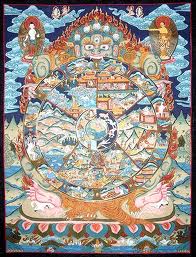
The wheel of transmigration

Although whatever is understood by transmigration or reincarnation does not strictly belong in this discussion on the “problem”, or the “reality” of death, it is so entrenched in people’s minds due to cultural and religious accretions, that a short account of it is not altogether out of place here. In the milieu of Hindu and Buddhist traditions reincarnation occupies the main doctrinal position in their exoteric or “religious” aspects, apart from belief in and worship of a deity or deities, and second only to the doctrine of karma – to which it is intimately related. Death of the body – the ‘gross body’ – is a foregone conclusion once it is irreversible (biological death).

A conventional account of reincarnation is as follows: ‘as for the jiva-atman carrying these vrittis, if during his lifetime the individual had performed some special acts of merit (punya) or demerit (papa), then the jiva-atman would proceed to heaven or hell. After spending his special karma-phala there, he comes back to the earth’. A more elaborate description is that once the seeker realizes nirguna Brahman he/she merges with Him/It, thus attaining immediate liberation (sadya mukti)’.Those who are eager to go beyond paths [the journey of life here and hereafter] tread no path’ (com. on Mu U. lll.2.6). ‘Just as the footmarks of birds cannot be traced in the sky or of fish in water, so is the departure of the illumined’ (Mahabharata). These two quotations are taken from ‘Methods of Knowledge’ – According to Advaita Vedanta’, by Swami Satprakashananda, p. 299. Continue reading

Vision Of Truth (sad darshanam) – Part 11


द्व्वन्द्वानि सर्वाण्यखिलास्त्रिपुट्यः

किन्चित्समाश्रित्य विभान्ति वस्तु ।

तन्मार्गणे स्याद् गलितम् समस्तम्

न पश्यताम् सच्चलनम् कदापि ॥—११


dvandvAni sarvANyakhilAstripuTayaH = all dualities and triads; ki~nchit = some

(indescribable); samAshritya = due basis;  vibhAnti = appear; vastu = reality; tanmArgaNe =

when that is inquired into; syAd galitam samastam = (dualities and triads) all resolve;

na pashyatAm sachchalanam kadApi = there is no wavering for those who see the truth.


All dualities and triads appear due to some indescribable basis, which is the reality. When that is inquired into, all (dualities and triads) resolve. There is no wavering for those who see the truth.


Any appearance needs a basis to be experienced. For e.g., a rope snake in semi darkness, needs the substratum of either a rope, or a hose or a crack on the ground. In the absence of these, the snake will not be perceived. So also, a mirage needs a dry land and silver seen on nacre cannot be seen without it. All these, the snake, mirage and silver on the mother- of- the- pearl are not really existent, nor can they be called absolutely non-existent (since they can be experienced). They appear by borrowing their existence from the substratum. In other words they have dependent existence….no existence of their own.

To arrive at the truth, meaning to arrive at the basis of these appearances amounts to the appearances getting resolved. Once the rope is enquired into, the snake vanishes. The preconceived notions of, whether the snake was a cobra or not etc, will become irrelevant. Did the snake run away on gaining knowledge of the rope? The snake did not run away. The snake was an appearance. It is no longer seen as the truth. The enquiry into the basis resolves all wrong notions of reality given to appearances. Rope enquiry is not the same as snake enquiry.

So also, if one enquires into the world or the ego while being attached to them, one will not gain anything. It is the substratum that one has to enquire into. Many people get misled by the ‘who am I’ question. If one is overly attached to the body mind, the “who am I’ question is only going to give him material answers like; I am 6 ft tall, father of so and so etc. The enquiry is deeper than this; it is an enquiry into the very basis of the material existence.  Hence, enquiry into the self is enquiry into the substratum of the ego. That substratum has to be the reality.  Once that truth is known, the appearances of the world, body and mind are resolved. Do they disappear? Does a wise man see no world? A wise man does perceive a world. Just as we see the sun rise in spite of knowing that it actually does not rise, so also a wise man will see a world, will have a functional body and mind but will clearly know them to be unsubstantial.


Will the knowledge keep wavering? Will one face misery again? Knowledge once gained is permanent. The misery was born of ignorance. The appearances of duality and triads were taken as the reality. Post knowledge, the substratum is known as the reality. A wise person will never waver. He has gained a firm conviction of the truth as his own self. Though he transacts in the world, he can never regard it as real.

Review of article on Shankara – Part 6, and final

Maya

A tarka (reasoning, argumentation) is required for the analysis of anubhava, as both SSS and RB agree – consistent with Shankara’s position. That is, language and thought, needless to say, have a role to play, chiefly for exposition and analysis.

However, after two long, dense paragraphs RB contends: “If the tarka required to examine anubhava is itself completely dependent on ´sruti, then by no means is anubhava the ‘kingpin’ of pram¯an.as.”

Prior to this, SSS was quoted as maintaining that “for this unique tarka all universal anubhavas or experiences (intuitive experiences) themselves are the support.” The author states that this affirmation  involves circular  argumentation, and that to say that Shankara interprets the Vedas  as being consistent with anubhava is wrong, the truth being the opposite: anubhava is consistent with the Vedas: “it should be clear that according to Sure´svar¯ac¯arya, the direct realization is directly from just ´sruti itself, thus satisfying the criteria for it to be a pram¯an.a…. The direct realization of the self is from ´sruti alone.”  Continue reading

Vision Of Truth (sad darshanam) – Part 10

भवन्तु सद्दर्शन साधनानि परस्य नामाकृतिभिः सपर्याः ।

सद्वस्तुनि प्राप्त तदात्म भावा निष्ठैव सद् दर्शनमित्यवेहि ॥ —१०

सद्दर्शन् साधनानि = means to vision of truth; परस्य = of the absolute; सपर्याः = worship;

नामाकृतिभिः = with names and forms; भवन्तु = let them be; सद्वस्तुनि = in reality; प्राप्त

तदात्म भावा = where abidance is as – ‘It is Me’;  निष्ठैव = clear abidance alone;  सद्

दर्शनमित्यवेहि = know as the vision of truth.


Let the worship of names and forms of the absolute, be means to the vision of truth. Know that, as the vision of truth where the abidance is abidance as – ‘It is Me’.


The scriptures have given out many methodologies for one to arrive at the truth. There is a synthesis between religion and philosophy; so much so that, for a lay man; philosophy is difficult (next to impossible) to be digested without religion. Religion as an independent dogma does nothing in the spiritual growth of a person. A person will remain the same insecure, ignorant mortal if he does not mature religiously as thought progresses.

To suit the needs of all people who are not ready for a dose of metaphysics, we have karma yoga and upAsana. One is engaged in activities and uses the very same activities to purify the mind and gain focus. Continue reading

Logical enquiry into ‘Who I am’ (4/4)

who am I 4We started this enquiry into identity by employing a simple piece of logic: you cannot be what you observe. From this point of view, the things we normally take ourselves to be, starting with the body, were systematically discounted because they turn out to be objects of perception, as covered in the first three parts of this series. Despite this reasoning, the tendency to believe our identity with the amalgam of body, senses and mind tends to remains very powerful: we continue to believe that we are these individuals bound by skin, with an experiential history and an instinctive, habitual mindset through which ‘I’ filter the world.

Identity with the body is evidenced by the vast cosmetic surgery industry today. People feel better with fewer wrinkles, larger breasts, drug-induced libido, less fat, etc. That’s the extreme end, but coming closer to the average person, we think of ourselves as too tall, too short, too hot or cold. If the body is in pain, we say: I am in pain. We really do mean ‘I’ when we say: I am hot, cold, ugly, beautiful, too short, too fat, too old. By employing the incontrovertible logic of ‘I cannot be what I can observe’, it does not take long for us to realise that the body is an object of perception: ‘I’ can experience my body using my five senses. We then ask: Who is observing the body? Continue reading