
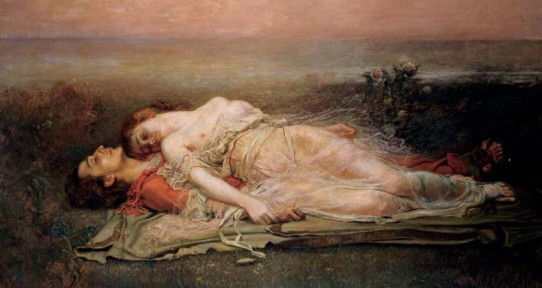
What is Death – Mythology ll (Tristan and Isolde) – part 5


tristan2013


The power of the feminine principle (Shakti, Prakrit-Nature): Creation, Life, Nurturing – and its cycles. Also representing desire, as well as beauty. Woman, however, (embodiment of the Goddess) can also be redemptress (e.g. Mary in Christianity).

In Wagner’s opera ‘Tristan und Isolde’, desire is linked with Life, and Love with death –  sacrificial death (Liebestod), which admits of multiple implications and interpretations. The Romantic hero – and Wagner was one, at least ideally – could only be redeemed by and through woman; in that opera love could not be fulfilled in earthly terms (for it was unlawful). The Romantic ideal was a combination of love, sacrifice, transcendence, union – union through the transcending of the human personality, of individuality itself. Is this not a universal theme, as well as being very German?. In Wagner’s own words, “What Destiny separated in life emerges as life transfigured by death”.  Continue reading

Q.343 – Meaning of Ishopanishad mantra

Q : The second line in the first Shloka of Ishopanishad begins with ” Tena tyaktena Bhunjeeta”. The literal meaning appears to be ” therefore, enjoy with a sense of tyaga or renunciation (as everything created in this world is permeated by Ishwara) but Adi Shankaracharya has interpreted these words to mean ” protect ourselves”. Is there a satisfactory explanation for this interpretation? 

Also, the second word of first verse of Ishopanishad: is it vasam (is full) or vasyam (should be considered full). Shankara says vasyam. Vasam appears more logical to me.

A (Ramesam): In order to fully appreciate and admire the beauty and profundity hidden behind the simplicity of a cryptic statement, one ought to know the background and the context against which that expression gets developed.  It is as much true when we talk of an equation such as E = mc^2 or a routine proverb like ‘Still waters run deep.’ Continue reading