
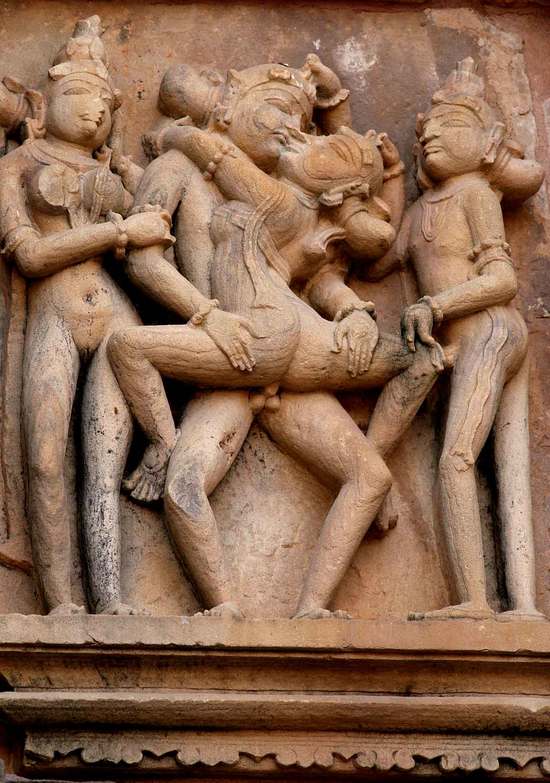
Pleasure of Sex vs. Bliss of Self in Brain Scans

Khajuraho Temple Sculpture – 10th – 12th Century

Khajuraho and Kamasutra fire the fancy of any foreign tourist to India.  Add Spirituality and the heady mix becomes a killer app for seekers of quick-fix salvation for paying a visit to India!  Biologically sex evolved as a reproductive mechanism to possibly capture the advantageous heritable genetic traits from a partner.  Only humans and a few animals like bonobos and dolphins indulge in recreational sex.  Sex is closely tied to sensory perceptions and lies within the realms of the mind. Salvation transcends both senses and mind. “Rajneesh, the ‘horse’s mouth’ concerning the topic of enlightenment for Westerners for many years,” regrets James Swartz, “wedded two largely incompatible concepts, sense enjoyment and enlightenment.” One may lose ‘self identity’ and get enwrapped in an inexplicable joy in either of them as Brihadaranyaka Upanishad says. But the bliss of enlightenment and the pleasure of sensual gratification are totally different. Our brains can show it all very clearly!

Human brain is a mass of interlinked neurons piled up in three layers. At the bottom is the most primitive brain common to all animals. Continue reading


Clearing the mind (Q. 311)

Q: I come across a lot about clearing the mind….but if there is no person, no-one that can have a will of his/her own, surely a desire or will to clear the mind is a nonsense? The mind cannot be tamed because there is not a person to whom it belongs, someone with their own free will? Is that at all right? Surely a clear mind would only arise because it is the will of Brahman?

 A: It’s only nonsense once you know that you are not a person!

 Also, you have to be very clear when you are talking about Brahman. Strictly speaking, the term ‘brahman’ refers to the non-dual reality and, if you are using it in this sense, it is not meaningful to speak of ‘the will of brahman’ – brahman does not have any will; there are no ‘parts’ to brahman and there is nothing other than brahman.

 If you are talking about the person (appearance) within the world (appearance), then you have to refer to Ishvara as the ‘creator’ and the dispenser of body-minds in accordance with accumulated karma from past lives.

 You have to be clear in your own mind about this distinction because, for example, the Brahma Sutras uses the word ‘brahman’ in both senses and expects you to know which one is being referred to in any given instance!

Objectification (Q. 310)

Q. I’ve been thinking about two things.

 To determine that awareness is my true self and that my true self is not my ‘I’ concept, I’ve been looking into the ‘I’ concept. It is not my mind, because I can say ‘my mind’. It is not my body, because I can say ‘my body’, but could it be the mind body complex? Most would say no, because the mind and body are plural and the self cannot be plural. However, I’m confused because I don’t see it this way. I see the mind and body as acting as one, which means that the ‘I’ could possibly be it. It is difficult to determine where the mind begins and the body ends, and vice versa, so I see them as one, like the Yin Yang symbol. How do I know that the true self is not the ‘I’ concept that arises within me? Is it because I can make the ‘I’ concept the object of awareness, thus it cannot be the subject? Continue reading

Science and the nature of absolute reality (Part 2)

Read Part 1

Although science is good at investigating objects, even there it is doomed to fail – because the essence of objects, too, is ultimately the same non-dual reality. As Atmananda Krishna Menon puts it, in his ‘Notes on Spiritual Discourses’: “As long as the least trace of subjectivity remains, objectivity cannot disappear. And until objectivity disappears completely, the real nature of the object can never be visualized. This is the fundamental error committed by science as well as philosophy, both in India and outside, in trying to approach the Truth through the medium of the mind.” (Vol 3 Notes, 1386)

Notes on Spiritual Discourses of Shri Atmananda: Volumes 1, 2 and 3, Shri Atmananda and Nitya Tripta, Non-Duality Press 2009, ISBN 978-0956309129 (Vol 1) Buy from Amazon US or Amazon UK. Continue reading

Mind Reifies Or Deifies

Mind occupies a significant place in the teaching of Vedanta philosophy.

All the talk of liberation pertains to the mind only.  Maîtri Upanishad (VI-34-11) holds mind to be central for the liberation or bondage of human beings.  amRitabindu Upanishad (mantra 2) makes it further clear stating that “the mind engrossed in objects of senses leads to bondage but the same mind free from attachment to objects leads to liberation.”

But what is this mind?

Continue reading

Where the mind cannot reach (Q. 307)

Q: I am allowing life to teach me as I go through it, but I’m not finding it easy.  Most of the time I feel I don’t want to even speak because I feel nothing I say is ‘correct’.  At the same time, however, I feel that even if I do speak, whatever I say would not be ‘wrong’ because ‘right’ and ‘wrong’, ‘correct’ and ‘incorrect’ do not exist.  Words and concepts are a massive hindrance to my understanding, yet I cannot overcome them.

 I want to say that I know that everything is Brahman, but then something says, ‘you can’t ‘know’ that everything is Brahman because that cannot be known with the mind’, so I’m always hitting a wall. Continue reading

Dennis: Free Will (Part 4)

Go to Part 3

“The experience of willing an act arises from interpreting one’s thoughts as the cause of the act.” Daniel Wegner, quoted in the excellent book: Consciousness: an Introduction, Susan Blackmore, Oxford University Press, 2004. ISBN 0-19-515343-X. Buy from Amazon US or UK.

The scientific views that are often cited in respect of these discussions stem from experiments conducted by Benjamin Libet in the late 1970’s and by Daniel Wegner in the 1990’s. I described these in my books ‘How to Meet Yourself’ and ‘Back to the Truth’. Since very few people have actually read the former, I will quote at length from that: Continue reading