The Pursuit of Happiness

Everyone wants to be happy. This is the motivational force for everyone. The Vedas acknowledge this. The first part of the Vedas – karmakANDa – is effectively aimed at those who look for their happiness in external, limited, objects and pursuits; the latter part of the Vedas – j~nAnakANDa – is aimed at those who are looking to find the happiness within, through gaining knowledge of their true nature.

Here is a brief article from Ramesh Pattni, called

WHAT IS VEDANTA? VEDANTA AND THE PURSUIT OF HAPPINESS

The pursuit of happiness has been the foremost goals of humanity from time immemorial. There is, however, a diversity of understanding and experience of happiness across traditions and cultures around the world. Eastern traditions which offer great insights into the human condition and psychological processes, have a universal appeal which point towards attainment of happiness by different means.

The development of Positive Psychology in recent decades has focused on the study of happiness and wellbeing and examined evidence for the ways and means to happiness.  Currently there are two dominant Western approaches to human happiness and well‐being: Hedonic and Eudaimonic perspectives. The former is based on the idea that pleasure is the only intrinsic good, and obtained through the contact with the world of objects. The eudaimonic approach is that happiness is an end in itself and the highest good and based on a life of virtuous living and contemplation. Continue reading
Vedanta the Solution – Part 27

venugopal_vedanta

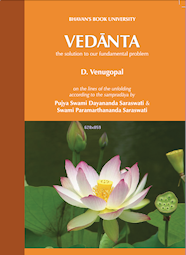
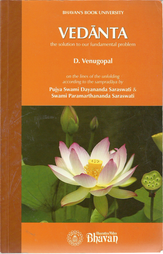
VEDĀNTA the solution to our fundamental problem by D. Venugopal

Part 27 begins the enquiry into the nature of the jIva. It looks at the various explanations for how Consciousness manifests in the body-mind and the special role of the buddhi.

There is a complete Contents List, to which links are added as each new part appears.

Vedanta the Solution – Part 26

venugopal_vedanta

VEDĀNTA the solution to our fundamental problem by D. Venugopal

Part 26 examines the nature of AtmA, utilising the ‘descriptions’ from the Brihadaranyaka, Kena and Mandukya Upanishads. How can we ‘know’ the Self, when it is not an object?

There is a complete Contents List, to which links are added as each new part appears.

Reflections on Body-Mind and Liberation

shankaraThere has been much healthy debate recently on the Advaita Vision Blog about Liberation, who or what is a jnani or jivanmukta, and what it means to follow traditional Advaita. The theme of this post is that we cannot resolve such questions without first gaining a clear understanding of the body-mind and its role in the context of Liberation. What follows are some reflections inspired by a spirited discussion with Ramesam, with due credit to him for stimulating many of the thoughts below. Any errors or possible misunderstandings are entirely my fault. Or perhaps not, since “Words fall back from it.” Continue reading

‘ego’, self, and metaphysics – Part lV

In the Buddhist perspective, the ego or self as ordinarily considered in Western traditions (i.e., as soul or person), is a non-self, actually a non-entity (anatta). Hence the suffering, which stems from an experience -ultimately illusory- of separation and vulnerability.

Here we have to consider two things. First, according to Mahayana Buddhism, Adi-Buddha, equivalent to Dharmakaya – the highest metaphysical, or divine, level – represents that unique Being or Divine ‘State’, pervading all manifestation as Buddha-nature; and second, the notion of the Self (Atman, derived from the Hindu Vedanta) is not only compatible with that view, but also with that of the Spirit in Christianity and in Islam.

As to the soul (metaphysics and theology), though intrinsically perfect or whole in itself (one could add: in ‘primordial man’ –the purusha or Hiranyagarbha of Hinduism)- it experiences imperfection, self-limitation, anxiety and doubt in its state of (aparent) separation -the ‘fallen state’. Being, not just potentially, a ‘focal point of the Universe’, yet it becomes, through ignorance and self-will, the subject of illusions, attachments, and passions which lead to that predicament. Its condition is thus ambivalent; it can orient itself upwards (or towards the centre) – to ‘holiness’ and integration – or downwards, pulled by its ‘lower nature’ (nafs in its lower stages, according to Sufism). The end result will be either self-denial, or self-assertion; self-giving, or ego-centeredness. Inevitably, this latter tendency, based on ignorance, can only lead to an unwanted result: dispersal, disintegration, and suffering. Alas!, on the whole, if not in principle, psychiatry is not interested in this distinction or dichotomy; but let not anything else be said about this at this point.

From the viewpoint of advaita vedanta, all of what is described in this paragraph – and what follows – pertains to the empirical, relative (ontological and epistemological) level: mithya (or vyavahara), in other words. Continue reading

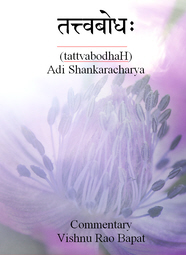
Tattvabodha – Part 7

OLYMPUS DIGITAL CAMERAPart 7 of the commentary by Dr. VIshnu Bapat on Shankara’s Tattvabodha.This is a key work which introduces all of the key concepts of Advaita in a systematic manner.

The commentary is based upon those by several other authors, together with the audio lectures of Swami Paramarthananda. It includes word-by-word breakdown of the Sanskrit shloka-s so should be of interest to everyone, from complete beginners to advanced students.

Part 7 begins the section on Atma vichAra – investigation into the nature of Atma – and in this part specifically asks the questions ‘What is true knowledge?’ and ‘Who is Self?’. There is also a hyperlinked Contents List, which is updated as each new part is published.

Consciousness/Awareness, the brain, and memories

(Q&A published recently in QUORA)

Q. ‘Why wasn’t my consciousness generated by another brain? Why am I linked with this brain?’

I heard that everybody experiences consciousness, but then why am I my consciousness and not another person’s consciousness? It’s hard to explain.

Paul Bush. Yes, it’s hard to explain. Basically it’s because the most important part of consciousness, which is awareness*, is the same for everybody. There is only one awareness, and in fact nothing else. All the other aspects of consciousness, the contents, are projections of awareness as it identifies with small parts of reality such as bodies and minds. Such misidentification creates a perspective. From each perspective the part of reality not identified with is seen as the external world. The observer with a particular perspective and the world observed as a consequence of that perspective are both inferences created at the moment of identification.

So, there is only one awareness that is continually pulled into the illusion of being this or that observer. The ongoing personal identity that we think of as ourselves maintains coherence through the construction of the concepts of time and space; memory and an apparent (though not total) physical separation from the rest of reality. Awareness has no personal identity, it is exactly the same for you and everyone else, because it is singular awareness that creates each experience depending on the perspective of the entity that it is identifying with.

*(AM Awareness and Consciousness are generally taken as equivalent in Advaita Vedanta – no distinction being made) Continue reading

Atma vichAra

The Self cannot be ‘known’ in any objective sense because it is the ultimate subject – there is no other subject that could know it. This is why science can never tell us anything about the Self. Science works by collecting data and analyzing it; formulating theories and then using them to predict what will happen when data are gathered in a different situation. This can never be applied to Self/brahman, because brahman has no data.

Strictly speaking, vichAra refers to investigation into ‘things’ so that Atma vichAra is effectively a contradiction in terms; the Self is not a thing. Spiritual investigation has to be done rather differently. The correct term is shAstra mImAMsA and it is really scriptural ‘investigation’ that we must conduct in order to find out about the Self. Monier-Williams translates mImAMsA as “profound thought or reflection or consideration; investigation, examination, discussion”. The philosophical branch that studies the Upanishads etc at the end of the Vedas (Vedanta) is called uttara mImAMsA. (uttara means “later, following, subsequent, concluding” but also “superior, chief, excellent, dominant”.)

We ‘discover’ the Self by removing ignorance. If someone holds up a screen in front of our face and then brings an object to show us, but keeps it behind the screen, we can say nothing at all about the object. However, as soon as the screen is taken away, the object is revealed to our senses and the perception takes place automatically. Similarly, knowledge of the Self is obscured by ignorance but as soon as that ignorance is removed, the Self is immediately self-evident; we do not have to do anything to ‘investigate’ it.

Scripture functions like a mirror. When we look into a mirror, we do not literally see our face and body, we only see an image of it. Yet this enables us directly to perform whatever actions are required on the body itself – combing the hair, shaving and so on. We do not shave the image but the actual hair on the face. Similarly, the scriptures do not directly represent the Self but the information therein, when explained by a qualified teacher, directly enables the ignorance in our mind to be removed, revealing the Self-knowledge which is as though hidden beneath.

Actions will never bring about Self-knowledge, since action is not opposed to ignorance. Nor will practices such as meditation or prayer. As Swami Paramarthananda puts it, meditation will only bring about quiet ignorance.

As Shankara puts it (if he was the author of vivekachUDAmaNi v.13): “It is through reflection over the words of a truly benevolent soul that one comes to a knowledge of reality, and not through bathing at sacred places, charity or hundreds of breathing practices”. [1] I.e. it is through shravaNa, manana and nididhyAsana and not through asking ‘Who am I?’ that one gains Self-knowledge.

[1] The Crest Jewel of Wisdom; viveka-chUDAmaNi, commentary by Hari Prasad Shastri, Shanti Sadan, 1997. ISBN 0-85421-047-0.

The Carpenters Story

OLYMPUS DIGITAL CAMERACarpenter’s Malady and Cognitive Consonance –
Rajarajeswari Srinivasan

I would like to start this discussion,with a Tamil verse ascribed to an ancient scripture called ‘Thirumanthiram’ attributed to ‘Thirumular’, considered a yogi who came from the north of India to the south. It is said that this work, consisting of more than 3000 verses formed the basis for the Saiva Siddhantha that developed in Tamilnadu. Only the verse has been taken from the text. A story has been added by me, for explanation.

There was a carpenter in a village, who specialized in making wooden toys. He had a son aged four. One day, the carpenter took his son to the temple. The little boy took a strong liking to the temple elephant and wanted to take it home. The carpenter convinced the adamant boy that it was not possible. But over the next few days he made a wooden elephant of reasonable size using a high quality wood and gifted it to his son. By this time, the child had forgotten his passion for the live elephant, and was very happy to possess a toy elephant and started playing with it, imagining it to be a real one. The carpenter’s father who was watching everything, said in Tamil, “marathai marraithathu maamadha yaanai” (“மரத்தை மறைத்தது மாமத யானை”), meaning, ‘the elephant (image) masks the wood’, i.e., “the elephant is perceived and not the wood”. Continue reading

Vision Of Truth (sad darshanam) – Part 20

yadIshiturvIkshaNamIkshitAram

avIkshya tanmAnasikekshaNam syAt

na drashTuranyaH paramo hi tasya

vIkshA svamUle pravilIya niShThA—22


yadIshituH vIkshaNam = that (which)vision of Ishvara as an object; IkshitAram = Atma, the observer; avIkshya = not recognizing; tanmAnasikekshaNam syAt = will be a mental projection; drashTuranyaH paramaH na = No supreme other than seer; hi = indeed; tasya vIkshA = his vision; svamUle niShThA = abidance in one’s own nature; pravilIya = having resolved.


That vision of Ishvara (as an object), which is, without recognizing the observer Atma, is only a mental projection. There indeed is no supreme other than the seer. His vision is the abidance in one’s own nature having resolved the triad.


As long as Ishvara is considered as an entity separate from oneself, so long misery continues. Vision of Ishvara as an object, is merely a mental projection. If one has a vision, it is something other, external to him, meaning, the form of the vision has a beginning outside of him. Hence, there is a limited form to the Ishvara seen in a vision. Such an Ishvara is finite. How is that vision of any help?

Continue reading